Application of Integrals
CBSE · Class 12 · Mathematics
Flashcards for Application of Integrals — CBSE Class 12 Mathematics. Quick Q&A cards covering key concepts, definitions, and formulas.
Interactive on Super Tutor
Studying Application of Integrals? Get the full interactive chapter.
Quizzes, flashcards, AI doubt-solver and a step-by-step study plan — built for flashcards and more.
1,000+ Class 12 students started this chapter today
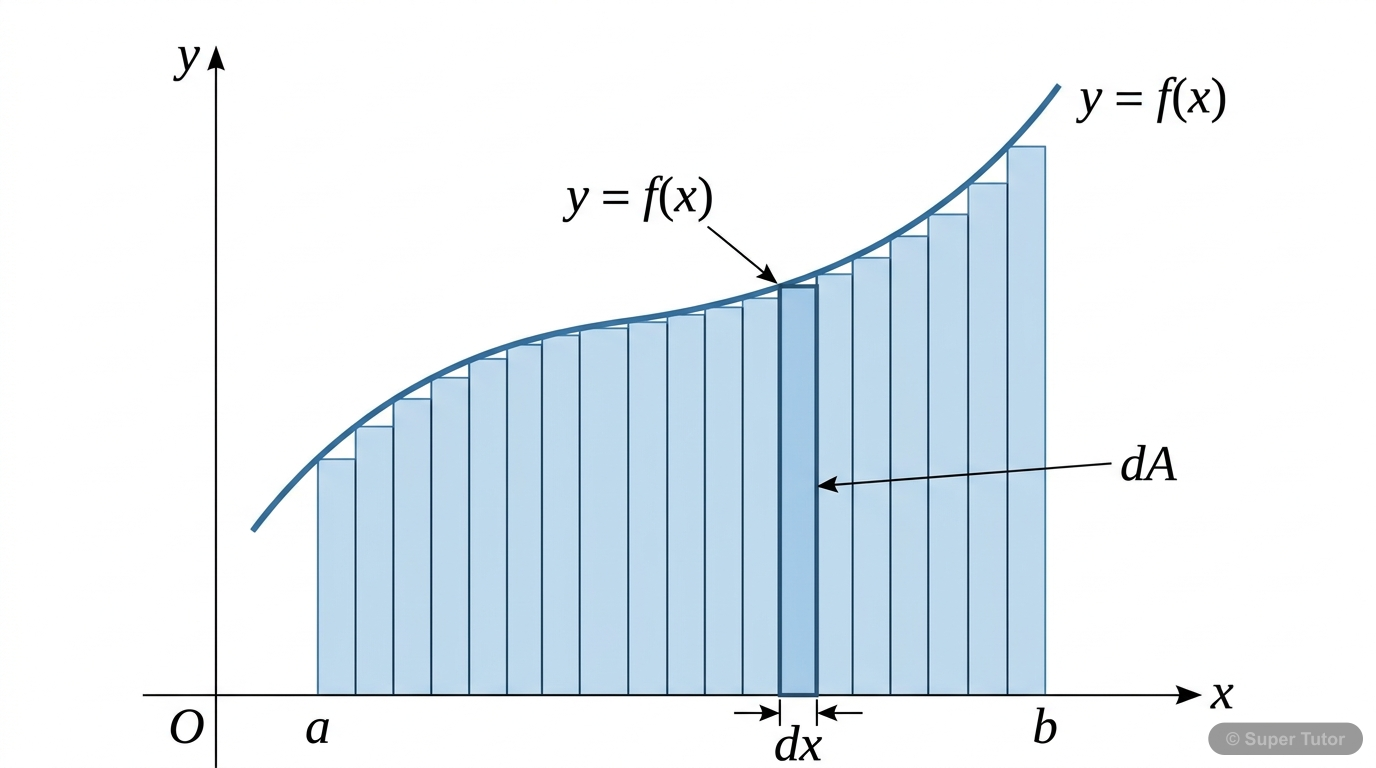
Super Tutor has 5+ illustrations like this for Application of Integrals alone — flashcards, concept maps, and step-by-step visuals.
See them allWhat is the basic formula for finding the area under a curve y = f(x) between x = a and x = b?
Answer
Area = ∫[a to b] f(x) dx, where the curve is above the x-axis. This represents the sum of infinitely many thin rectangular strips of width dx and height y = f(x).
How do you find the area of a region bounded by x = g(y), y-axis, and lines y = c and y = d?
Answer
Area = ∫[c to d] g(y) dy. Here we use horizontal strips instead of vertical strips, integrating with respect to y from y = c to y = d.
What is an elementary area strip and how is it represented mathematically?
Answer
An elementary area strip is a thin vertical rectangle of height y and width dx. Its area is dA = y dx = f(x) dx. The total area is found by summing all such strips using integration.
What happens when the curve y = f(x) lies below the x-axis?
Answer
When f(x) < 0, the integral ∫[a to b] f(x) dx gives a negative value. Since area is always positive, we take the absolute value: Area = |∫[a to b] f(x) dx|.
How do you find the area when part of the curve is above x-axis and part is below?
Answer
Split the region at points where the curve crosses the x-axis. Calculate area for each part separately and add their absolute values: Total Area = |A₁| + |A₂| + ... where each Aᵢ represents area of on…
Find the area bounded by y = x², x-axis, and lines x = 1 and x = 3.
Answer
Area = ∫[1 to 3] x² dx = [x³/3]₁³ = (27/3) - (1/3) = 9 - 1/3 = 26/3 square units.
What is the area bounded by y = √x, x-axis, and lines x = 0 and x = 4?
Answer
Area = ∫[0 to 4] √x dx = ∫[0 to 4] x^(1/2) dx = [2x^(3/2)/3]₀⁴ = (2/3)(4)^(3/2) = (2/3)(8) = 16/3 square units.
How do you find the area between two curves y = f(x) and y = g(x) from x = a to x = b?
Answer
If f(x) ≥ g(x) in the interval [a,b], then Area = ∫[a to b] [f(x) - g(x)] dx. Always subtract the lower curve from the upper curve.
+12 more flashcards available
Practice AllFrequently Asked Questions
What are the important topics in Application of Integrals for CBSE Class 12 Mathematics?
How to score full marks in Application of Integrals — CBSE Class 12 Mathematics?
How many flashcards are available for Application of Integrals?
Sources & Official References
- NCERT Official — ncert.nic.in
- CBSE Academic — cbseacademic.nic.in
- CBSE Official — cbse.gov.in
- National Education Policy 2020 — education.gov.in
Content is aligned to the official syllabus. Refer to the board website for the latest curriculum.
More resources for Application of Integrals
Important Questions
Practice with board exam-style questions
Syllabus
What topics to cover
Revision Notes
Key points for last-minute revision
Study Plan
Step-by-step plan to ace this chapter
Formula Sheet
All formulas in one place
Chapter Summary
Understand the chapter at a glance
Practice Quiz
Test yourself with a quick quiz
Concept Maps
See how topics connect visually
For serious students
Get the full Application of Integrals chapter — for free.
Quizzes, flashcards, AI doubt-solver and a step-by-step study plan for CBSE Class 12 Mathematics.