Inverse Trigonometric Functions
CBSE · Class 12 · Mathematics
Flashcards for Inverse Trigonometric Functions — CBSE Class 12 Mathematics. Quick Q&A cards covering key concepts, definitions, and formulas.
Interactive on Super Tutor
Studying Inverse Trigonometric Functions? Get the full interactive chapter.
Quizzes, flashcards, AI doubt-solver and a step-by-step study plan — built for flashcards and more.
1,000+ Class 12 students started this chapter today
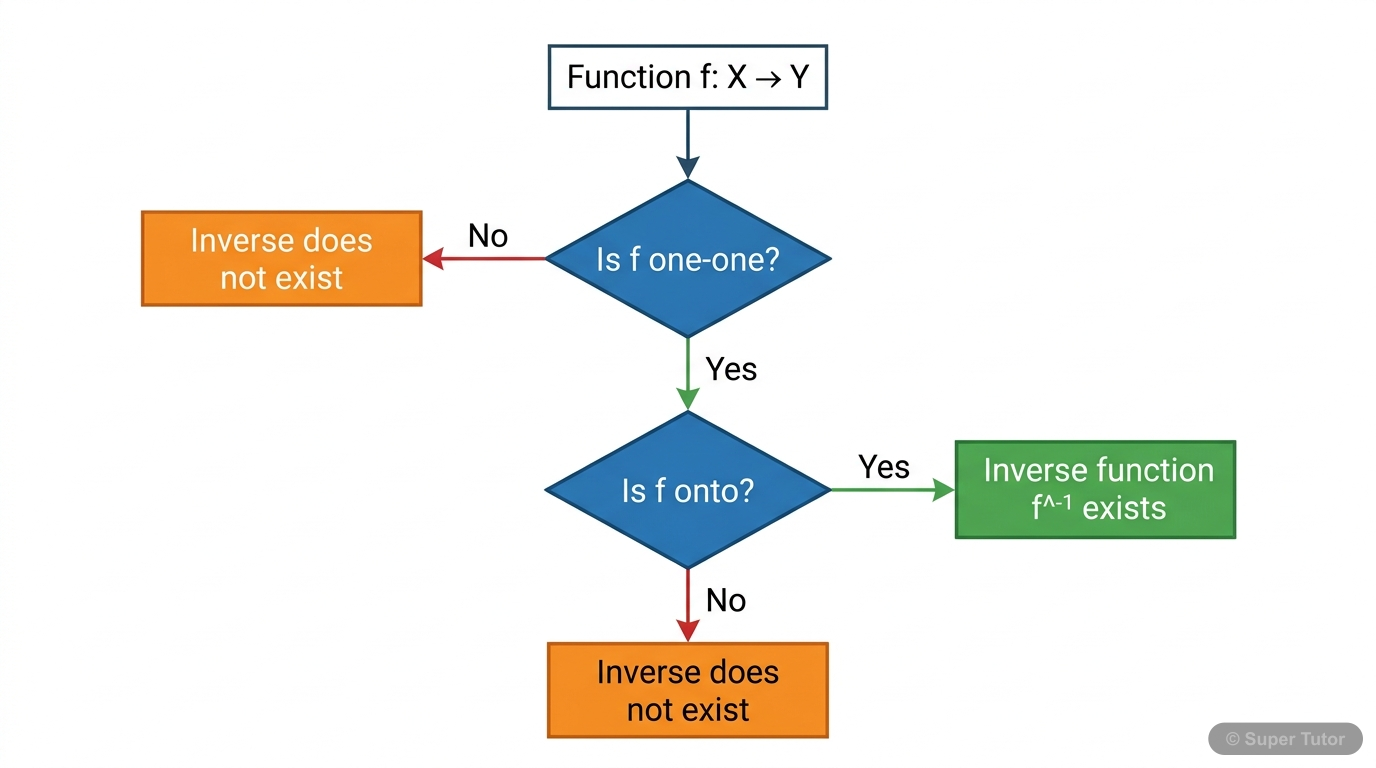
Super Tutor has 10+ illustrations like this for Inverse Trigonometric Functions alone — flashcards, concept maps, and step-by-step visuals.
See them allWhy don't inverse trigonometric functions exist for the original domains of trigonometric functions?
Answer
Trigonometric functions are not one-one (injective) over their natural domains. For a function to have an inverse, it must be both one-one and onto (bijective). Since sin x, cos x, etc. repeat their v…
What is the domain and range of sin⁻¹x?
Answer
Domain: [-1, 1] Range: [-π/2, π/2] This range is called the principal value branch of sin⁻¹x. The function sin⁻¹: [-1, 1] → [-π/2, π/2]…
What is the domain and range of cos⁻¹x?
Answer
Domain: [-1, 1] Range: [0, π] This range is the principal value branch of cos⁻¹x. The function cos⁻¹: [-1, 1] → [0, π]…
What is the domain and range of tan⁻¹x?
Answer
Domain: R (all real numbers) Range: (-π/2, π/2) This range is the principal value branch of tan⁻¹x. The function tan⁻¹: R → (-π/2, π/2)…
What is the domain and range of cot⁻¹x?
Answer
Domain: R (all real numbers) Range: (0, π) This range is the principal value branch of cot⁻¹x. The function cot⁻¹: R → (0, π)…
What is the domain and range of sec⁻¹x?
Answer
Domain: R - (-1, 1) or (-∞, -1] ∪ [1, ∞) Range: [0, π] - {π/2} This range is the principal value branch of sec⁻¹x. The function sec⁻¹: R - (-1, 1) → [0, π] - {π/2}…
What is the domain and range of cosec⁻¹x?
Answer
Domain: R - (-1, 1) or (-∞, -1] ∪ [1, ∞) Range: [-π/2, π/2] - {0} This range is the principal value branch of cosec⁻¹x. The function cosec⁻¹: R - (-1, 1) → [-π/2, π/2] - {0}…
What is meant by the principal value of an inverse trigonometric function?
Answer
The principal value of an inverse trigonometric function is the value that lies in the range of the principal value branch of that function. When we write sin⁻¹x, cos⁻¹x, etc., without specifying a br…
+17 more flashcards available
Practice AllFrequently Asked Questions
What are the important topics in Inverse Trigonometric Functions for CBSE Class 12 Mathematics?
How to score full marks in Inverse Trigonometric Functions — CBSE Class 12 Mathematics?
How many flashcards are available for Inverse Trigonometric Functions?
Sources & Official References
- NCERT Official — ncert.nic.in
- CBSE Academic — cbseacademic.nic.in
- CBSE Official — cbse.gov.in
- National Education Policy 2020 — education.gov.in
Content is aligned to the official syllabus. Refer to the board website for the latest curriculum.
More resources for Inverse Trigonometric Functions
Important Questions
Practice with board exam-style questions
Syllabus
What topics to cover
Revision Notes
Key points for last-minute revision
Study Plan
Step-by-step plan to ace this chapter
Formula Sheet
All formulas in one place
Chapter Summary
Understand the chapter at a glance
Practice Quiz
Test yourself with a quick quiz
Concept Maps
See how topics connect visually
For serious students
Get the full Inverse Trigonometric Functions chapter — for free.
Quizzes, flashcards, AI doubt-solver and a step-by-step study plan for CBSE Class 12 Mathematics.