Probability
CBSE · Class 12 · Mathematics
Flashcards for Probability — CBSE Class 12 Mathematics. Quick Q&A cards covering key concepts, definitions, and formulas.
Interactive on Super Tutor
Studying Probability? Get the full interactive chapter.
Quizzes, flashcards, AI doubt-solver and a step-by-step study plan — built for flashcards and more.
1,000+ Class 12 students started this chapter today
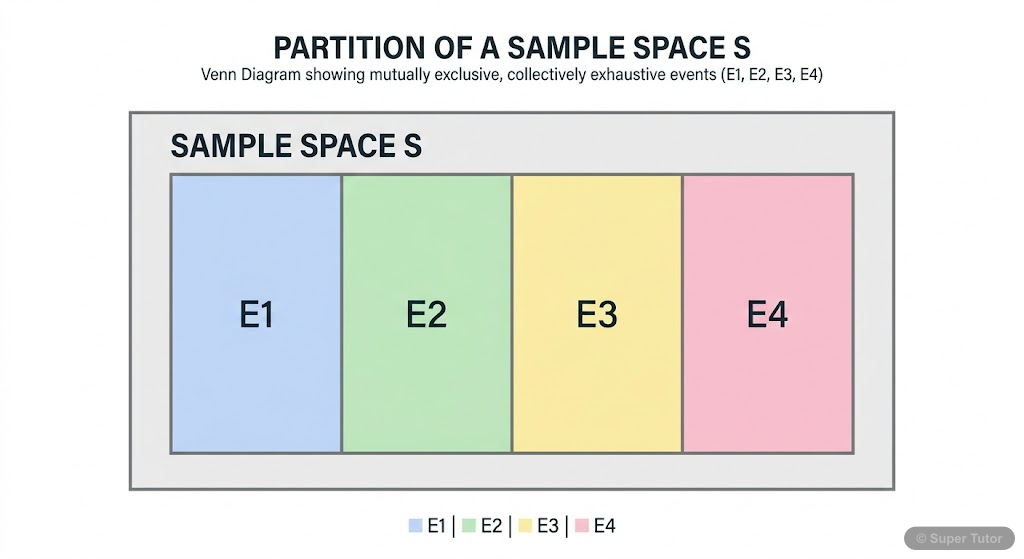
This is just one of 9+ visuals inside Super Tutor's Probability chapter
Explore the full setDefine conditional probability and write its formula.
Answer
Conditional probability is the probability of event E given that event F has already occurred. Formula: P(E|F) = P(E∩F)/P(F), where P(F) ≠ 0. This measures how the occurrence of F affects the likeliho…
Three fair coins are tossed. Event E = 'at least two heads', Event F = 'first coin is tail'. Find P(E|F).
Answer
Sample space S = {HHH, HHT, HTH, THH, HTT, THT, TTH, TTT} F = {THH, THT, TTH, TTT} E∩F = {THH} P(E|F) = Number of favorable outcomes in F / Total outcomes in F = 1/4 Alternatively: P(E|F) = P(E∩F)/P(F…
State the three properties of conditional probability.
Answer
Property 1: P(S|F) = P(F|F) = 1 Property 2: P((A∪B)|F) = P(A|F) + P(B|F) - P((A∩B)|F) For disjoint events: P((A∪B)|F) = P(A|F) + P(B|F) Property 3: P(E'|F) = 1 - P(E|F)…
State the Multiplication Theorem on Probability.
Answer
For two events E and F: P(E∩F) = P(E)·P(F|E) = P(F)·P(E|F) This theorem helps find the probability of simultaneous occurrence of two events. It's valid when P(E) ≠ 0 and P(F) ≠ 0.
A bag contains 4 red and 6 black balls. Two balls are drawn without replacement. Find the probability both are red.
Answer
Let E₁ = first ball is red, E₂ = second ball is red P(E₁) = 4/10 = 2/5 P(E₂|E₁) = 3/9 = 1/3 (after removing one red ball) Using multiplication theorem: P(both red) = P(E₁∩E₂) = P(E₁)·P(E₂|E₁) = (2/5)·…
Define independent events and give the mathematical condition.
Answer
Two events E and F are independent if the occurrence of one does not affect the probability of the other. Mathematical conditions: 1. P(E|F) = P(E) (provided P(F) ≠ 0) 2. P(F|E) = P(F) (provided P(E) …
A card is drawn from a deck. E = 'card is spade', F = 'card is ace'. Are E and F independent?
Answer
P(E) = 13/52 = 1/4 P(F) = 4/52 = 1/13 P(E∩F) = P(ace of spades) = 1/52 Check: P(E)·P(F) = (1/4)·(1/13) = 1/52 Since P(E∩F) = P(E)·P(F), events E and F are independent.
What is the difference between independent events and mutually exclusive events?
Answer
Independent Events: - P(E∩F) = P(E)·P(F) - Can have common outcomes - Occurrence of one doesn't affect the other Mutually Exclusive Events: - E∩F = ϕ (no common outcomes) - P(E∩F) = 0 - Cannot occur …
+17 more flashcards available
Practice AllFrequently Asked Questions
What are the important topics in Probability for CBSE Class 12 Mathematics?
How to score full marks in Probability — CBSE Class 12 Mathematics?
How many flashcards are available for Probability?
Sources & Official References
- NCERT Official — ncert.nic.in
- CBSE Academic — cbseacademic.nic.in
- CBSE Official — cbse.gov.in
- National Education Policy 2020 — education.gov.in
Content is aligned to the official syllabus. Refer to the board website for the latest curriculum.
More resources for Probability
Important Questions
Practice with board exam-style questions
Syllabus
What topics to cover
Revision Notes
Key points for last-minute revision
Study Plan
Step-by-step plan to ace this chapter
Formula Sheet
All formulas in one place
Chapter Summary
Understand the chapter at a glance
Practice Quiz
Test yourself with a quick quiz
Concept Maps
See how topics connect visually
For serious students
Get the full Probability chapter — for free.
Quizzes, flashcards, AI doubt-solver and a step-by-step study plan for CBSE Class 12 Mathematics.