Capacitors — Study Plan
JEE Advanced · Physics
Step-by-step Capacitors study plan for JEE Advanced Physics 2026 — structured month-wise approach to mastering this chapter.
Interactive on Super Tutor
Studying Capacitors? Get the full chapter — free.
Practice questions, revision notes, formula sheet and AI doubt-solver — built for JEE Advanced Physics.
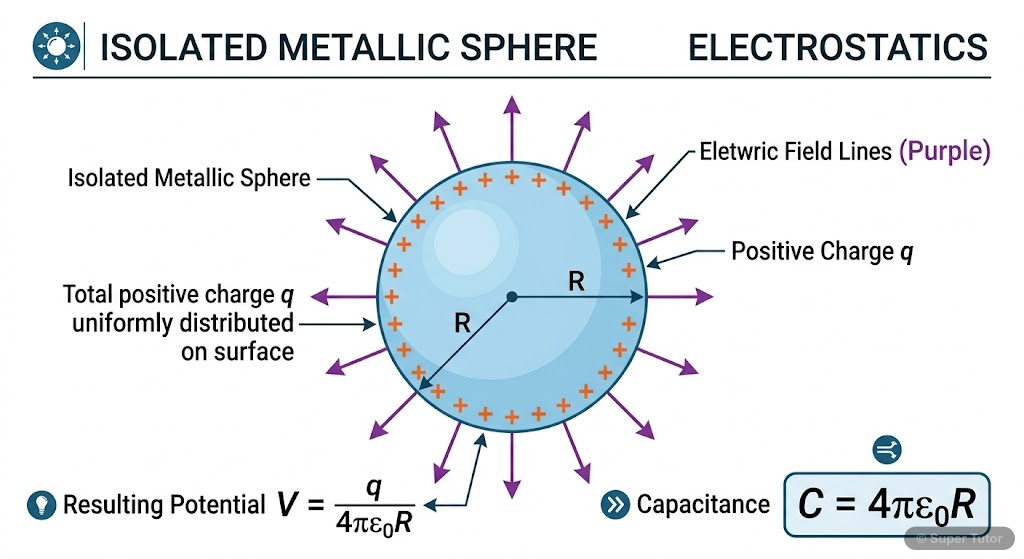
This is just one of 20+ visuals inside Super Tutor's Capacitors chapter
Explore the full setHow to Study Capacitors
A structured approach to studying Capacitors for JEE Advanced Physics.
Study Plan for Capacitors
Day 1–2: Learn the Theory
Study the chapter thoroughly. Note down definitions, formulas, and key concepts.
Day 3: Practice Problems
Solve practice questions and previous year JEE Advanced problems. There are 73 questions available for this chapter.
Day 4: Revise & Test
Revise key formulas and concepts without looking at notes. Take a practice quiz to test your understanding.
What to Focus On
- Capacitance $C = q/V$ depends only on geometry and medium, not on the charge.
- SI unit: Farad (F) = C/V; practical units are μF, nF, pF.
- Dimensional formula: $[M^{-1}L^{-2}T^4A^2]$.
- Energy stored: $U = q^2/(2C) = CV^2/2 = qV/2$ — memorise all three forms.
- The q-V graph is linear; U = area of triangle = (1/2)(q)(V).
- Common potential after sharing: $V = (C_1V_1 + C_2V_2)/(C_1 + C_2)$ — weighted average.
- Parallel plate: $C = \varepsilon_0 A/d$; depends only on geometry.
- Dielectric increases capacitance: $C = K\varepsilon_0 A/d = KC_0$.
- Induced charge on dielectric: $q_i = q(1 - 1/K)$; for conductor $K=\infty$, $q_i = q$.
Common Mistakes to Avoid
In capacitors connected in parallel, the charge on each capacitor is the same (confusing the series rule with the parallel rule).
Inserting a dielectric slab between capacitor plates always increases the voltage across the capacitor.
The equivalent capacitance in series is found by adding capacitances directly (like resistors in series), and equivalent capacitance in parallel uses the reciprocal formula (like resistors in parallel
Want a personalised study plan?
Super Tutor creates a day-by-day plan for JEE Advanced Physics that adapts to your exam date and pace.
Create My Study Plan — FreeFrequently Asked Questions
What topics are covered in Capacitors for JEE Advanced?
How important is Capacitors for JEE Advanced?
How to prepare Capacitors for JEE Advanced?
More resources for Capacitors
For JEE Advanced aspirants
Get the full Capacitors chapter — for free.
Practice questions, revision notes, formula sheet and AI doubt-solver for JEE Advanced Physics.