Experiments — Study Plan
JEE Advanced · Physics
Step-by-step Experiments study plan for JEE Advanced Physics 2026 — structured month-wise approach to mastering this chapter.
Interactive on Super Tutor
Studying Experiments? Get the full chapter — free.
Practice questions, revision notes, formula sheet and AI doubt-solver — built for JEE Advanced Physics.
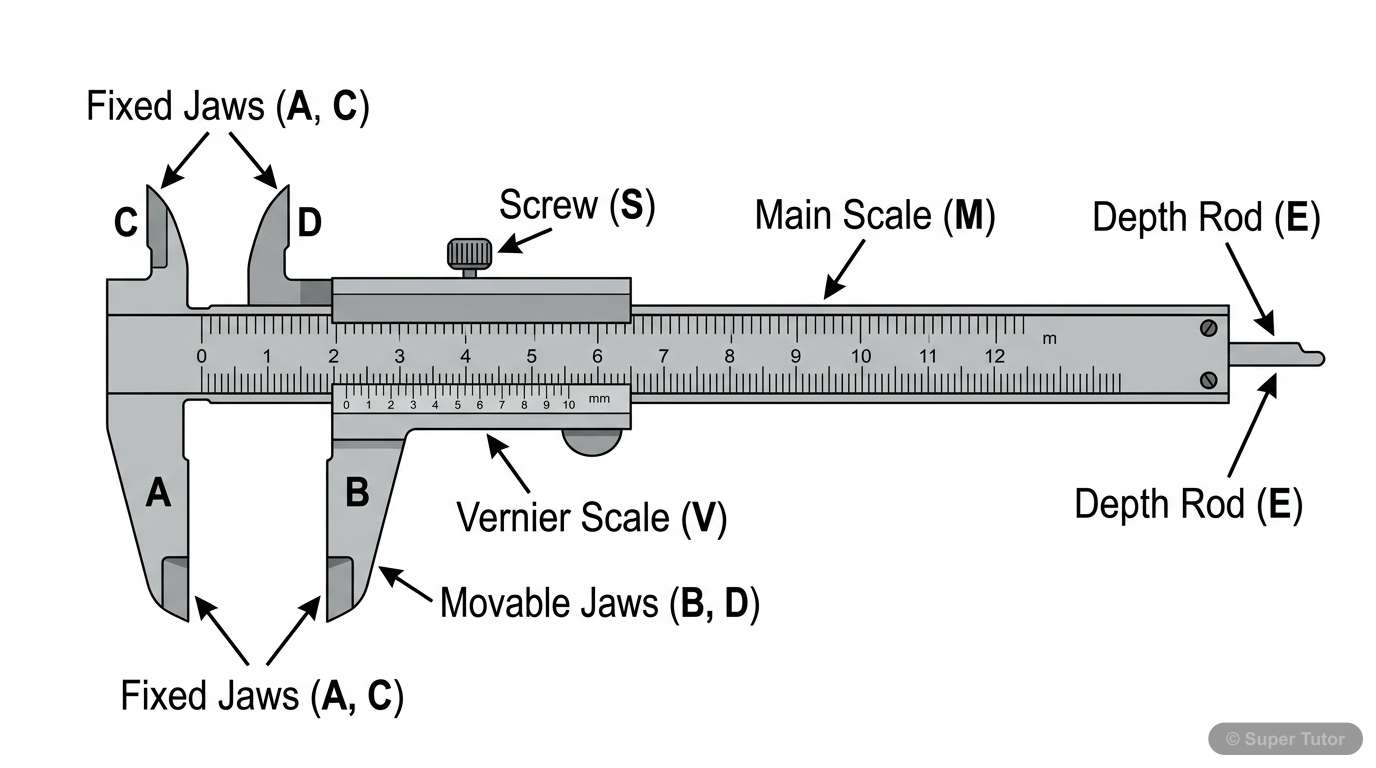
This is just one of 30+ visuals inside Super Tutor's Experiments chapter
Explore the full setHow to Study Experiments
A structured approach to studying Experiments for JEE Advanced Physics.
Study Plan for Experiments
Day 1–2: Learn the Theory
Study the chapter thoroughly. Note down definitions, formulas, and key concepts.
Day 3: Practice Problems
Solve practice questions and previous year JEE Advanced problems. There are 53 questions available for this chapter.
Day 4: Revise & Test
Revise key formulas and concepts without looking at notes. Take a practice quiz to test your understanding.
What to Focus On
- LC = 1 MSD − 1 VSD = (Smallest MS division) / (Number of VS divisions)
- Standard vernier: 1 MSD = 1 mm, n = 10, LC = 0.01 cm
- Total reading = N + n × LC, where N is MS reading left of VS zero and n is coinciding VS division
- LC = Pitch / Number of circular scale divisions; standard values: 0.01 mm with p = 1 mm, 100 divisions
- Total reading = N (linear scale reading in mm) + n × LC (circular scale contribution)
- Negative zero error: zero of circular scale has advanced beyond reference line; correction is positive
- Effective pendulum length L = l (string) + r (bob radius)
- T = 2π√(L/g); therefore g = 4π²L/T²
- T² vs L graph: slope = 4π²/g; L vs T² graph: slope = g/4π²
Common Mistakes to Avoid
In a screw gauge, if the circular scale zero is BELOW the reference line, the zero error is positive (and vice versa).
The main scale reading (MSR) in a Vernier calliper is the reading of the main scale division that is CLOSEST to the Vernier zero — whether to the left or to the right.
In the simple pendulum experiment, the time period T depends on the mass of the bob, so using a heavier bob gives a more accurate result.
Want a personalised study plan?
Super Tutor creates a day-by-day plan for JEE Advanced Physics that adapts to your exam date and pace.
Create My Study Plan — FreeFrequently Asked Questions
What topics are covered in Experiments for JEE Advanced?
How important is Experiments for JEE Advanced?
How to prepare Experiments for JEE Advanced?
More resources for Experiments
For JEE Advanced aspirants
Get the full Experiments chapter — for free.
Practice questions, revision notes, formula sheet and AI doubt-solver for JEE Advanced Physics.