Current Electricity — Study Plan
JEE Advanced · Physics
Step-by-step Current Electricity study plan for JEE Advanced Physics 2026 — structured month-wise approach to mastering this chapter.
Interactive on Super Tutor
Studying Current Electricity? Get the full chapter — free.
Practice questions, revision notes, formula sheet and AI doubt-solver — built for JEE Advanced Physics.
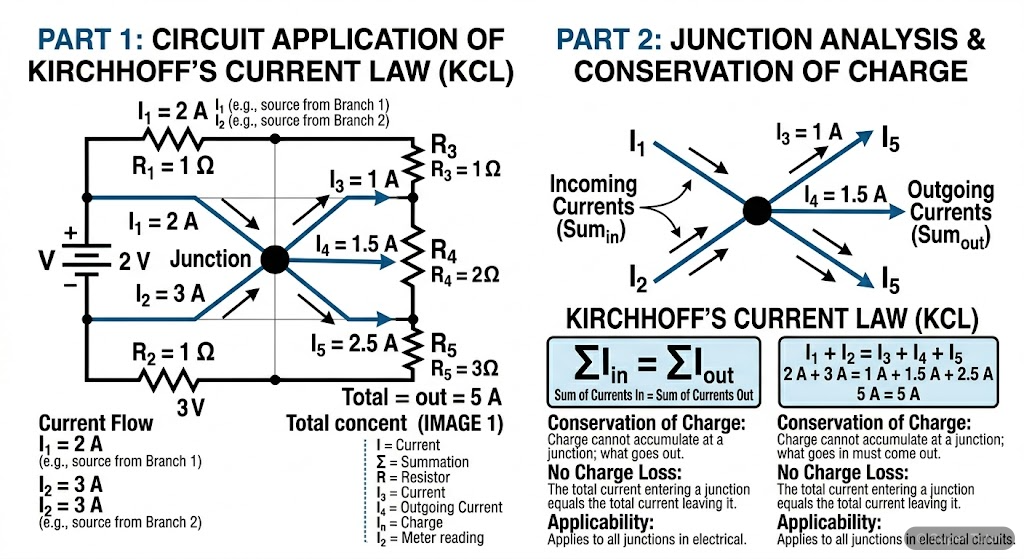
This is just one of 19+ visuals inside Super Tutor's Current Electricity chapter
Explore the full setHow to Study Current Electricity
A structured approach to studying Current Electricity for JEE Advanced Physics.
Study Plan for Current Electricity
Day 1–2: Learn the Theory
Study the chapter thoroughly. Note down definitions, formulas, and key concepts.
Day 3: Practice Problems
Solve practice questions and previous year JEE Advanced problems. There are 113 questions available for this chapter.
Day 4: Revise & Test
Revise key formulas and concepts without looking at notes. Take a practice quiz to test your understanding.
What to Focus On
- I = dq/dt (instantaneous); I_avg = q/t (average). Unit: Ampere = C/s.
- Conventional current direction = direction of positive charge flow = opposite to electron flow in metals.
- Current is a scalar. At any junction, currents add algebraically.
- Drift velocity: v_d = eEτ/m ≈ 10⁻⁴ m/s (much less than thermal speed ~10⁵ m/s).
- Current-drift relation: I = neAv_d. Here n = free electron density (m⁻³).
- Current density J = I/A = nev_d (vector, directed along E).
- R = ρl/A; ρ (resistivity) is a material property; R depends on geometry too.
- ρ = m/(ne²τ) — derived from microscopic model; ρ ∝ 1/τ.
- Stretching wire to k times: new resistance = k²R (volume constant).
Common Mistakes to Avoid
When a conductor has non-uniform cross-section, the electric current is different at different cross-sections — narrower sections carry less current.
EMF is a force. Since it is called 'electromotive force', it must have units of newtons and is some kind of push applied to electrons.
When resistors are connected in parallel, the equivalent resistance is larger than the largest individual resistance — or at least equal to the smallest one.
Want a personalised study plan?
Super Tutor creates a day-by-day plan for JEE Advanced Physics that adapts to your exam date and pace.
Create My Study Plan — FreeFrequently Asked Questions
What topics are covered in Current Electricity for JEE Advanced?
How important is Current Electricity for JEE Advanced?
How to prepare Current Electricity for JEE Advanced?
More resources for Current Electricity
For JEE Advanced aspirants
Get the full Current Electricity chapter — for free.
Practice questions, revision notes, formula sheet and AI doubt-solver for JEE Advanced Physics.