Direction Decision Making — Revision Notes
SNAP · Data Interpretation & Logical Reasoning
Quick revision notes for Direction Decision Making — key concepts, formulas, and definitions for SNAP Data Interpretation & Logical Reasoning preparation.
Interactive on Super Tutor
Studying Direction Decision Making? Get the full chapter — free.
Practice questions, revision notes, formula sheet and AI doubt-solver — built for SNAP Data Interpretation & Logical Reasoning.
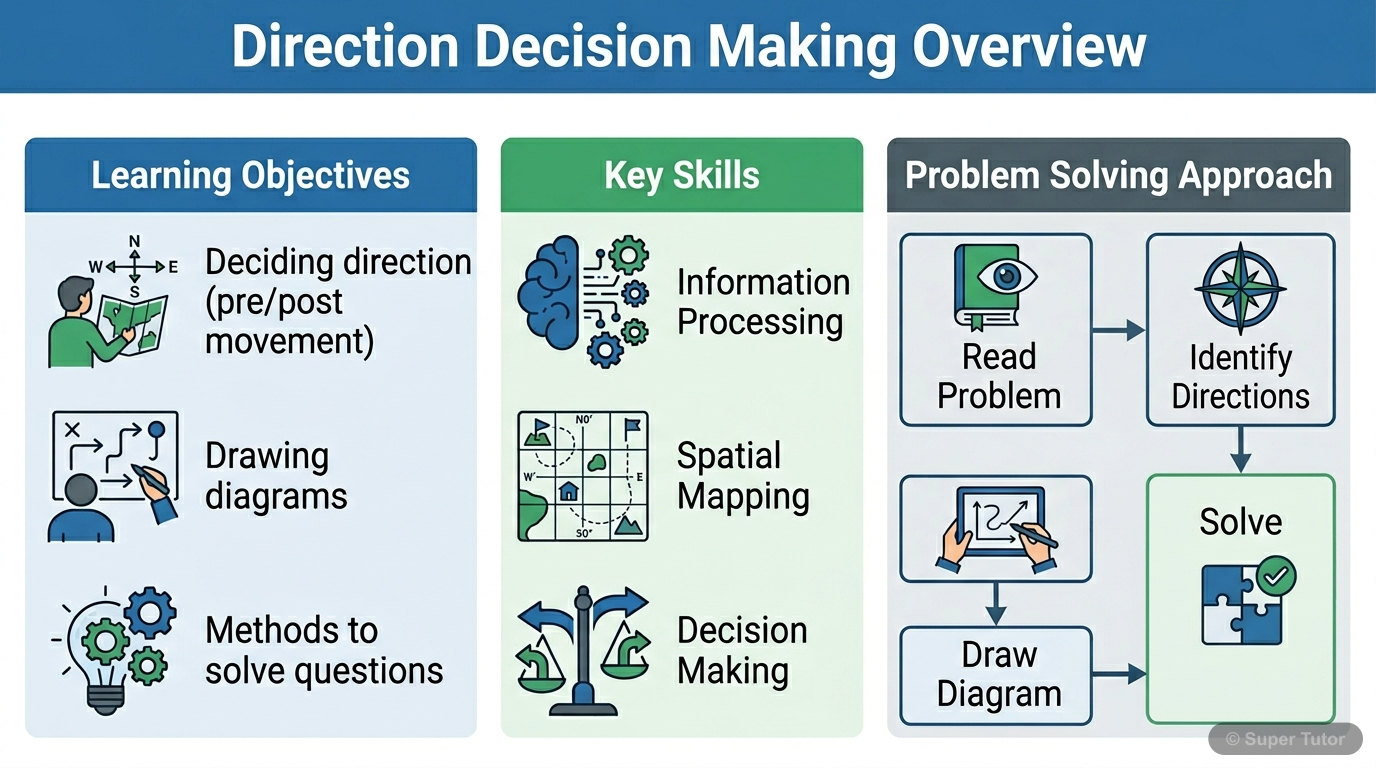
This is just one of 10+ visuals inside Super Tutor's Direction Decision Making chapter
Explore the full setRevision Notes — Direction Decision Making
Key concepts, formulas, and definitions from Direction Decision Making for SNAP Data Interpretation & Logical Reasoning preparation.
Key Topics to Revise
Basic Directions and Orientation
- Eight main directions: North (N), South (S), East (E), West (W), North-East (NE), North-West (NW), South-East (SE), South-West (SW)
- Intermediate directions like North-East are exactly at 45° angles between main directions
- Clockwise movement follows the order: N → NE → E → SE → S → SW → W → NW → N
Problem-Solving Methodology
- Step 1: Identify the starting position and initial direction
- Step 2: Draw a clear diagram with proper scale
- Step 3: Mark each movement sequentially on the diagram
Advanced Direction Problems
- Problems involving multiple people or objects moving simultaneously
- Relative direction problems where you need to find position of one person with respect to another
- Time-based movement problems with constant speeds
Get complete revision notes with diagrams and examples — continue in Super Tutor
Key Concepts
Frequently Asked Questions
What topics are covered in Direction Decision Making for SNAP?
How important is Direction Decision Making for SNAP?
How to prepare Direction Decision Making for SNAP?
More resources for Direction Decision Making
For SNAP aspirants
Get the full Direction Decision Making chapter — for free.
Practice questions, revision notes, formula sheet and AI doubt-solver for SNAP Data Interpretation & Logical Reasoning.