Sequencing and Arrangements — Revision Notes
SNAP · Data Interpretation & Logical Reasoning
Quick revision notes for Sequencing and Arrangements — key concepts, formulas, and definitions for SNAP Data Interpretation & Logical Reasoning preparation.
Interactive on Super Tutor
Studying Sequencing and Arrangements? Get the full chapter — free.
Practice questions, revision notes, formula sheet and AI doubt-solver — built for SNAP Data Interpretation & Logical Reasoning.
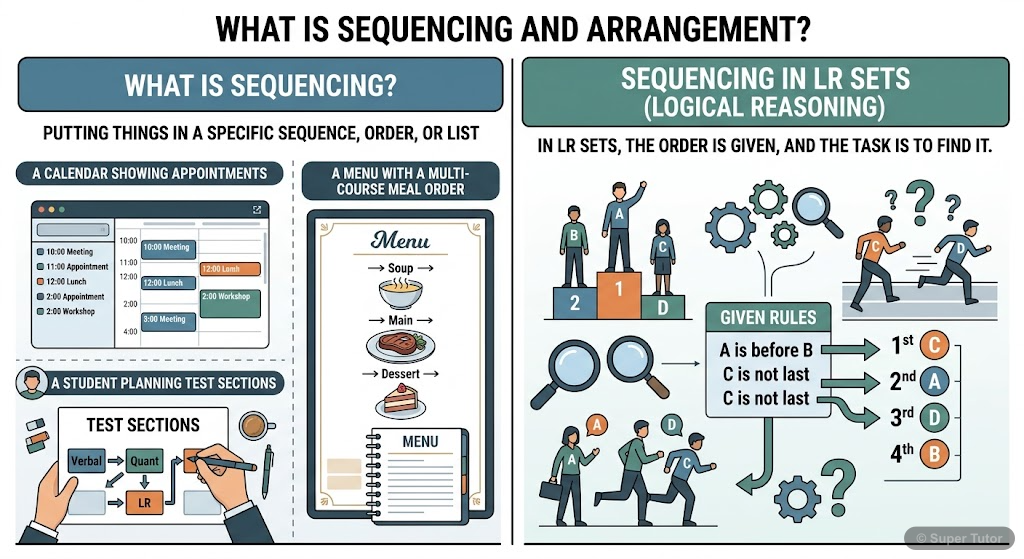
Super Tutor has 5+ illustrations like this for Sequencing and Arrangements alone — flashcards, concept maps, and step-by-step visuals.
See them allRevision Notes — Sequencing and Arrangements
Key concepts, formulas, and definitions from Sequencing and Arrangements for SNAP Data Interpretation & Logical Reasoning preparation.
Key Topics to Revise
Understanding Sequencing and Arrangement
- Sequencing is the process of arranging things in a specific order or list
- In real life, we sequence daily activities like appointments, meal orders, or test sections
- In logical reasoning, you must find the predetermined order of variables from given conditions
Types of Sequencing Problems
- Strict Sequencing: Provides exact positions or fixed relative positions of variables
- Loose Sequencing: Gives relative positioning without exact locations
- Strict sequencing uses definite statements like 'A is fourth' or 'B immediately follows C'
Circular Arrangement Concepts
- Circular arrangement involves closed-loop structures, not necessarily circular tables
- Can include rectangular, hexagonal, or any closed-loop arrangement
- Key relationships remain the same regardless of actual shape
Problem-Solving Strategies
- Start by identifying the type of sequencing (strict vs loose)
- Create appropriate visual representations (linear for sequences, circular for loops)
- Process conditions systematically, marking both positive and negative constraints
Get complete revision notes with diagrams and examples — continue in Super Tutor
Key Concepts
Frequently Asked Questions
What topics are covered in Sequencing and Arrangements for SNAP?
How important is Sequencing and Arrangements for SNAP?
How to prepare Sequencing and Arrangements for SNAP?
More resources for Sequencing and Arrangements
For SNAP aspirants
Get the full Sequencing and Arrangements chapter — for free.
Practice questions, revision notes, formula sheet and AI doubt-solver for SNAP Data Interpretation & Logical Reasoning.