Introduction to Data Interpretation — Revision Notes
SNAP · Data Interpretation & Logical Reasoning
Quick revision notes for Introduction to Data Interpretation — key concepts, formulas, and definitions for SNAP Data Interpretation & Logical Reasoning preparation.
Interactive on Super Tutor
Studying Introduction to Data Interpretation? Get the full chapter — free.
Practice questions, revision notes, formula sheet and AI doubt-solver — built for SNAP Data Interpretation & Logical Reasoning.
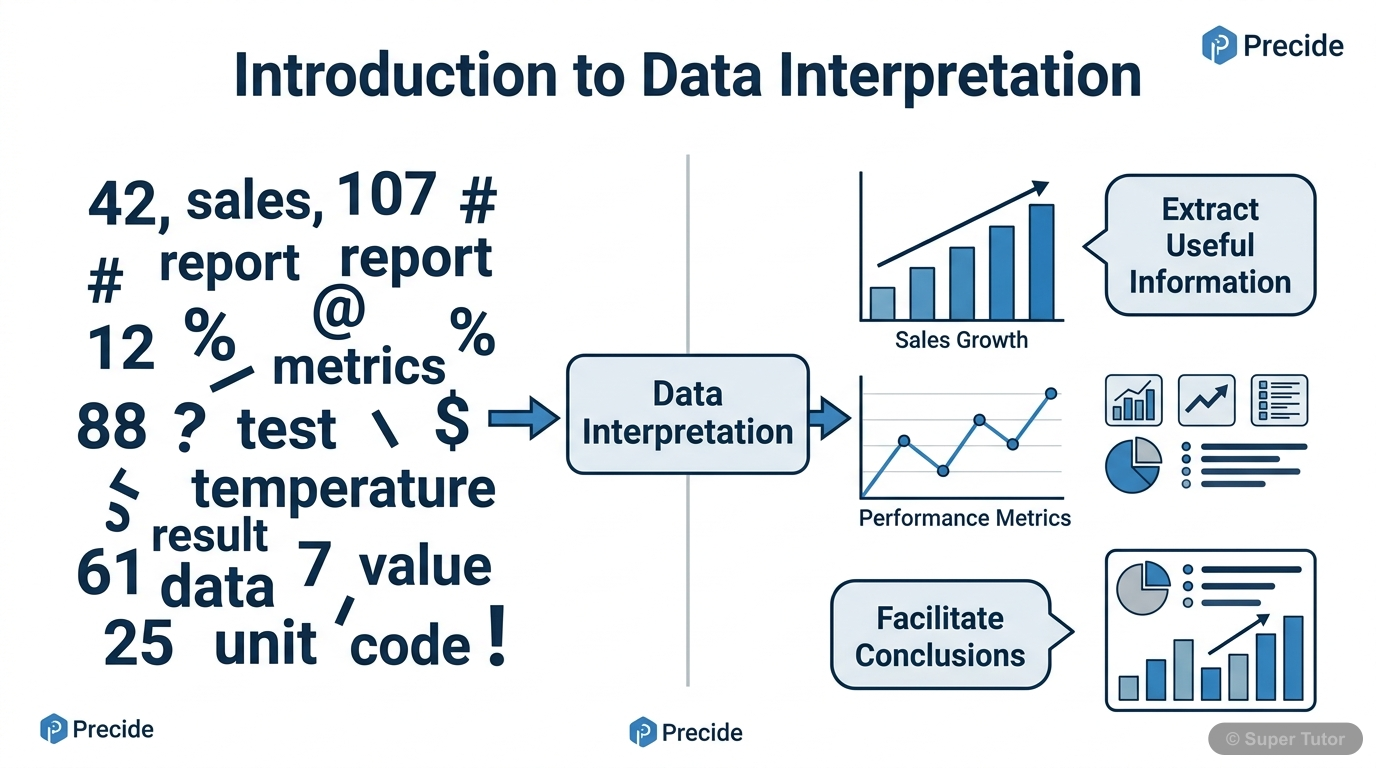
Super Tutor has 12+ illustrations like this for Introduction to Data Interpretation alone — flashcards, concept maps, and step-by-step visuals.
See them allRevision Notes — Introduction to Data Interpretation
Key concepts, formulas, and definitions from Introduction to Data Interpretation for SNAP Data Interpretation & Logical Reasoning preparation.
Key Topics to Revise
Understanding Data and Data Interpretation
- Data is a means to represent facts, concepts, or instructions in a formalized manner suitable for communication and processing
- Data can be numerical or non-numerical facts related to social, economic, or political events
- Data Interpretation involves transforming data to extract useful information and facilitate conclusions
Pie Charts - Circular Data Representation
- Pie charts represent data as parts of a circle where the circle represents 100%
- Arc length, central angle, and area of each sector are proportional to the part it represents
- Two approaches: Degree approach (360°) and Percentage approach (100%)
Bar Charts - Length-based Representation
- Bar charts use rectangular bars with lengths proportional to values represented
- More versatile than pie charts - can compare multiple variables
- Length matters, not width of bars
Line Charts and Other Advanced Representations
- Line charts are simplified forms of bar charts, ideal when time is a variable
- Show trends and percentage changes more clearly
- Can handle data with two different scales
Get complete revision notes with diagrams and examples — continue in Super Tutor
Key Concepts
Frequently Asked Questions
What topics are covered in Introduction to Data Interpretation for SNAP?
How important is Introduction to Data Interpretation for SNAP?
How to prepare Introduction to Data Interpretation for SNAP?
More resources for Introduction to Data Interpretation
Syllabus
Introduction to Data Interpretation — syllabus
Important Topics
Introduction to Data Interpretation — important topics
Practice Questions
Introduction to Data Interpretation — practice questions
Study Plan
Introduction to Data Interpretation — study plan
Formula Sheet
Introduction to Data Interpretation — formula sheet
For SNAP aspirants
Get the full Introduction to Data Interpretation chapter — for free.
Practice questions, revision notes, formula sheet and AI doubt-solver for SNAP Data Interpretation & Logical Reasoning.