Ratio, Proportion and Variation — Study Plan
XAT · Quantitative Ability & Data Interpretation
Step-by-step Ratio, Proportion and Variation study plan for XAT Quantitative Ability & Data Interpretation 2026 — structured month-wise approach to mastering this chapter.
Interactive on Super Tutor
Studying Ratio, Proportion and Variation? Get the full chapter — free.
Practice questions, revision notes, formula sheet and AI doubt-solver — built for XAT Quantitative Ability & Data Interpretation.
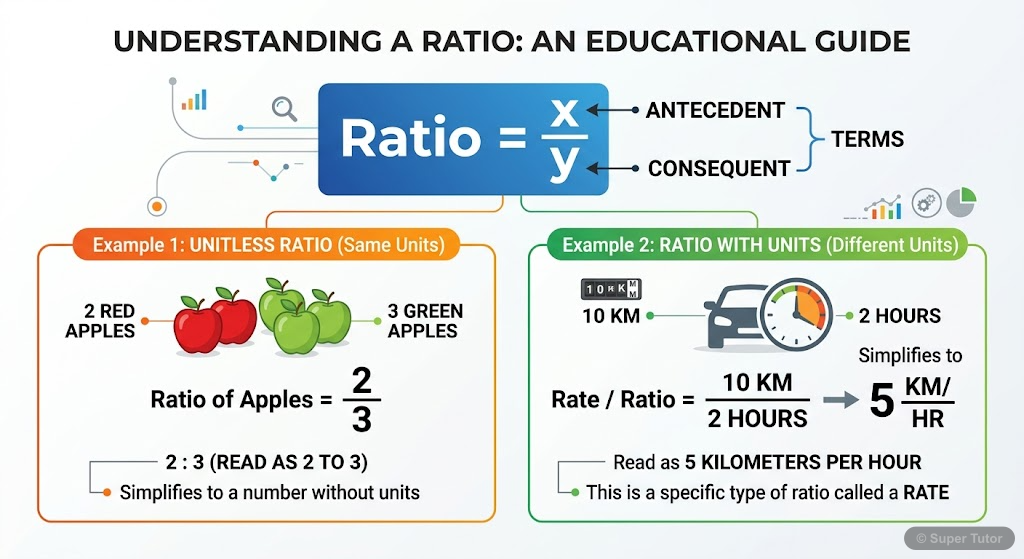
Learn better with visuals Super Tutor has hundreds of illustrations like this across every chapter — all free to try.
Get startedHow to Study Ratio, Proportion and Variation
A structured approach to studying Ratio, Proportion and Variation for XAT Quantitative Ability & Data Interpretation.
Study Plan for Ratio, Proportion and Variation
Day 1–2: Learn the Theory
Study the chapter thoroughly. Note down definitions, formulas, and key concepts.
Day 3: Practice Problems
Solve practice questions and previous year XAT problems. There are 49 questions available for this chapter.
Day 4: Revise & Test
Revise key formulas and concepts without looking at notes. Take a practice quiz to test your understanding.
What to Focus On
- Ratio = First quantity ÷ Second quantity
- Written as a:b, equals a/b
- First term = antecedent, Second term = consequent
- Multiplying/dividing both terms by same number keeps ratio unchanged
- Cross multiplication: a/b vs c/d, compare a×d with b×c
- Chain ratios: connect multiple quantities through common terms
- Proportion: a:b::c:d means a/b = c/d
- Product of extremes = Product of means (a×d = b×c)
- Mean proportional: if a:b::b:c, then b² = ac
Common Mistakes to Avoid
When comparing two ratios, the one with bigger numerator and denominator is always larger
In inverse proportion, if one quantity doubles, the other becomes half of its original value
In chain ratios like A:B = 2:3 and B:C = 4:5, you can directly write A:B:C = 2:3:4:5
Want a personalised study plan?
Super Tutor creates a day-by-day plan for XAT Quantitative Ability & Data Interpretation that adapts to your exam date and pace.
Create My Study Plan — FreeFrequently Asked Questions
What topics are covered in Ratio, Proportion and Variation for XAT?
How important is Ratio, Proportion and Variation for XAT?
How to prepare Ratio, Proportion and Variation for XAT?
More resources for Ratio, Proportion and Variation
Syllabus
Ratio, Proportion and Variation — syllabus
Revision Notes
Ratio, Proportion and Variation — revision notes
Important Topics
Ratio, Proportion and Variation — important topics
Practice Questions
Ratio, Proportion and Variation — practice questions
Formula Sheet
Ratio, Proportion and Variation — formula sheet
For XAT aspirants
Get the full Ratio, Proportion and Variation chapter — for free.
Practice questions, revision notes, formula sheet and AI doubt-solver for XAT Quantitative Ability & Data Interpretation.