Earth's Structure
ICSE · Class 9 · Geography
Summary of Earth's Structure for ICSE Class 9 Geography. Key concepts, important points, and chapter overview.
Interactive on Super Tutor
Studying Earth's Structure? Get the full interactive chapter.
Quizzes, flashcards, AI doubt-solver and a step-by-step study plan — built for chapter summary and more.
1,000+ Class 9 students started this chapter today
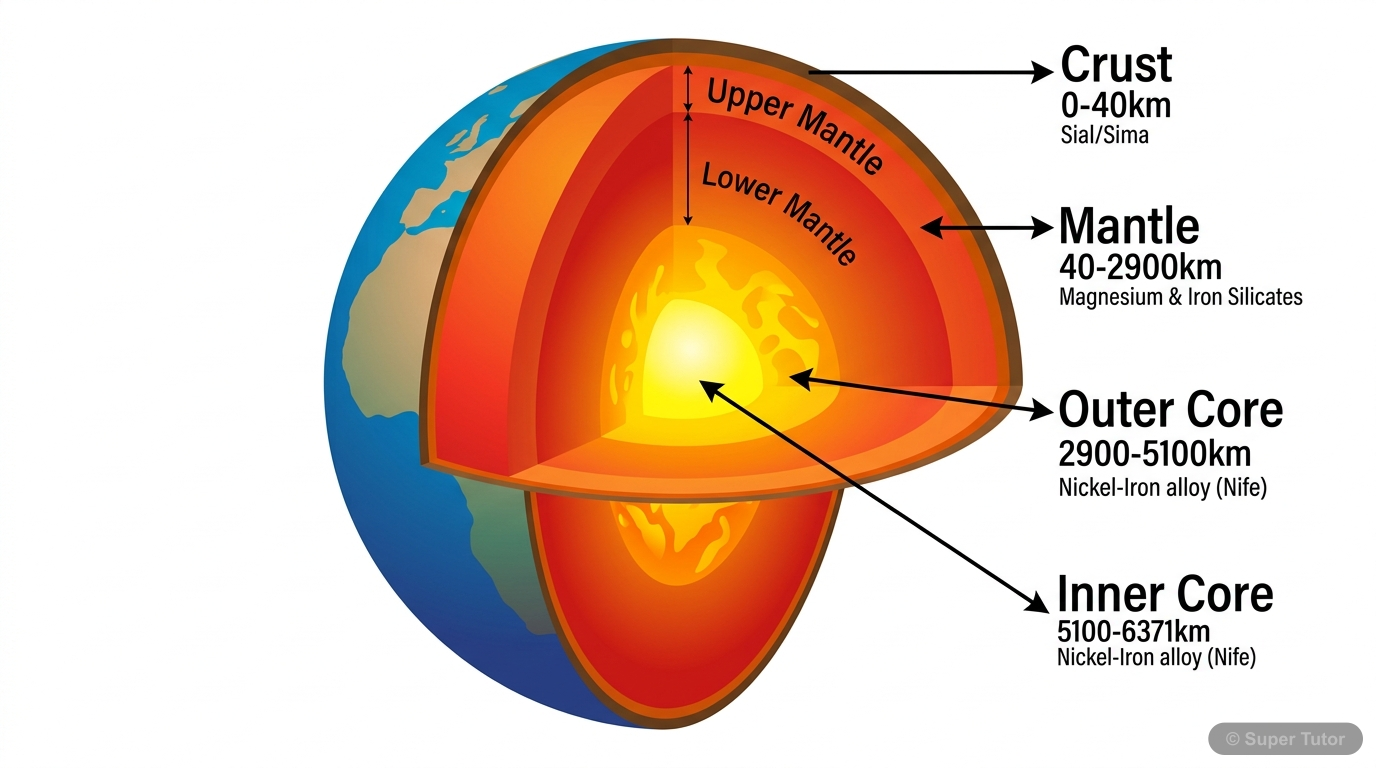
Learn better with visuals Super Tutor has hundreds of illustrations like this across every chapter — all free to try.
Get startedOverview
The Earth's interior remains one of the great mysteries in geology and geophysics. While humans have explored space and ocean depths extensively, the structure and composition of our planet's interior is studied through indirect evidence. Our knowledge comes from analyzing physical properties like t
Key Concepts
Temperature increases at 1°C per 32
Temperature increases at 1°C per 32 meters depth, reaching 4000°C at the core. Pressure increases dramatically to 3.5 million atmospheres at the cente
The outermost layer
The outermost layer, 6-48 km thick, composed of Sial (Silicon-Aluminum rich granite layer) floating on Sima (Silicon-Magnesium rich basalt layer). Sia
The middle layer extending from 35
The middle layer extending from 35-2900 km depth, bounded by Mohorovicic Discontinuity above and Gutenberg Discontinuity below. Contains Upper Mantle
The innermost layer starting at 2900
The innermost layer starting at 2900 km depth, made of Nickel-Iron (Nife). Outer core is molten with temperature ~2700°C, inner core is solid due to e
Mohorovicic Discontinuity separates crust from mantle
Mohorovicic Discontinuity separates crust from mantle, discovered by Yugoslav scientist. Gutenberg Discontinuity separates mantle from core. These bou
Learning Objectives
- Understand the three-layered structure of Earth: Core, Mantle, and Crust
- Analyze the composition and extent of each layer
- Explain how temperature, pressure, and density change with depth
- Distinguish between Sial and Sima layers within the crust
- Identify major discontinuities separating Earth's layers
Frequently Asked Questions
What are the important topics in Earth's Structure for ICSE Class 9 Geography?
How to score full marks in Earth's Structure — ICSE Class 9 Geography?
Sources & Official References
Content is aligned to the official syllabus. Refer to the board website for the latest curriculum.
More resources for Earth's Structure
Important Questions
Practice with board exam-style questions
Syllabus
What topics to cover
Revision Notes
Key points for last-minute revision
Study Plan
Step-by-step plan to ace this chapter
Flashcards
Quick-fire cards for active recall
Formula Sheet
All formulas in one place
Practice Quiz
Test yourself with a quick quiz
Concept Maps
See how topics connect visually
For serious students
Get the full Earth's Structure chapter — for free.
Quizzes, flashcards, AI doubt-solver and a step-by-step study plan for ICSE Class 9 Geography.