Earth's Structure
ICSE · Class 9 · Geography
Quick revision notes for Earth's Structure — ICSE Class 9 Geography. Key concepts, formulas, and definitions for last-minute revision.
Interactive on Super Tutor
Studying Earth's Structure? Get the full interactive chapter.
Quizzes, flashcards, AI doubt-solver and a step-by-step study plan — built for revision notes and more.
1,000+ Class 9 students started this chapter today
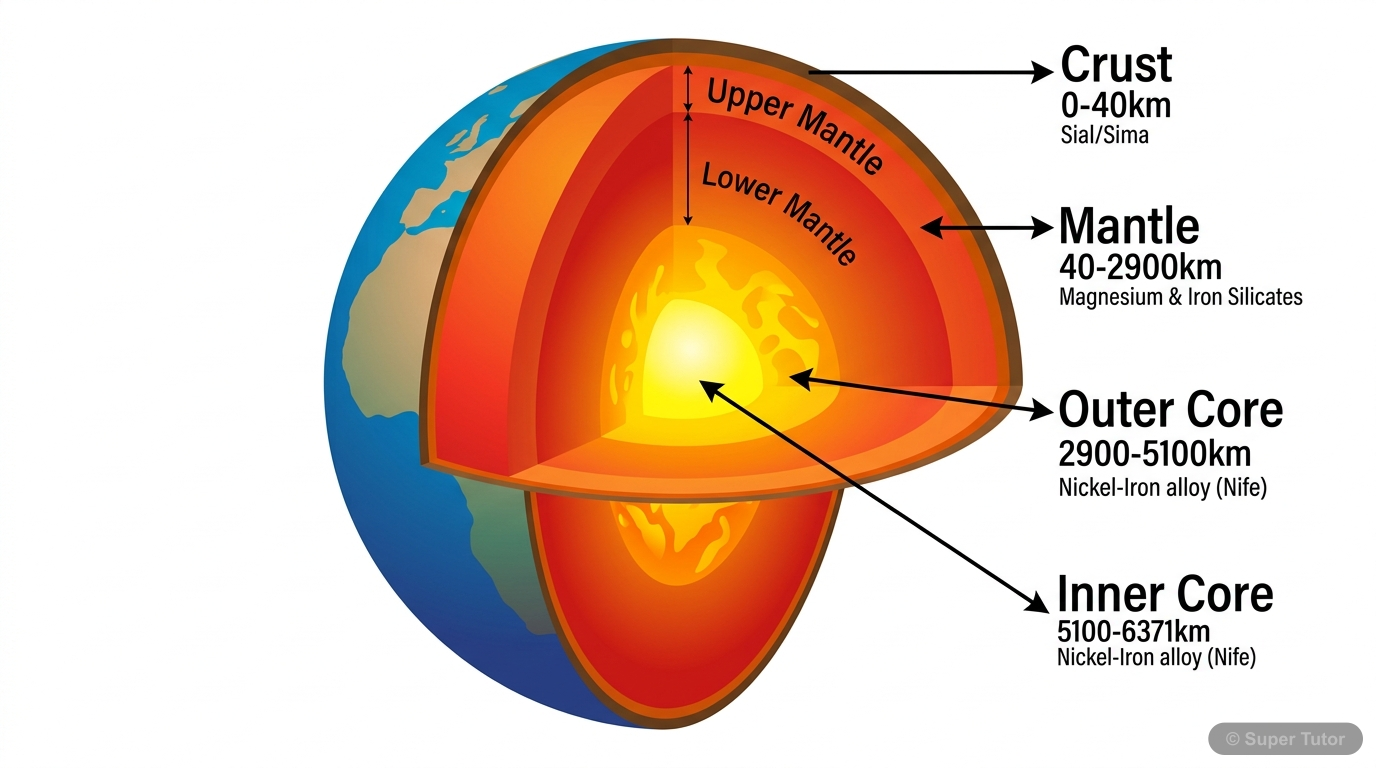
Learn better with visuals Super Tutor has hundreds of illustrations like this across every chapter — all free to try.
Get startedKey Topics to Revise
Introduction to Earth's Interior
- Earth's interior knowledge comes from indirect evidence - seismic waves, volcanic lava, temperature gradients
- Three main realms: Lithosphere (solid), Hydrosphere (water), Atmosphere (gases)
- Physical properties vary with depth: temperature, pressure, and density all increase
The Crust (Lithosphere)
- Outermost layer, 6-48 km thick, from Greek 'Lithos' meaning rock
- Two sublayers: SIAL (upper) and SIMA (lower)
- SIAL: Silica + Aluminum, density 2.7, granitic composition, discontinuous
The Mantle
- Middle layer between crust and core (35-2900 km depth)
- Bounded by Mohorovicic Discontinuity (top) and Gutenberg Discontinuity (bottom)
- Density ranges from 3.3 to 3.7
The Core (Barysphere)
- Central part below 2900 km depth, also called Barysphere
- Two parts: Outer Core (liquid) and Inner Core (solid)
- Outer Core: 2900-5100 km, liquid NIFE (Nickel + Iron), temperature ~2700°C
Get complete notes with diagrams and examples
Full NotesKey Concepts
Frequently Asked Questions
What are the important topics in Earth's Structure for ICSE Class 9 Geography?
How to score full marks in Earth's Structure — ICSE Class 9 Geography?
Sources & Official References
Content is aligned to the official syllabus. Refer to the board website for the latest curriculum.
More resources for Earth's Structure
Important Questions
Practice with board exam-style questions
Syllabus
What topics to cover
Study Plan
Step-by-step plan to ace this chapter
Flashcards
Quick-fire cards for active recall
Formula Sheet
All formulas in one place
Chapter Summary
Understand the chapter at a glance
Practice Quiz
Test yourself with a quick quiz
Concept Maps
See how topics connect visually
For serious students
Get the full Earth's Structure chapter — for free.
Quizzes, flashcards, AI doubt-solver and a step-by-step study plan for ICSE Class 9 Geography.