Earth's Structure
ICSE · Class 9 · Geography
Step-by-step guide to study Earth's Structure in ICSE Class 9 Geography. Topics to cover, practice strategy, and time allocation.
Interactive on Super Tutor
Studying Earth's Structure? Get the full interactive chapter.
Quizzes, flashcards, AI doubt-solver and a step-by-step study plan — built for study plan and more.
1,000+ Class 9 students started this chapter today
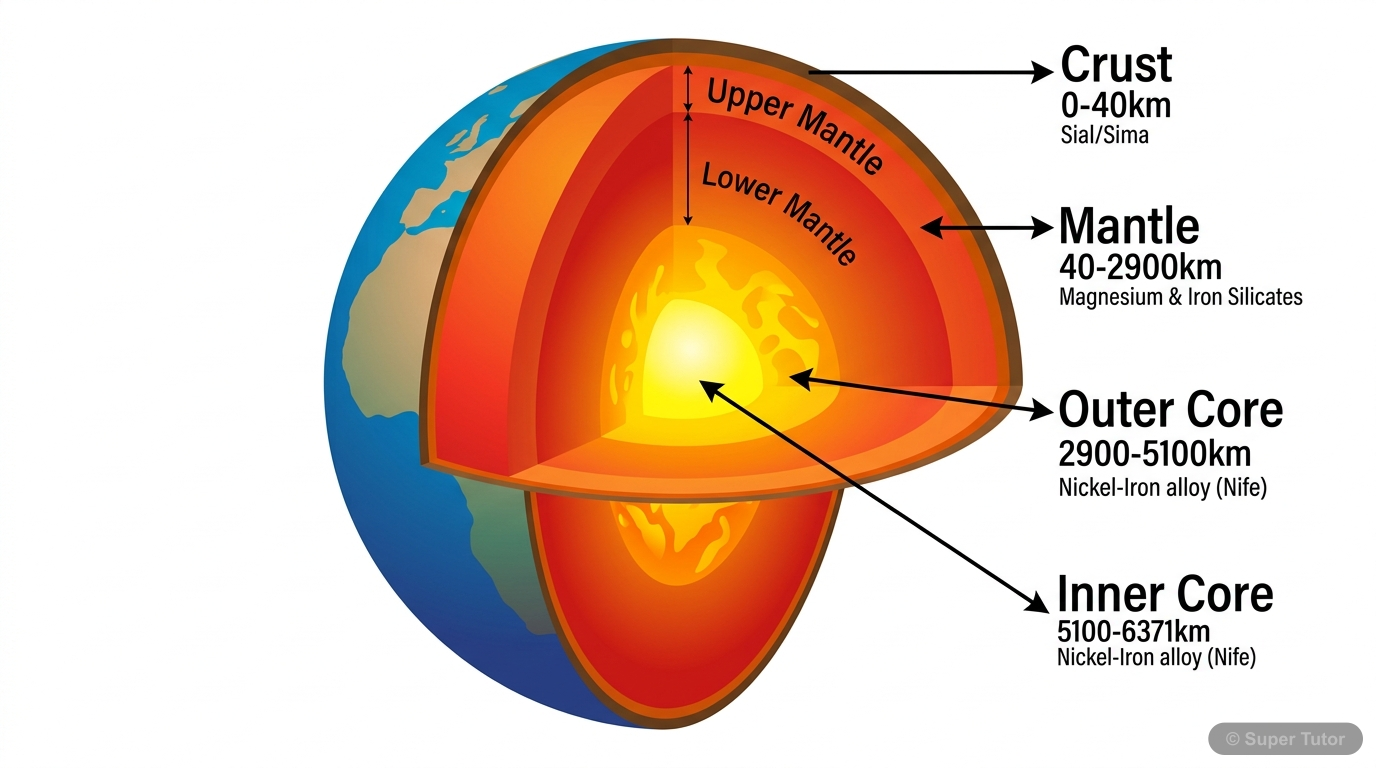
Learn better with visuals Super Tutor has hundreds of illustrations like this across every chapter — all free to try.
Get startedStudy Plan
Learn the Theory
Read the textbook chapter carefully. Note down definitions, formulas, and key concepts.
Practice Problems
Solve textbook exercises and additional practice questions. Focus on numerical problems and application-based questions.
Revise & Test
Revise key formulas and concepts without looking at notes. Take a practice quiz to test your understanding. Mark weak areas for re-revision.
Spaced Revision
Revisit Earth's Structure after a week. Use flashcards for quick recall. Solve previous year questions from this chapter.
What to Focus On
- Temperature increases 1°C per 32 meters of depth
- Seismic waves reveal internal structure through velocity changes
- Volcanic materials provide direct samples from deep layers
- Crust thickness varies: 6-10 km (oceanic) to 35-48 km (continental)
- SIAL layer: granitic, continental, discontinuous, density 2.7
- SIMA layer: basaltic, continuous, underlies oceans, density 2.95
- Extends from 35 km to 2,900 km depth
- Two divisions: Asthenosphere (upper) and Mesosphere (lower)
- Upper Asthenosphere: partially molten, enables plate tectonics
Common Mistakes to Avoid
The Earth's crust is uniformly thick everywhere - same thickness under oceans and continents
Temperature increases at a constant rate of 1°C per 32 meters throughout the entire Earth
SIAL and SIMA are two separate, distinct layers stacked on top of each other
Memory Tips
Three layers of Earth - Crust, Mantle, Core
Crust composition - SIAL and SIMA
SIAL composition - Silica and Aluminum
SIMA composition - Silica and Magnesium
Want a personalised study plan?
Super Tutor creates a day-by-day plan for ICSE Class 9 Geography that adapts to your exam date and pace.
Create My Study Plan — FreeFrequently Asked Questions
What are the important topics in Earth's Structure for ICSE Class 9 Geography?
How to score full marks in Earth's Structure — ICSE Class 9 Geography?
Sources & Official References
Content is aligned to the official syllabus. Refer to the board website for the latest curriculum.
More resources for Earth's Structure
Important Questions
Practice with board exam-style questions
Syllabus
What topics to cover
Revision Notes
Key points for last-minute revision
Flashcards
Quick-fire cards for active recall
Formula Sheet
All formulas in one place
Chapter Summary
Understand the chapter at a glance
Practice Quiz
Test yourself with a quick quiz
Concept Maps
See how topics connect visually
For serious students
Get the full Earth's Structure chapter — for free.
Quizzes, flashcards, AI doubt-solver and a step-by-step study plan for ICSE Class 9 Geography.