Alternating Current
Kerala Board · Class 12 · Physics
Flashcards for Alternating Current — Kerala Board Class 12 Physics. Quick Q&A cards covering key concepts, definitions, and formulas.
Interactive on Super Tutor
Studying Alternating Current? Get the full interactive chapter.
Quizzes, flashcards, AI doubt-solver and a step-by-step study plan — built for flashcards and more.
1,000+ Class 12 students started this chapter today
Learn better with visuals Super Tutor has hundreds of illustrations like this across every chapter — all free to try.
Get startedWhat is alternating current (AC) and how does it differ from direct current (DC)?
Answer
Alternating current (AC) is current that changes direction periodically with time, varying like a sine function. Unlike DC which flows in one direction only, AC current reverses direction every half c…
Define RMS (Root Mean Square) value and write the formula for RMS current.
Answer
RMS value is the effective value of AC current that produces the same heating effect as DC current. For current: I = im/√2 = 0.707 im, where im is peak current. Similarly, for voltage: V = vm/√2 = 0.7…
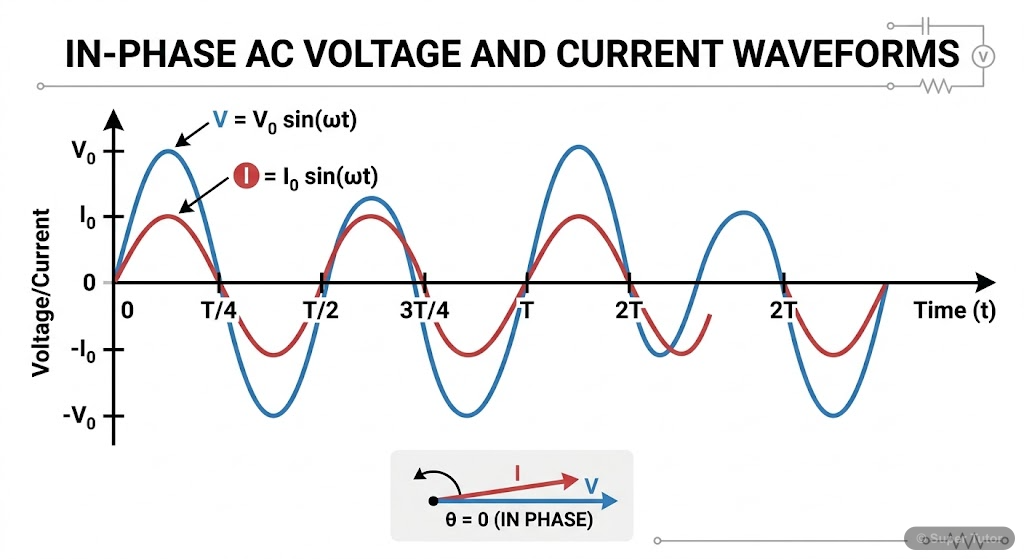
When AC voltage v = vm sin ωt is applied to a resistor R, what is the current expression and phase relationship?
Answer
Current through resistor: i = im sin ωt, where im = vm/R. The current is IN PHASE with voltage (phase difference = 0°). Both voltage and current reach maximum, minimum, and zero values at the same tim…
What is inductive reactance? Write its formula and unit.
Answer
Inductive reactance (XL) is the opposition offered by an inductor to AC current. Formula: XL = ωL = 2πfL, where ω is angular frequency, f is frequency, and L is inductance. Unit: Ohm (Ω). XL increases…
When AC voltage is applied to a pure inductor, what is the phase relationship between current and voltage?
Answer
In a pure inductor, current LAGS voltage by π/2 (90°). Current expression: i = im sin(ωt - π/2), where im = vm/XL. The current reaches maximum value one-quarter cycle (T/4) after voltage reaches maxim…
What is capacitive reactance? Write its formula and explain its frequency dependence.
Answer
Capacitive reactance (XC) is the opposition offered by a capacitor to AC current. Formula: XC = 1/(ωC) = 1/(2πfC), where C is capacitance. Unit: Ohm (Ω). XC is INVERSELY proportional to frequency and …
When AC voltage is applied to a pure capacitor, what is the phase relationship between current and voltage?
Answer
In a pure capacitor, current LEADS voltage by π/2 (90°). Current expression: i = im sin(ωt + π/2), where im = vm/XC. The current reaches maximum value one-quarter cycle (T/4) before voltage reaches ma…
What is a phasor? How does it help in AC circuit analysis?
Answer
A phasor is a rotating vector that represents AC quantities (voltage/current). It rotates with angular velocity ω. The magnitude represents amplitude, and the vertical projection gives instantaneous v…
+14 more flashcards available
Practice AllFrequently Asked Questions
What are the important topics in Alternating Current for Kerala Board Class 12 Physics?
How to score full marks in Alternating Current — Kerala Board Class 12 Physics?
How many flashcards are available for Alternating Current?
Sources & Official References
- Kerala Board of Public Examinations — keralapareekshabhavan.in
- National Education Policy 2020 — education.gov.in
Content is aligned to the official syllabus. Refer to the board website for the latest curriculum.
More resources for Alternating Current
Important Questions
Practice with board exam-style questions
Syllabus
What topics to cover
Revision Notes
Key points for last-minute revision
Study Plan
Step-by-step plan to ace this chapter
Formula Sheet
All formulas in one place
Chapter Summary
Understand the chapter at a glance
Practice Quiz
Test yourself with a quick quiz
Concept Maps
See how topics connect visually
For serious students
Get the full Alternating Current chapter — for free.
Quizzes, flashcards, AI doubt-solver and a step-by-step study plan for Kerala Board Class 12 Physics.