Alternating Current
Kerala Board · Class 12 · Physics
Summary of Alternating Current for Kerala Board Class 12 Physics. Key concepts, important points, and chapter overview.
Interactive on Super Tutor
Studying Alternating Current? Get the full interactive chapter.
Quizzes, flashcards, AI doubt-solver and a step-by-step study plan — built for chapter summary and more.
1,000+ Class 12 students started this chapter today
Learn better with visuals Super Tutor has hundreds of illustrations like this across every chapter — all free to try.
Get startedOverview
Alternating Current (AC) is a fundamental concept in physics that describes electrical systems where voltage and current change direction periodically with time. Unlike Direct Current (DC) where current flows in one direction, AC voltage and current follow sinusoidal patterns, making them essential
Key Concepts
AC voltage varies sinusoidally as v
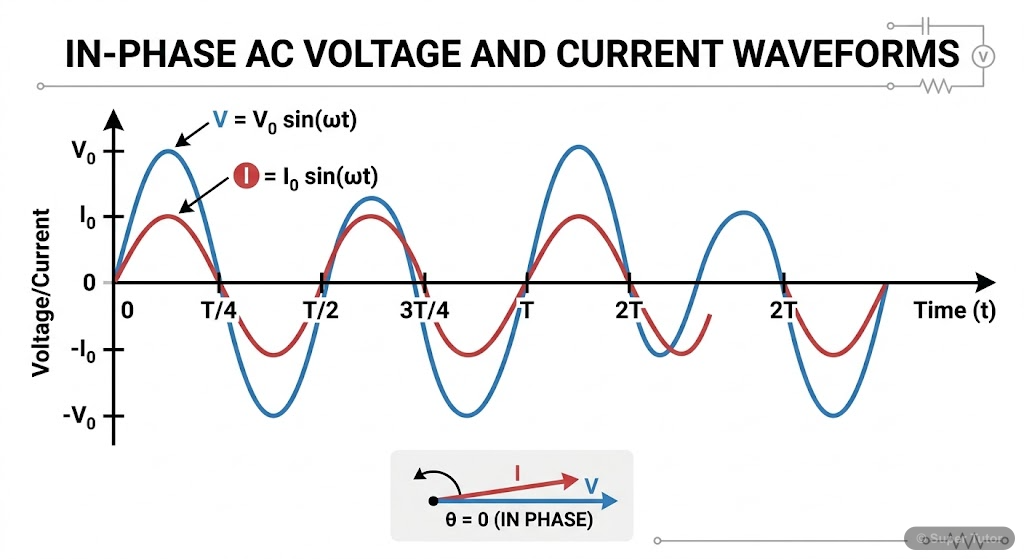
AC voltage varies sinusoidally as v = vm sin ωt, where vm is peak voltage and ω is angular frequency. This drives an alternating current that also var
When AC voltage is applied
When AC voltage is applied to a pure resistor, current and voltage are in phase (φ = 0). The current follows Ohm's law: i = vm sin ωt / R. Average pow
In a pure inductor
In a pure inductor, current lags voltage by π/2 (90°). The opposition to current flow is inductive reactance XL = ωL. Current amplitude: im = vm/XL. A
In a pure capacitor
In a pure capacitor, current leads voltage by π/2 (90°). The opposition is capacitive reactance XC = 1/ωC. Current amplitude: im = vm/XC. No net energ
Phasors are rotating vectors that represent
Phasors are rotating vectors that represent AC quantities. They rotate with angular frequency ω, and their vertical projections give instantaneous val
Learning Objectives
- Understand the basic principles of alternating current and voltage
- Analyze AC circuits containing resistors, inductors, and capacitors
- Master the concept of phasors for representing AC quantities
- Learn about impedance, reactance, and phase relationships in AC circuits
- Understand resonance phenomenon in RLC circuits
Frequently Asked Questions
What are the important topics in Alternating Current for Kerala Board Class 12 Physics?
How to score full marks in Alternating Current — Kerala Board Class 12 Physics?
Sources & Official References
- Kerala Board of Public Examinations — keralapareekshabhavan.in
- National Education Policy 2020 — education.gov.in
Content is aligned to the official syllabus. Refer to the board website for the latest curriculum.
More resources for Alternating Current
Important Questions
Practice with board exam-style questions
Syllabus
What topics to cover
Revision Notes
Key points for last-minute revision
Study Plan
Step-by-step plan to ace this chapter
Flashcards
Quick-fire cards for active recall
Formula Sheet
All formulas in one place
Practice Quiz
Test yourself with a quick quiz
Concept Maps
See how topics connect visually
For serious students
Get the full Alternating Current chapter — for free.
Quizzes, flashcards, AI doubt-solver and a step-by-step study plan for Kerala Board Class 12 Physics.