Nucle
Kerala Board · Class 12 · Physics
Flashcards for Nucle — Kerala Board Class 12 Physics. Quick Q&A cards covering key concepts, definitions, and formulas.
Interactive on Super Tutor
Studying Nucle? Get the full interactive chapter.
Quizzes, flashcards, AI doubt-solver and a step-by-step study plan — built for flashcards and more.
1,000+ Class 12 students started this chapter today
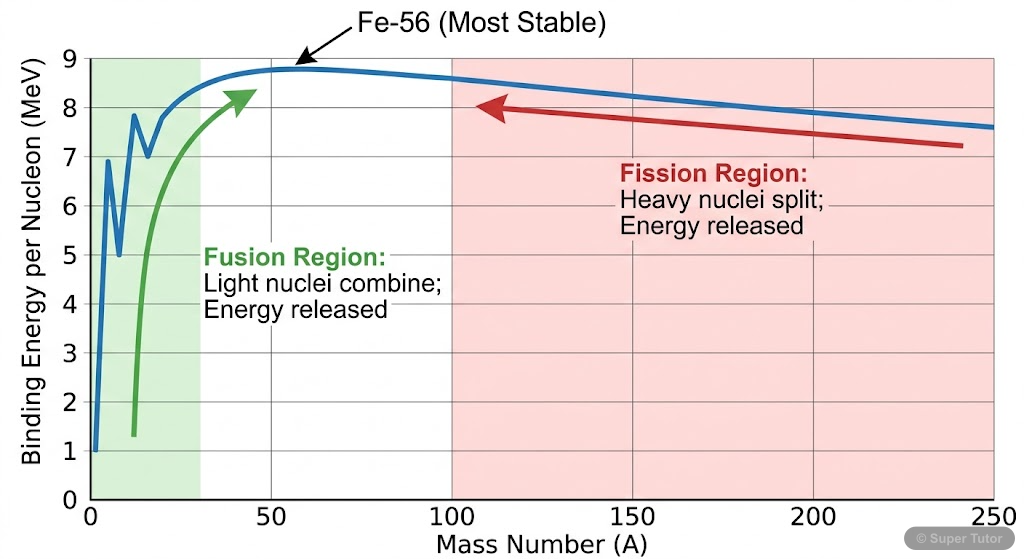
This is just one of 8+ visuals inside Super Tutor's Nucle chapter
Explore the full setDefine atomic mass unit (u) and give its value in kilograms.
Answer
Atomic mass unit (u) is defined as 1/12th of the mass of a carbon-12 atom. 1u = 1.660539 × 10⁻²⁷ kg. This unit is used because atomic masses are extremely small compared to kilogram, making calculatio…
What are isotopes? Give an example with their relative abundances.
Answer
Isotopes are atomic species of the same element that have the same chemical properties but differ in mass. Example: Chlorine has two isotopes with masses 34.98 u (75.4% abundance) and 36.98 u (24.6% a…
Define the following nuclear notation terms: Z, N, A, and write their relationships.
Answer
Z = atomic number (number of protons) N = neutron number (number of neutrons) A = mass number (total nucleons) Relationship: A = Z + N Nuclear notation: ᴬZ X where X is the chemical symbol…
What are the masses of proton and neutron in atomic mass units?
Answer
Mass of proton (mp) = 1.00727 u = 1.67262 × 10⁻²⁷ kg Mass of neutron (mn) = 1.00866 u = 1.6749 × 10⁻²⁷ kg Note: Neutron is slightly heavier than proton. Free neutron is unstable with mean life ~1000s.
Derive the formula for nuclear radius and state the value of R₀.
Answer
Nuclear radius formula: R = R₀ A^(1/3) where R₀ = 1.2 × 10⁻¹⁵ m = 1.2 fm This shows that nuclear volume is proportional to mass number A, making nuclear density constant for all nuclei (~2.3 × 10¹⁷ kg…
State Einstein's mass-energy equivalence relation and explain its significance in nuclear physics.
Answer
Einstein's mass-energy relation: E = mc² Significance: Mass can be converted to energy and vice versa. In nuclear reactions, mass defect is converted to binding energy. This principle explains the eno…
Define mass defect and derive the formula for nuclear binding energy.
Answer
Mass defect (ΔM) = [Z·mp + (A-Z)·mn] - M where M is the actual nuclear mass. Binding energy: Eb = ΔM·c² This is the energy required to separate a nucleus into its constituent nucleons, or energy relea…
Calculate the binding energy of ¹⁶O nucleus given its atomic mass is 15.99493 u.
Answer
For ¹⁶O: Z = 8, N = 8, A = 16 Mass of constituents = 8(1.00727) + 8(1.00866) = 16.12744 u Nuclear mass = 15.99493 - 8(0.00055) = 15.99053 u Mass defect = 16.12744 - 15.99053 = 0.13691 u Binding energy…
+14 more flashcards available
Practice AllFrequently Asked Questions
What are the important topics in Nucle for Kerala Board Class 12 Physics?
How to score full marks in Nucle — Kerala Board Class 12 Physics?
How many flashcards are available for Nucle?
Sources & Official References
- Kerala Board of Public Examinations — keralapareekshabhavan.in
- National Education Policy 2020 — education.gov.in
Content is aligned to the official syllabus. Refer to the board website for the latest curriculum.
More resources for Nucle
Important Questions
Practice with board exam-style questions
Syllabus
What topics to cover
Revision Notes
Key points for last-minute revision
Study Plan
Step-by-step plan to ace this chapter
Formula Sheet
All formulas in one place
Chapter Summary
Understand the chapter at a glance
Practice Quiz
Test yourself with a quick quiz
Concept Maps
See how topics connect visually
For serious students
Get the full Nucle chapter — for free.
Quizzes, flashcards, AI doubt-solver and a step-by-step study plan for Kerala Board Class 12 Physics.