Nucle
Kerala Board · Class 12 · Physics
Summary of Nucle for Kerala Board Class 12 Physics. Key concepts, important points, and chapter overview.
Interactive on Super Tutor
Studying Nucle? Get the full interactive chapter.
Quizzes, flashcards, AI doubt-solver and a step-by-step study plan — built for chapter summary and more.
1,000+ Class 12 students started this chapter today
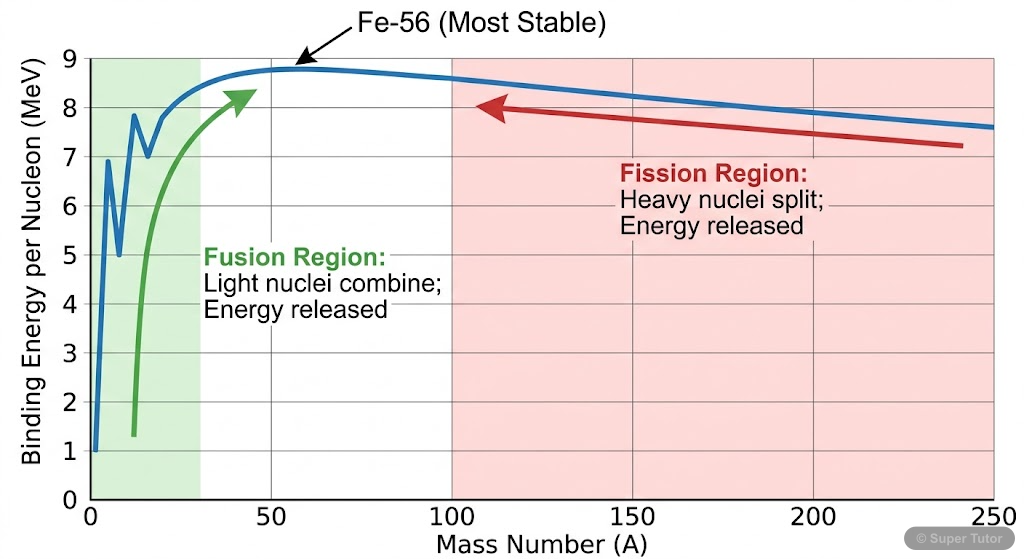
This is just one of 8+ visuals inside Super Tutor's Nucle chapter
Explore the full setOverview
This chapter explores the fascinating world of atomic nuclei, which contain over 99.9% of an atom's mass concentrated in a space 10,000 times smaller than the atom itself. We discover how nuclei are composed of protons and neutrons, held together by the strong nuclear force, and how nuclear processe
Key Concepts
A nucleus consists of protons (positively
A nucleus consists of protons (positively charged) and neutrons (neutral), collectively called nucleons. The atomic number Z equals the number of prot
Isotopes are atoms of the same
Isotopes are atoms of the same element with identical Z but different N values. They have the same chemical properties but different masses. Nuclear s
Einstein's equation E = mc² shows
Einstein's equation E = mc² shows mass and energy are interconvertible. The atomic mass unit (u) is defined as 1/12 the mass of ¹²C atom = 1.66 × 10⁻²
Binding energy (Eb = ΔMc²)
Binding energy (Eb = ΔMc²) is the energy required to separate a nucleus into individual nucleons. Binding energy per nucleon peaks around A = 56 at ~8
Nuclear force is much stronger than
Nuclear force is much stronger than electromagnetic or gravitational forces but operates only over very short ranges (~1 fm). It's attractive beyond 0
Learning Objectives
- Understand the composition and structure of atomic nuclei
- Learn about isotopes, atomic mass units, and nuclear notation
- Comprehend nuclear binding energy and mass-energy equivalence
- Explore the properties and characteristics of nuclear forces
- Understand radioactivity and different types of nuclear decay
Frequently Asked Questions
What are the important topics in Nucle for Kerala Board Class 12 Physics?
How to score full marks in Nucle — Kerala Board Class 12 Physics?
Sources & Official References
- Kerala Board of Public Examinations — keralapareekshabhavan.in
- National Education Policy 2020 — education.gov.in
Content is aligned to the official syllabus. Refer to the board website for the latest curriculum.
More resources for Nucle
Important Questions
Practice with board exam-style questions
Syllabus
What topics to cover
Revision Notes
Key points for last-minute revision
Study Plan
Step-by-step plan to ace this chapter
Flashcards
Quick-fire cards for active recall
Formula Sheet
All formulas in one place
Practice Quiz
Test yourself with a quick quiz
Concept Maps
See how topics connect visually
For serious students
Get the full Nucle chapter — for free.
Quizzes, flashcards, AI doubt-solver and a step-by-step study plan for Kerala Board Class 12 Physics.