Ancient World
NIOS · Class 10 · Social Studies
Summary of Ancient World for NIOS Class 10 Social Studies. Key concepts, important points, and chapter overview.
Interactive on Super Tutor
Studying Ancient World? Get the full interactive chapter.
Quizzes, flashcards, AI doubt-solver and a step-by-step study plan — built for chapter summary and more.
1,000+ Class 10 students started this chapter today
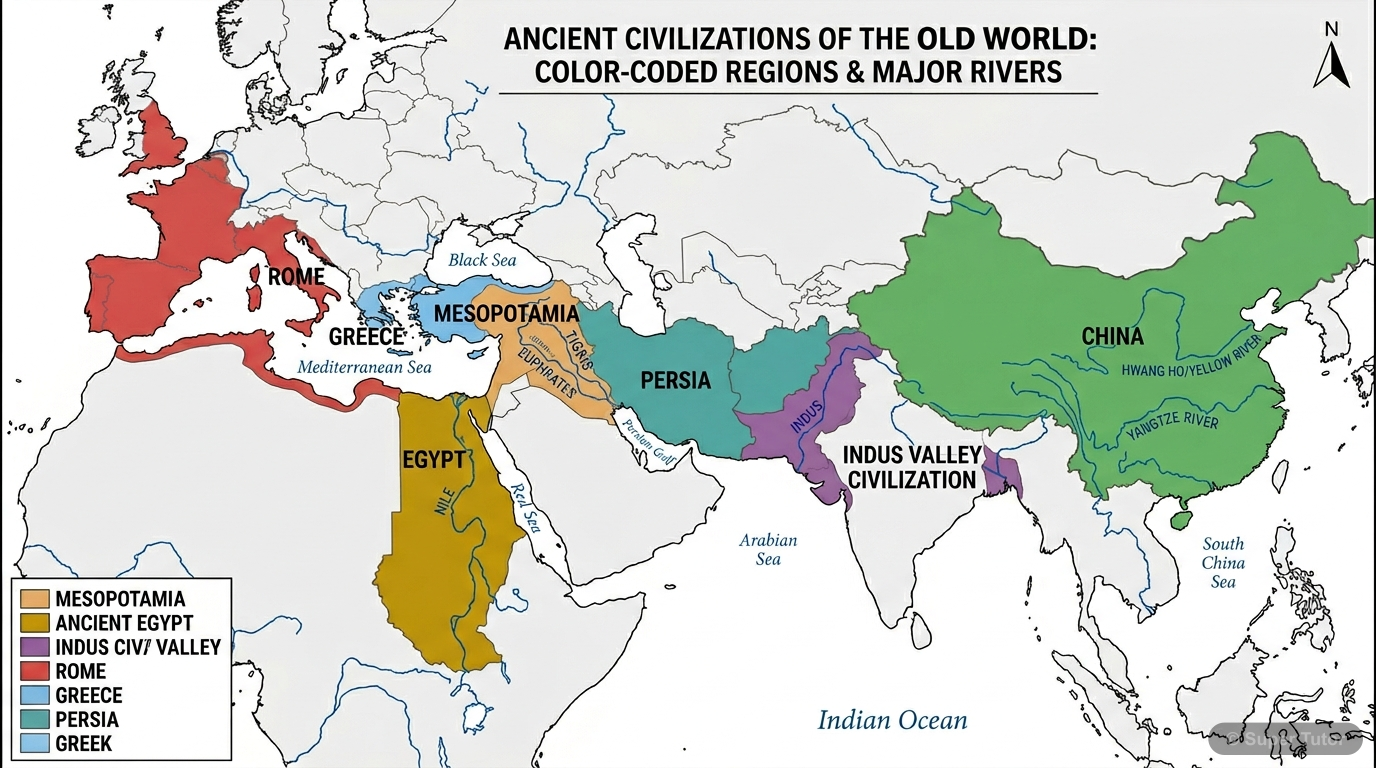
This is just one of 13+ visuals inside Super Tutor's Ancient World chapter
Explore the full setOverview
The Ancient World chapter explores the evolution of human civilization from the Stone Age through various Metal Ages, highlighting the development of major civilizations across different continents. This comprehensive journey takes us through the Bronze Age civilizations of Mesopotamia, Egypt, China
Key Concepts
The Bronze Age marked the transition
The Bronze Age marked the transition from stone tools to metal implements, with copper being the first metal used. This period saw the rise of town-ba
Also known as Harappan Civilization
Also known as Harappan Civilization, it flourished in the Indus River valley around 2500-1500 BCE. Major cities included Harappa, Mohenjo-Daro, Lothal
The Iron Age began around 1000
The Iron Age began around 1000 BCE when iron tools became common. This period saw the rise of Greek city-states with democratic governance, the Roman
Divided into Early Vedic Period (1500
Divided into Early Vedic Period (1500-1000 BCE) and Later Vedic Period (1000-600 BCE). Early period was primarily pastoral with tribal organization, w
Both religions emerged in 6th century
Both religions emerged in 6th century BCE as reform movements against ritualistic Brahmanism. Buddha taught the Four Noble Truths and Eightfold Path,
Learning Objectives
- Describe contributions of Bronze Age civilizations - Mesopotamian, Chinese, Egyptian, and Indus Valley
- Recognize contributions of Iron Age civilizations - Greek, Roman, and Persian
- Explain important developments in Indian history from Vedic Age to Harsha's time
- Examine different aspects of India's contribution to world civilization
Frequently Asked Questions
What are the important topics in Ancient World for NIOS Class 10 Social Studies?
How to score full marks in Ancient World — NIOS Class 10 Social Studies?
Sources & Official References
Content is aligned to the official syllabus. Refer to the board website for the latest curriculum.
More resources for Ancient World
Important Questions
Practice with board exam-style questions
Syllabus
What topics to cover
Revision Notes
Key points for last-minute revision
Study Plan
Step-by-step plan to ace this chapter
Flashcards
Quick-fire cards for active recall
Formula Sheet
All formulas in one place
Practice Quiz
Test yourself with a quick quiz
Concept Maps
See how topics connect visually
For serious students
Get the full Ancient World chapter — for free.
Quizzes, flashcards, AI doubt-solver and a step-by-step study plan for NIOS Class 10 Social Studies.