Medieval World
NIOS · Class 10 · Social Studies
Summary of Medieval World for NIOS Class 10 Social Studies. Key concepts, important points, and chapter overview.
Interactive on Super Tutor
Studying Medieval World? Get the full interactive chapter.
Quizzes, flashcards, AI doubt-solver and a step-by-step study plan — built for chapter summary and more.
1,000+ Class 10 students started this chapter today
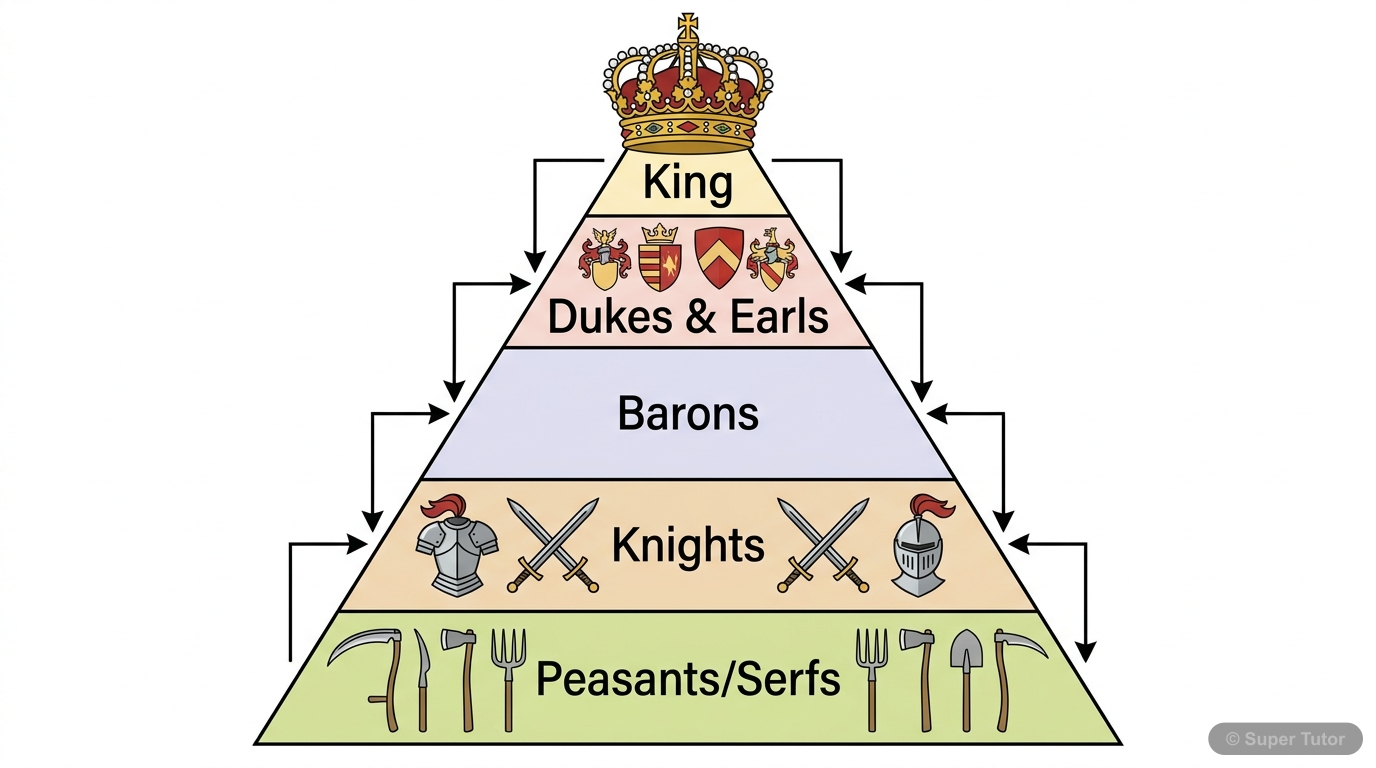
Learn better with visuals Super Tutor has hundreds of illustrations like this across every chapter — all free to try.
Get startedOverview
The Medieval Period, also called the Middle Ages, represents a crucial stage in human evolution spanning from the fall of the Roman Empire to the beginning of the Modern Period. Far from being a 'dark age', this period witnessed remarkable transformations in Europe, the rise of Islamic civilization
Key Concepts
A hierarchical political and social system
A hierarchical political and social system that emerged after the Roman Empire's fall. It featured a ladder-like structure with kings at the top, foll
The economic foundation of feudalism based
The economic foundation of feudalism based on self-sufficient landed estates called manors. Serfs (tied peasants) worked the lord's land and paid rent
Founded by Prophet Muhammad in 7th
Founded by Prophet Muhammad in 7th century Arabia, Islam emerged as a monotheistic religion emphasizing submission to Allah. Starting from Mecca and M
Arab scholars made groundbreaking contributions
Arab scholars made groundbreaking contributions in mathematics (Arabic numerals from India), medicine (discovering infectious diseases), chemistry (di
Turkish rulers established the Delhi Sultanate
Turkish rulers established the Delhi Sultanate in 13th century, followed by the Mughal Empire in 16th century. These empires introduced new governance
Learning Objectives
- Understand the Medieval Period as an important stage in human society's evolution
- Analyze the political changes after the Roman Empire's collapse and the emergence of Feudalism
- Examine the rise of Islamic civilization and its contributions to world culture
- Explore Medieval India's political, economic, and cultural developments
- Recognize the synthesis of traditions that characterized Medieval Indian civilization
Frequently Asked Questions
What are the important topics in Medieval World for NIOS Class 10 Social Studies?
How to score full marks in Medieval World — NIOS Class 10 Social Studies?
Sources & Official References
Content is aligned to the official syllabus. Refer to the board website for the latest curriculum.
More resources for Medieval World
Important Questions
Practice with board exam-style questions
Syllabus
What topics to cover
Revision Notes
Key points for last-minute revision
Study Plan
Step-by-step plan to ace this chapter
Flashcards
Quick-fire cards for active recall
Formula Sheet
All formulas in one place
Practice Quiz
Test yourself with a quick quiz
Concept Maps
See how topics connect visually
For serious students
Get the full Medieval World chapter — for free.
Quizzes, flashcards, AI doubt-solver and a step-by-step study plan for NIOS Class 10 Social Studies.