Compound Interest (Without Using Formula)
ICSE · Class 9 · Mathematics
Flashcards for Compound Interest (Without Using Formula) — ICSE Class 9 Mathematics. Quick Q&A cards covering key concepts, definitions, and formulas.
Interactive on Super Tutor
Studying Compound Interest (Without Using Formula)? Get the full interactive chapter.
Quizzes, flashcards, AI doubt-solver and a step-by-step study plan — built for flashcards and more.
1,000+ Class 9 students started this chapter today
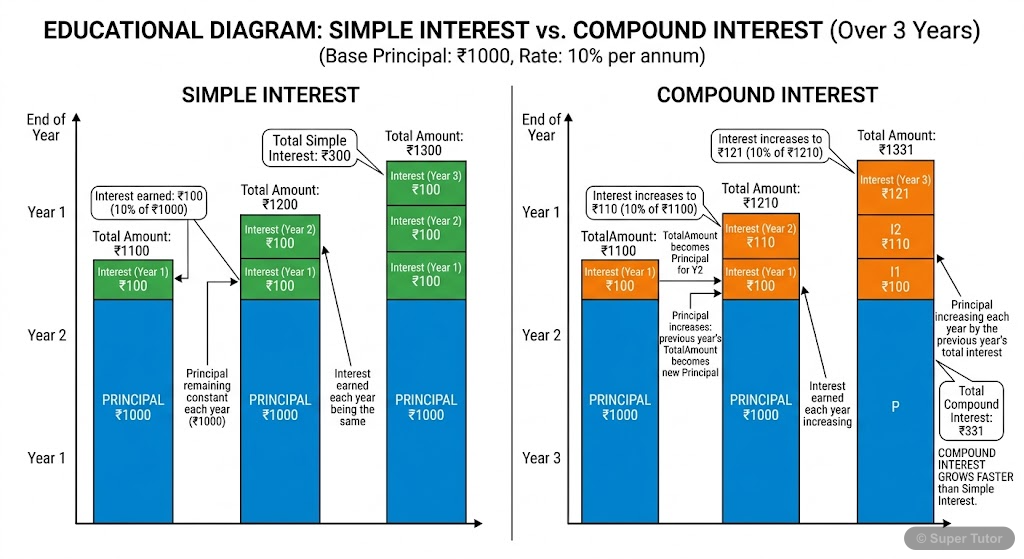
Super Tutor has 6+ illustrations like this for Compound Interest (Without Using Formula) alone — flashcards, concept maps, and step-by-step visuals.
See them allWhat is the basic meaning of 'interest' in financial terms?
Answer
Interest is the extra money paid for using someone else's money. When you borrow money (principal), you must return the original amount plus interest. The total money paid back is called the amount. F…
Define Simple Interest and explain its key characteristic.
Answer
Simple Interest is calculated on the original principal throughout the entire loan period, regardless of how long the money is borrowed. The interest remains the same every year. Formula: S.I. = (P × …
What is Compound Interest and how does it differ from Simple Interest?
Answer
Compound Interest is when the interest earned is added to the principal at the end of each period, and this new amount becomes the principal for the next period. Unlike Simple Interest, the principal …
Calculate the compound interest on ₹5,000 at 10% per annum for 2 years.
Answer
Year 1: P = ₹5,000, I = (5,000 × 10 × 1)/100 = ₹500, A = ₹5,500 Year 2: P = ₹5,500, I = (5,500 × 10 × 1)/100 = ₹550, A = ₹6,050 C.I. = ₹6,050 - ₹5,000 = ₹1,050…
What is a 'conversion period' in compound interest?
Answer
A conversion period is the time after which the principal changes (increases) in compound interest calculations. For yearly compounding, the conversion period is one year. For half-yearly compounding,…
Why does compound interest increase each year while simple interest remains constant?
Answer
In Simple Interest, the principal remains the same throughout, so interest is constant. In Compound Interest, the interest earned is added to the principal, making it larger each period. Since interes…
Calculate the amount on ₹8,000 at 5% compound interest for 1 year, compounded half-yearly.
Answer
First 6 months: P = ₹8,000, I = (8,000 × 5 × 1)/(100 × 2) = ₹200, A = ₹8,200 Second 6 months: P = ₹8,200, I = (8,200 × 5 × 1)/(100 × 2) = ₹205, A = ₹8,405 Final Amount = ₹8,405…
For the first year, are Simple Interest and Compound Interest equal? Explain why.
Answer
Yes, for the first year, Simple Interest equals Compound Interest because both are calculated on the same original principal amount. The difference appears from the second year onwards when compound i…
+14 more flashcards available
Practice AllFrequently Asked Questions
What are the important topics in Compound Interest (Without Using Formula) for ICSE Class 9 Mathematics?
How to score full marks in Compound Interest (Without Using Formula) — ICSE Class 9 Mathematics?
How many flashcards are available for Compound Interest (Without Using Formula)?
Sources & Official References
Content is aligned to the official syllabus. Refer to the board website for the latest curriculum.
More resources for Compound Interest (Without Using Formula)
Important Questions
Practice with board exam-style questions
Syllabus
What topics to cover
Revision Notes
Key points for last-minute revision
Study Plan
Step-by-step plan to ace this chapter
Formula Sheet
All formulas in one place
Chapter Summary
Understand the chapter at a glance
Practice Quiz
Test yourself with a quick quiz
Concept Maps
See how topics connect visually
For serious students
Get the full Compound Interest (Without Using Formula) chapter — for free.
Quizzes, flashcards, AI doubt-solver and a step-by-step study plan for ICSE Class 9 Mathematics.