Indices
ICSE · Class 9 · Mathematics
Flashcards for Indices — ICSE Class 9 Mathematics. Quick Q&A cards covering key concepts, definitions, and formulas.
Interactive on Super Tutor
Studying Indices? Get the full interactive chapter.
Quizzes, flashcards, AI doubt-solver and a step-by-step study plan — built for flashcards and more.
1,000+ Class 9 students started this chapter today
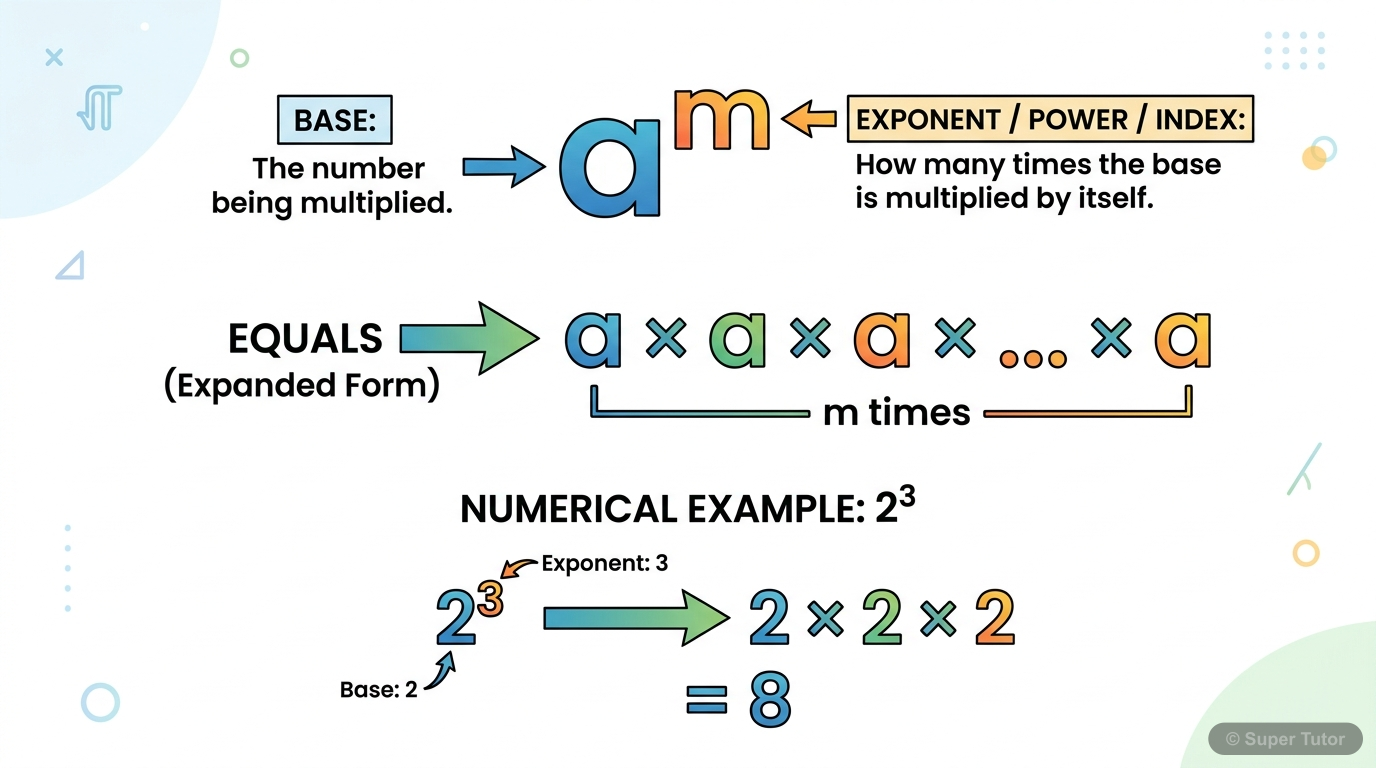
This is just one of 5+ visuals inside Super Tutor's Indices chapter
Explore the full setWhat is the definition of a^m where m is a positive integer?
Answer
a^m means 'a' multiplied by itself m times. Here, 'a' is called the base and 'm' is called the power, exponent, or index. For example: 2^5 = 2 × 2 × 2 × 2 × 2 = 32…
State the First Law of Indices (Product Law)
Answer
a^m × a^n = a^(m+n). When multiplying powers with the same base, add the exponents. Example: 3^4 × 3^2 = 3^(4+2) = 3^6…
State the Second Law of Indices (Quotient Law)
Answer
a^m ÷ a^n = a^(m-n). When dividing powers with the same base, subtract the exponents. Example: 5^7 ÷ 5^3 = 5^(7-3) = 5^4…
State the Third Law of Indices (Power Law)
Answer
(a^m)^n = a^(mn). When raising a power to another power, multiply the exponents. Example: (2^3)^4 = 2^(3×4) = 2^12…
What does a^0 equal for any non-zero number a?
Answer
a^0 = 1 for any non-zero number a. Examples: 5^0 = 1, (-3)^0 = 1, (1/2)^0 = 1. This is one of the fundamental properties of exponents.
How do you express a^(-n) in terms of positive exponents?
Answer
a^(-n) = 1/a^n. A negative exponent means the reciprocal of the positive exponent. Example: 2^(-3) = 1/2^3 = 1/8. Also, 1/a^(-n) = a^n…
How do you write nth root of a using fractional exponents?
Answer
∜a = a^(1/n). The nth root of a number can be written as a fractional exponent. Examples: ∛8 = 8^(1/3) = 2, √16 = 16^(1/2) = 4…
Express a^(m/n) in radical form
Answer
a^(m/n) = ∜(a^m) = (∜a)^m. A fractional exponent can be written as a radical. Example: 8^(2/3) = ∛(8^2) = ∛64 = 4, or (∛8)^2 = 2^2 = 4…
+16 more flashcards available
Practice AllFrequently Asked Questions
What are the important topics in Indices for ICSE Class 9 Mathematics?
How to score full marks in Indices — ICSE Class 9 Mathematics?
How many flashcards are available for Indices?
Sources & Official References
Content is aligned to the official syllabus. Refer to the board website for the latest curriculum.
More resources for Indices
Important Questions
Practice with board exam-style questions
Syllabus
What topics to cover
Revision Notes
Key points for last-minute revision
Study Plan
Step-by-step plan to ace this chapter
Formula Sheet
All formulas in one place
Chapter Summary
Understand the chapter at a glance
Practice Quiz
Test yourself with a quick quiz
Concept Maps
See how topics connect visually
For serious students
Get the full Indices chapter — for free.
Quizzes, flashcards, AI doubt-solver and a step-by-step study plan for ICSE Class 9 Mathematics.