Inequalities
ICSE · Class 9 · Mathematics
Flashcards for Inequalities — ICSE Class 9 Mathematics. Quick Q&A cards covering key concepts, definitions, and formulas.
Interactive on Super Tutor
Studying Inequalities? Get the full interactive chapter.
Quizzes, flashcards, AI doubt-solver and a step-by-step study plan — built for flashcards and more.
1,000+ Class 9 students started this chapter today
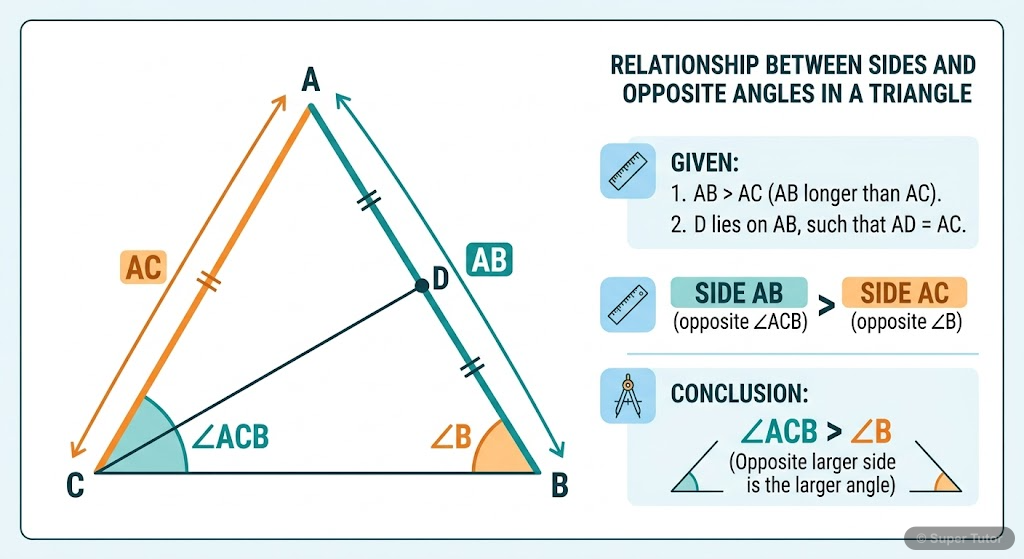
This is just one of 6+ visuals inside Super Tutor's Inequalities chapter
Explore the full setWhat does the symbol '>' mean in mathematics?
Answer
The symbol '>' means 'is greater than'. For example, if a is greater than b, we write a > b.
What does the symbol '<' mean in mathematics?
Answer
The symbol '<' means 'is less than'. For example, if a is less than b, we write a < b.
State Theorem 3 about the relationship between unequal sides and angles in a triangle.
Answer
If two sides of a triangle are unequal, the greater side has the greater angle opposite to it. In other words, if AB > AC in triangle ABC, then ∠ACB > ∠ABC.
State Theorem 4 (Converse of Theorem 3) about the relationship between unequal angles and sides in a triangle.
Answer
If two angles of a triangle are unequal, the greater angle has the greater side opposite to it. In other words, if ∠A > ∠B in triangle ABC, then BC > AC.
What is the shortest distance from a point to a line?
Answer
The perpendicular distance from the point to the line is the shortest distance. This is stated in Theorem 5: Of all the lines that can be drawn to a given straight line from a given point outside it, …
State the Triangle Inequality Theorem (Corollary 1).
Answer
The sum of the lengths of any two sides of a triangle is always greater than the third side. For triangle ABC: (i) AB + AC > BC, (ii) AB + BC > AC, and (iii) BC + AC > AB.
State Corollary 2 about the difference between sides of a triangle.
Answer
The difference between the lengths of any two sides of a triangle is always less than the third side. For triangle ABC: (i) AB - AC < BC, (ii) AB - BC < AC, and (iii) BC - AC < AB.
In triangle ABC, if AB = 8 cm and BC = 5 cm, what are the possible values for AC?
Answer
Using the triangle inequality theorem: AB - BC < AC < AB + BC. Therefore, 8 - 5 < AC < 8 + 5, which gives us 3 < AC < 13. So AC must be between 3 cm and 13 cm (exclusive).
+14 more flashcards available
Practice AllFrequently Asked Questions
What are the important topics in Inequalities for ICSE Class 9 Mathematics?
How to score full marks in Inequalities — ICSE Class 9 Mathematics?
How many flashcards are available for Inequalities?
Sources & Official References
Content is aligned to the official syllabus. Refer to the board website for the latest curriculum.
More resources for Inequalities
Important Questions
Practice with board exam-style questions
Syllabus
What topics to cover
Revision Notes
Key points for last-minute revision
Study Plan
Step-by-step plan to ace this chapter
Formula Sheet
All formulas in one place
Chapter Summary
Understand the chapter at a glance
Practice Quiz
Test yourself with a quick quiz
Concept Maps
See how topics connect visually
For serious students
Get the full Inequalities chapter — for free.
Quizzes, flashcards, AI doubt-solver and a step-by-step study plan for ICSE Class 9 Mathematics.