Introduction To Probability
NIOS · Class 10 · Maths
Summary of Introduction To Probability for NIOS Class 10 Maths. Key concepts, important points, and chapter overview.
Interactive on Super Tutor
Studying Introduction To Probability? Get the full interactive chapter.
Quizzes, flashcards, AI doubt-solver and a step-by-step study plan — built for chapter summary and more.
1,000+ Class 10 students started this chapter today
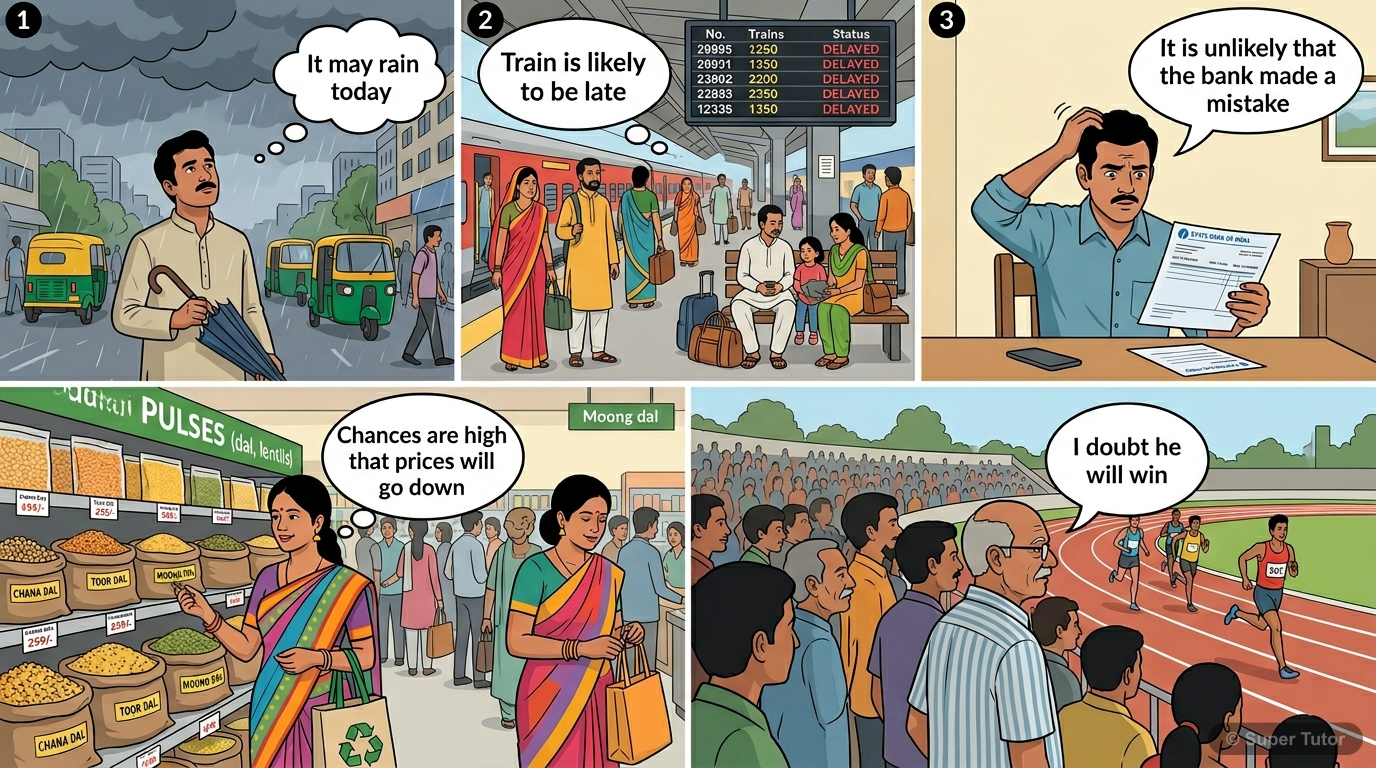
Super Tutor has 7+ illustrations like this for Introduction To Probability alone — flashcards, concept maps, and step-by-step visuals.
See them allOverview
Probability is a branch of mathematics that deals with uncertainty and helps us predict the likelihood of events occurring. In daily life, we often use words like 'likely', 'unlikely', 'chances', or 'may' to express uncertainty about events. The theory of probability, which began in the 16th century
Key Concepts
An experiment that has more than
An experiment that has more than one possible outcome and whose exact result cannot be predicted in advance. Examples include tossing a coin (outcomes
An event is one or more
An event is one or more outcomes of a random experiment. For example, 'getting an even number' when throwing a die is an event consisting of outcomes
The probability of an event E
The probability of an event E is defined as P(E) = (Number of outcomes favorable to E)/(Number of all possible outcomes), assuming all outcomes are eq
Key properties include
Key properties include: (1) 0 ≤ P(E) ≤ 1 for any event E, (2) P(impossible event) = 0, (3) P(certain event) = 1, (4) Sum of probabilities of all eleme
For any event E
For any event E, its complement Ē (read as 'E bar') represents the event 'not E'. The fundamental relationship is P(E) + P(Ē) = 1. For example, if P(g
Learning Objectives
- Understand the meaning of random experiments and their outcomes
- Differentiate between outcomes and events in probability
- Define and calculate probability P(E) of an event E
- Determine P(Ē) when P(E) is given using complementary events
- Apply the fundamental property that 0 ≤ P(E) ≤ 1
Frequently Asked Questions
What are the important topics in Introduction To Probability for NIOS Class 10 Maths?
How to score full marks in Introduction To Probability — NIOS Class 10 Maths?
Sources & Official References
Content is aligned to the official syllabus. Refer to the board website for the latest curriculum.
More resources for Introduction To Probability
Important Questions
Practice with board exam-style questions
Syllabus
What topics to cover
Revision Notes
Key points for last-minute revision
Study Plan
Step-by-step plan to ace this chapter
Flashcards
Quick-fire cards for active recall
Formula Sheet
All formulas in one place
Practice Quiz
Test yourself with a quick quiz
Concept Maps
See how topics connect visually
For serious students
Get the full Introduction To Probability chapter — for free.
Quizzes, flashcards, AI doubt-solver and a step-by-step study plan for NIOS Class 10 Maths.