Measures Of Central Tendency
NIOS · Class 10 · Maths
Summary of Measures Of Central Tendency for NIOS Class 10 Maths. Key concepts, important points, and chapter overview.
Interactive on Super Tutor
Studying Measures Of Central Tendency? Get the full interactive chapter.
Quizzes, flashcards, AI doubt-solver and a step-by-step study plan — built for chapter summary and more.
1,000+ Class 10 students started this chapter today
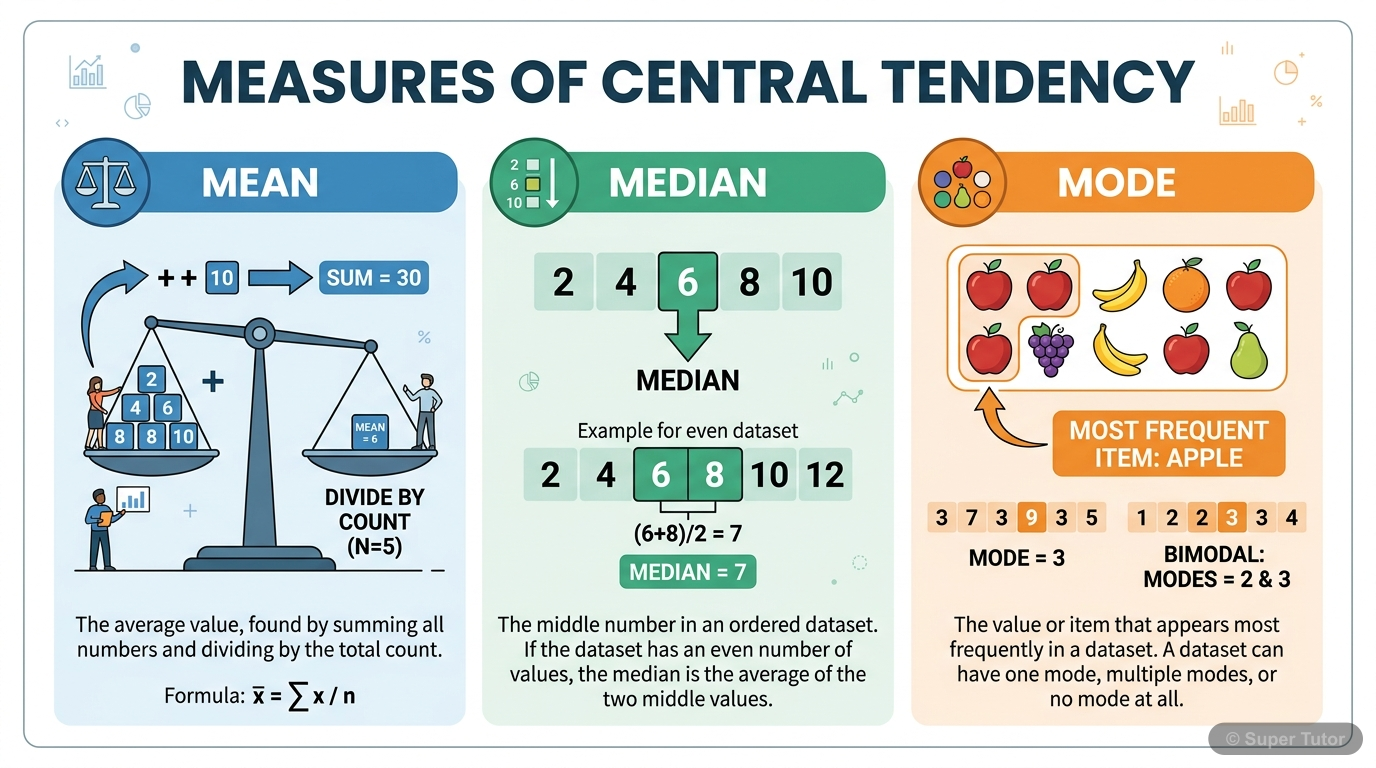
Super Tutor has 9+ illustrations like this for Measures Of Central Tendency alone — flashcards, concept maps, and step-by-step visuals.
See them allOverview
Measures of central tendency are statistical values that represent the center or typical value of a dataset. In this chapter, we explore three fundamental measures: Mean (arithmetic average), Median (middle value), and Mode (most frequent value). These measures help us summarize large datasets with
Key Concepts
The mean is calculated by adding
The mean is calculated by adding all values and dividing by the total number of observations. For raw data: Mean = (Sum of all observations) / (Number
The median is the middle value
The median is the middle value when data is arranged in ascending or descending order. For odd number of observations: Median = ((n+1)/2)th term. For
The mode is the value
The mode is the value that appears most frequently in a dataset. A dataset can have no mode (all values occur equally), one mode (unimodal), or multip
The straightforward approach where mean
The straightforward approach where mean is calculated as the sum of all (frequency × value) divided by total frequency. Formula: x̄ = (Σfi×xi) / (Σfi)
A shortcut method used when dealing
A shortcut method used when dealing with large numbers. Choose an assumed mean 'a', calculate deviations (di = xi - a), then apply: x̄ = a + (Σfi×di)
Learning Objectives
- Calculate the arithmetic mean for raw data, ungrouped data, and grouped data using different methods
- Find the median of datasets arranged in ascending or descending order
- Identify the mode as the most frequently occurring value in a dataset
- Apply step-by-step problem-solving techniques for each measure of central tendency
- Choose appropriate methods (direct, assumed mean, step deviation) based on data type
Frequently Asked Questions
What are the important topics in Measures Of Central Tendency for NIOS Class 10 Maths?
How to score full marks in Measures Of Central Tendency — NIOS Class 10 Maths?
Sources & Official References
Content is aligned to the official syllabus. Refer to the board website for the latest curriculum.
More resources for Measures Of Central Tendency
Important Questions
Practice with board exam-style questions
Syllabus
What topics to cover
Revision Notes
Key points for last-minute revision
Study Plan
Step-by-step plan to ace this chapter
Flashcards
Quick-fire cards for active recall
Formula Sheet
All formulas in one place
Practice Quiz
Test yourself with a quick quiz
Concept Maps
See how topics connect visually
For serious students
Get the full Measures Of Central Tendency chapter — for free.
Quizzes, flashcards, AI doubt-solver and a step-by-step study plan for NIOS Class 10 Maths.