Data And Their Representations
NIOS · Class 10 · Maths
Summary of Data And Their Representations for NIOS Class 10 Maths. Key concepts, important points, and chapter overview.
Interactive on Super Tutor
Studying Data And Their Representations? Get the full interactive chapter.
Quizzes, flashcards, AI doubt-solver and a step-by-step study plan — built for chapter summary and more.
1,000+ Class 10 students started this chapter today
This is just one of 11+ visuals inside Super Tutor's Data And Their Representations chapter
Explore the full setOverview
Statistics is a powerful branch of mathematics that helps us collect, organize, analyze, and interpret numerical data to make meaningful conclusions. In our daily lives, we encounter data everywhere - exam scores, weather reports, population figures, and sports statistics. This chapter introduces yo
Key Concepts
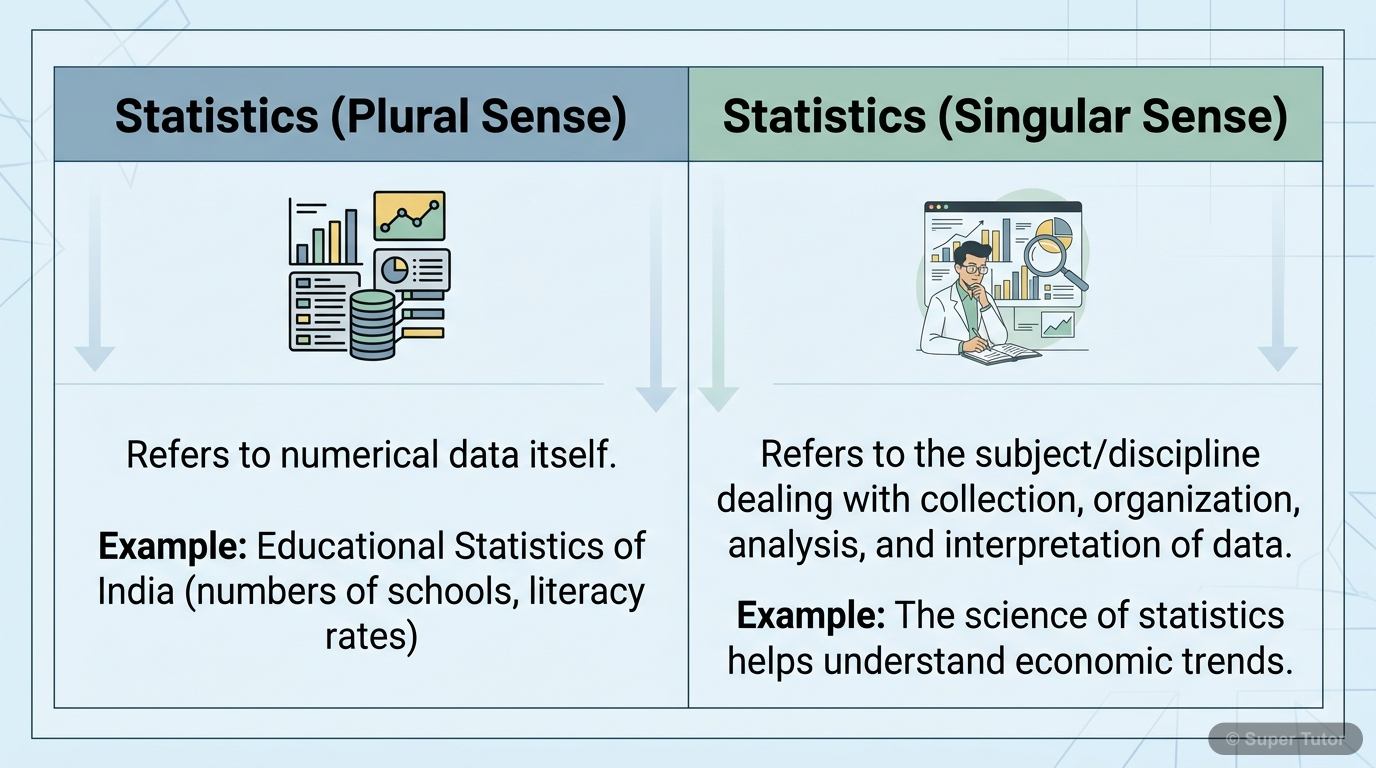
Statistics has two distinct meanings
Statistics has two distinct meanings: (1) Plural sense - refers to numerical data itself (like 'Educational Statistics of India'), and (2) Singular se
Primary data is collected directly by
Primary data is collected directly by the investigator for their specific purpose (like conducting a survey), while secondary data is obtained from ex
These tables organize data by showing
These tables organize data by showing how often each value appears. For ungrouped data, we list each distinct value with its frequency. For grouped da
A class interval like 20
A class interval like 20-30 has: lower limit (20), upper limit (30), class width (10), and class mark (25). For continuous data, we convert to true cl
Cumulative frequency of a class equals
Cumulative frequency of a class equals the frequency of that class plus all frequencies of preceding classes. It shows how many observations fall belo
Learning Objectives
- Understand the meaning and importance of statistics in both singular and plural forms
- Differentiate between primary and secondary data with practical examples
- Master the concepts of class intervals, class limits, class marks, and frequency distributions
- Convert raw data into organized frequency tables for both ungrouped and grouped data
- Create cumulative frequency distributions and understand their applications
Frequently Asked Questions
What are the important topics in Data And Their Representations for NIOS Class 10 Maths?
How to score full marks in Data And Their Representations — NIOS Class 10 Maths?
Sources & Official References
Content is aligned to the official syllabus. Refer to the board website for the latest curriculum.
More resources for Data And Their Representations
Important Questions
Practice with board exam-style questions
Syllabus
What topics to cover
Revision Notes
Key points for last-minute revision
Study Plan
Step-by-step plan to ace this chapter
Flashcards
Quick-fire cards for active recall
Formula Sheet
All formulas in one place
Practice Quiz
Test yourself with a quick quiz
Concept Maps
See how topics connect visually
For serious students
Get the full Data And Their Representations chapter — for free.
Quizzes, flashcards, AI doubt-solver and a step-by-step study plan for NIOS Class 10 Maths.