Surface Areas And Volumes Of Solid Figures
NIOS · Class 10 · Maths
Summary of Surface Areas And Volumes Of Solid Figures for NIOS Class 10 Maths. Key concepts, important points, and chapter overview.
Interactive on Super Tutor
Studying Surface Areas And Volumes Of Solid Figures? Get the full interactive chapter.
Quizzes, flashcards, AI doubt-solver and a step-by-step study plan — built for chapter summary and more.
1,000+ Class 10 students started this chapter today
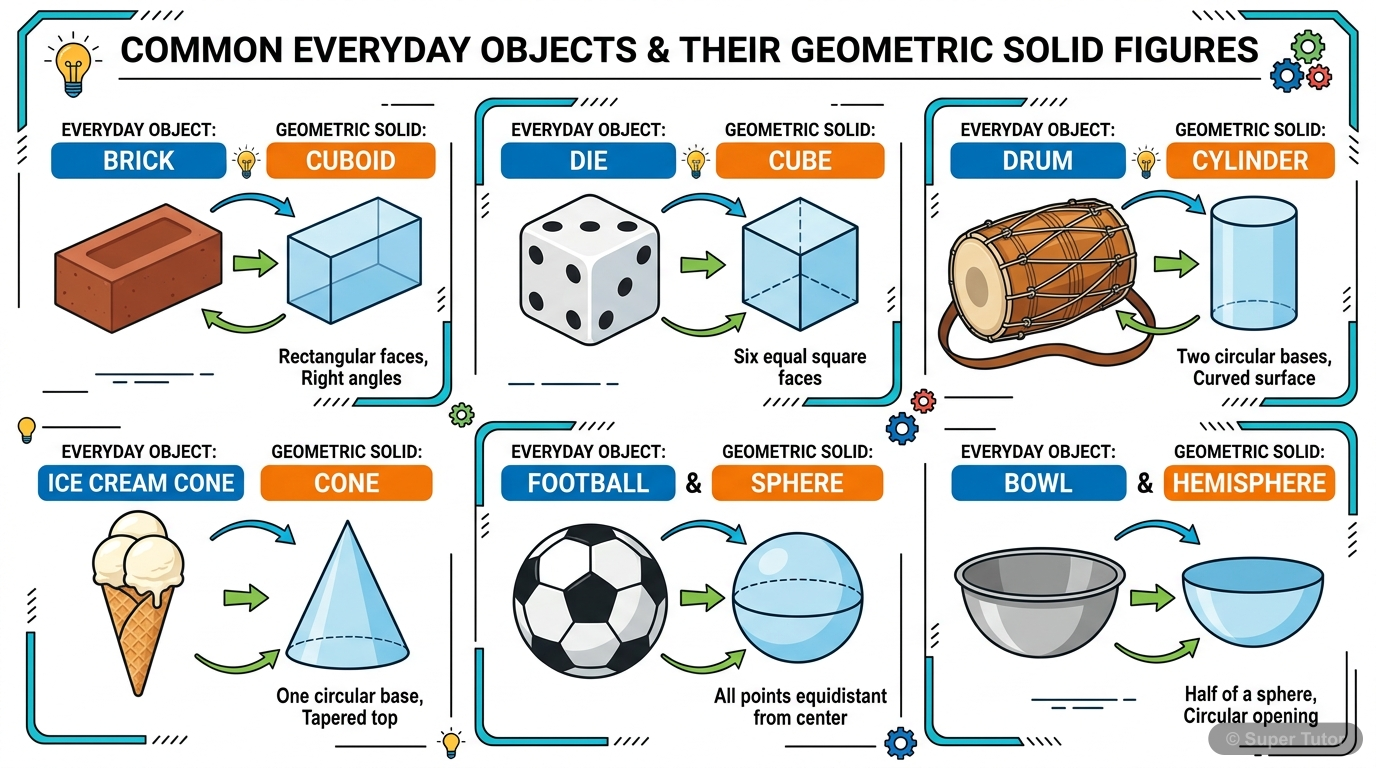
Super Tutor has 10+ illustrations like this for Surface Areas And Volumes Of Solid Figures alone — flashcards, concept maps, and step-by-step visuals.
See them allOverview
This chapter focuses on understanding and calculating surface areas and volumes of three-dimensional solid figures that we encounter in daily life. Unlike plane figures which have only length and breadth, solid figures have three dimensions - length, breadth, and height. We study six main solid figu
Key Concepts
Surface area is the total area
Surface area is the total area of all faces or surfaces of a solid figure, measured in square units. Volume is the amount of space occupied by a solid
For a cuboid with length l
For a cuboid with length l, breadth b, and height h: Surface Area = 2(lb + bh + hl), Volume = lbh, Diagonal = √(l² + b² + h²). Special case: Area of f
For a cube with edge length
For a cube with edge length a: Surface Area = 6a², Volume = a³, Diagonal = a√3. A cube is a special cuboid where all edges are equal.
For a cylinder with radius r
For a cylinder with radius r and height h: Curved Surface Area = 2πrh, Total Surface Area = 2πr(r + h), Volume = πr²h. CSA covers only the curved surf
For a cone with radius r
For a cone with radius r, height h, and slant height l: l = √(r² + h²), Curved Surface Area = πrl, Total Surface Area = πr(l + r), Volume = (1/3)πr²h.
Learning Objectives
- Understand the difference between surface area and volume of solid figures
- Calculate surface area and volume of cuboids and cubes using appropriate formulas
- Apply formulas to find surface area and volume of right circular cylinders
- Solve problems involving surface area and volume of right circular cones
- Calculate surface area and volume of spheres and hemispheres
Frequently Asked Questions
What are the important topics in Surface Areas And Volumes Of Solid Figures for NIOS Class 10 Maths?
How to score full marks in Surface Areas And Volumes Of Solid Figures — NIOS Class 10 Maths?
Sources & Official References
Content is aligned to the official syllabus. Refer to the board website for the latest curriculum.
More resources for Surface Areas And Volumes Of Solid Figures
Important Questions
Practice with board exam-style questions
Syllabus
What topics to cover
Revision Notes
Key points for last-minute revision
Study Plan
Step-by-step plan to ace this chapter
Flashcards
Quick-fire cards for active recall
Formula Sheet
All formulas in one place
Practice Quiz
Test yourself with a quick quiz
Concept Maps
See how topics connect visually
For serious students
Get the full Surface Areas And Volumes Of Solid Figures chapter — for free.
Quizzes, flashcards, AI doubt-solver and a step-by-step study plan for NIOS Class 10 Maths.