Introduction To Trigonometry
NIOS · Class 10 · Maths
Summary of Introduction To Trigonometry for NIOS Class 10 Maths. Key concepts, important points, and chapter overview.
Interactive on Super Tutor
Studying Introduction To Trigonometry? Get the full interactive chapter.
Quizzes, flashcards, AI doubt-solver and a step-by-step study plan — built for chapter summary and more.
1,000+ Class 10 students started this chapter today
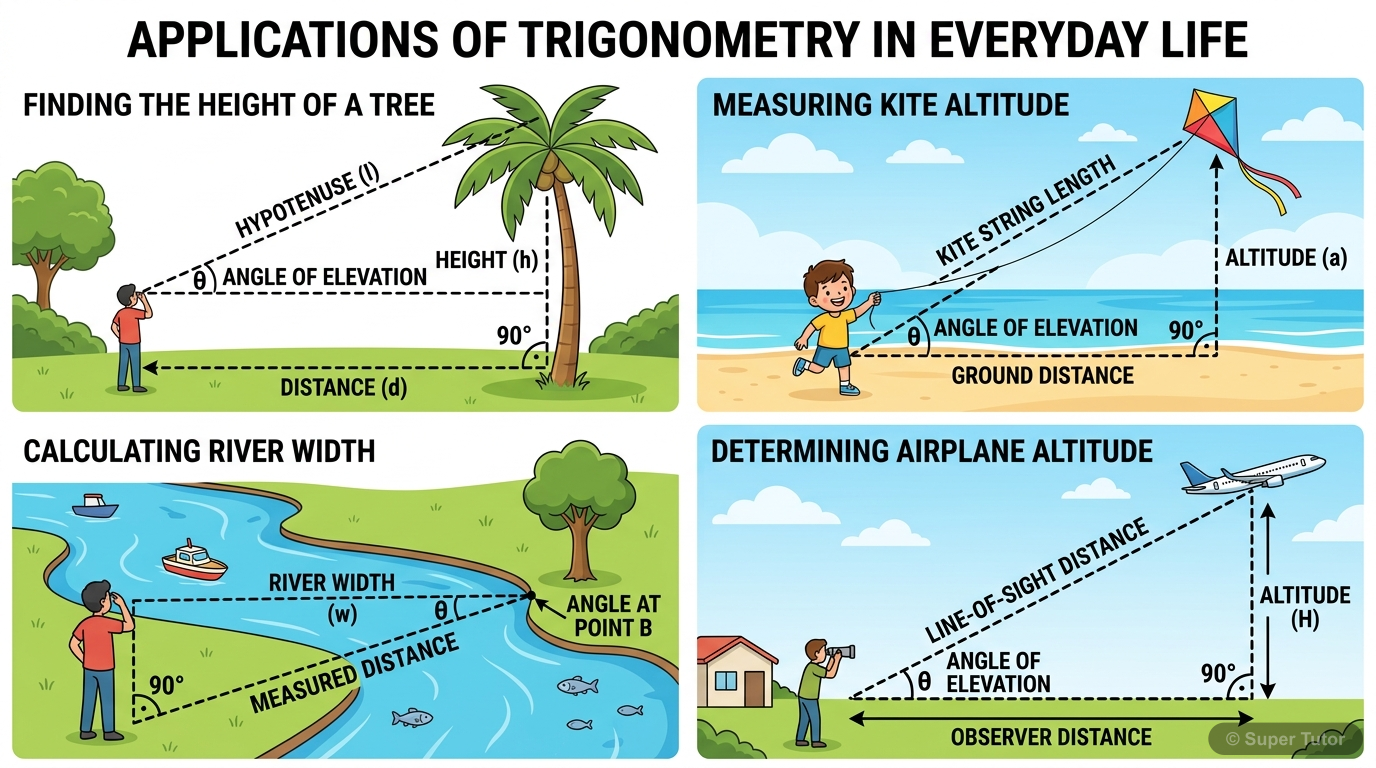
This is just one of 8+ visuals inside Super Tutor's Introduction To Trigonometry chapter
Explore the full setOverview
Trigonometry, derived from Greek words meaning 'triangle measurement', is a fundamental branch of mathematics that deals with relationships between sides and angles in triangles. This chapter introduces the six trigonometric ratios (sine, cosine, tangent, cosecant, secant, cotangent) for acute angle
Key Concepts
For an acute angle θ
For an acute angle θ in a right triangle: sin θ = opposite/hypotenuse, cos θ = adjacent/hypotenuse, tan θ = opposite/adjacent, cosec θ = hypotenuse/op
sin θ and cosec θ
sin θ and cosec θ are reciprocals (sin θ × cosec θ = 1), cos θ and sec θ are reciprocals (cos θ × sec θ = 1), tan θ and cot θ are reciprocals (tan θ ×
Three basic identities
Three basic identities: (1) sin²θ + cos²θ = 1, (2) sec²θ - tan²θ = 1, (3) cosec²θ - cot²θ = 1. These are derived from Pythagoras theorem and remain tr
If A + B = 90°
If A + B = 90°, then sin A = cos B, cos A = sin B, tan A = cot B, cot A = tan B, sec A = cosec B, cosec A = sec B. This means sin(90° - θ) = cos θ, co
Method 1
Method 1: When two sides given, use Pythagoras theorem to find third side, then calculate ratios. Method 2: When one ratio given, assume proportional
Learning Objectives
- Define and calculate the six trigonometric ratios for acute angles in right triangles
- Understand that trigonometric ratios depend only on the angle, not the triangle size
- Find trigonometric ratios when two sides of a right triangle are given
- Determine all trigonometric ratios when one ratio is known
- Apply fundamental trigonometric identities to solve problems
Frequently Asked Questions
What are the important topics in Introduction To Trigonometry for NIOS Class 10 Maths?
How to score full marks in Introduction To Trigonometry — NIOS Class 10 Maths?
Sources & Official References
Content is aligned to the official syllabus. Refer to the board website for the latest curriculum.
More resources for Introduction To Trigonometry
Important Questions
Practice with board exam-style questions
Syllabus
What topics to cover
Revision Notes
Key points for last-minute revision
Study Plan
Step-by-step plan to ace this chapter
Flashcards
Quick-fire cards for active recall
Formula Sheet
All formulas in one place
Practice Quiz
Test yourself with a quick quiz
Concept Maps
See how topics connect visually
For serious students
Get the full Introduction To Trigonometry chapter — for free.
Quizzes, flashcards, AI doubt-solver and a step-by-step study plan for NIOS Class 10 Maths.