Quadrilaterals
NIOS · Class 10 · Maths
Flashcards for Quadrilaterals — NIOS Class 10 Maths. Quick Q&A cards covering key concepts, definitions, and formulas.
Interactive on Super Tutor
Studying Quadrilaterals? Get the full interactive chapter.
Quizzes, flashcards, AI doubt-solver and a step-by-step study plan — built for flashcards and more.
1,000+ Class 10 students started this chapter today
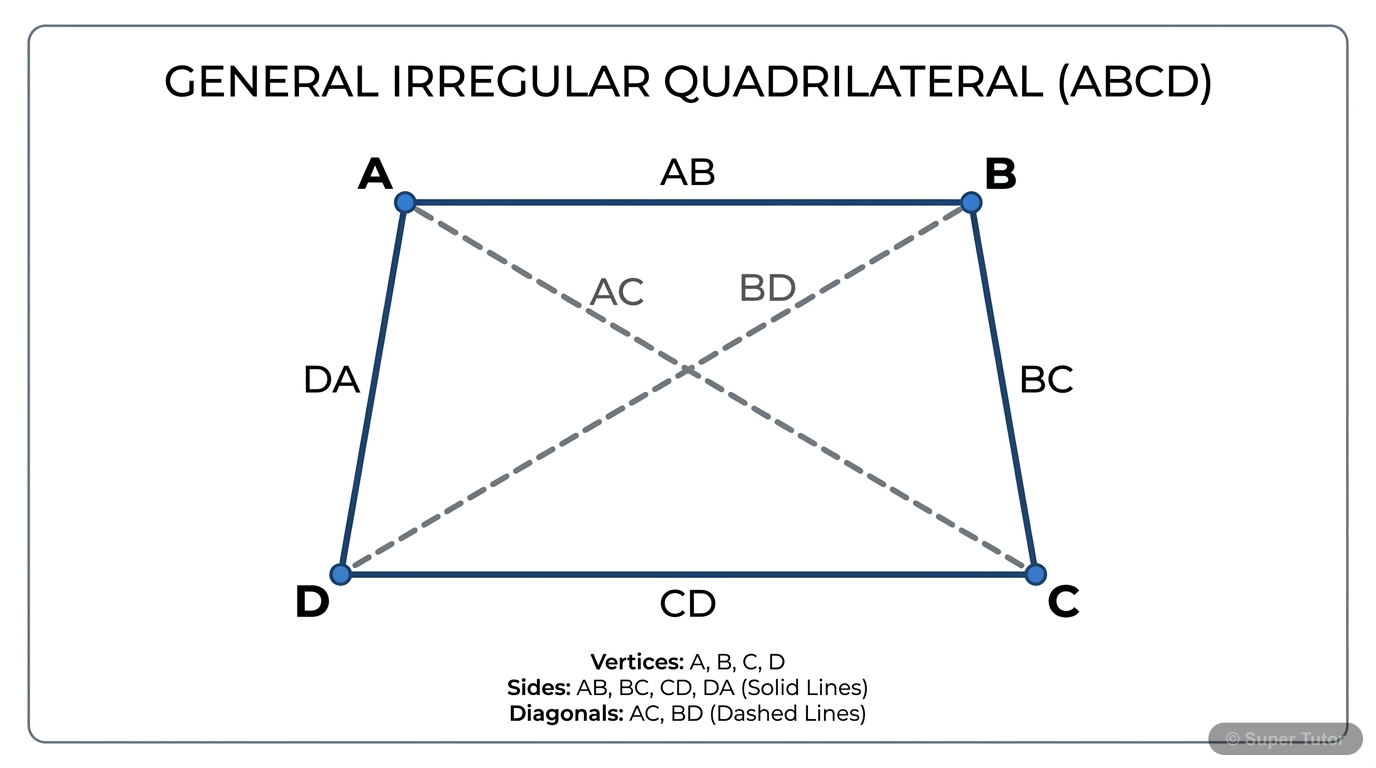
Learn better with visuals Super Tutor has hundreds of illustrations like this across every chapter — all free to try.
Get startedFind the fourth angle of a quadrilateral if three angles are 85°, 95°, and 70°.
Answer
Step 1: Use angle sum property - sum of all angles in quadrilateral = 360° Step 2: Let fourth angle = x Step 3: 85° + 95° + 70° + x = 360° Step 4: 250° + x = 360° Step 5: x = 360° - 250° = 110° Answer…
In parallelogram ABCD, if ∠A = 75°, find all other angles.
Answer
Step 1: In parallelogram, opposite angles are equal So ∠A = ∠C = 75° Step 2: Adjacent angles are supplementary (sum = 180°) ∠A + ∠B = 180° 75° + ∠B = 180° ∠B = 105° Step 3: ∠B = ∠D = 105° (opposite an…
Two adjacent angles of a rhombus are in ratio 2:3. Find all angles of the rhombus.
Answer
Step 1: Let adjacent angles be 2x and 3x Step 2: Adjacent angles in rhombus are supplementary 2x + 3x = 180° 5x = 180° x = 36° Step 3: The two adjacent angles are: 2x = 72° and 3x = 108° Step 4: Oppos…
When do you use the Mid-Point Theorem? Give the formula and solve: In triangle ABC, D and E are midpoints of AB and AC. If BC = 12 cm, find DE.
Answer
Use when: Line segment joins midpoints of two sides of a triangle Theorem: DE = ½BC and DE || BC Solution: Step 1: Given BC = 12 cm Step 2: D and E are midpoints of AB and AC Step 3: Apply mid-point t…
In rectangle PQRS, diagonal PR = 13 cm and PQ = 5 cm. Find the perimeter.
Answer
Step 1: In rectangle, opposite sides equal and all angles 90° Step 2: Use Pythagoras theorem in right triangle PQR PR² = PQ² + QR² 13² = 5² + QR² 169 = 25 + QR² QR² = 144 QR = 12 cm Step 3: PQ = RS = …
Find the area of parallelogram ABCD if base AB = 8 cm and corresponding height = 6 cm. If another side AD = 5 cm, find the height corresponding to AD.
Answer
Step 1: Area of parallelogram = base × height Area = AB × h₁ = 8 × 6 = 48 cm² Step 2: For same parallelogram with different base: Area = AD × h₂ 48 = 5 × h₂ h₂ = 48/5 = 9.6 cm Step 3: Verify: Both giv…
Prove that diagonals of a rhombus bisect each other at right angles. If one diagonal = 16 cm and other = 12 cm, find the side length.
Answer
Proof: Rhombus is parallelogram → diagonals bisect each other. All sides equal → diagonals perpendicular. Problem Solution: Step 1: Diagonals AC = 16 cm, BD = 12 cm Step 2: They bisect at O, so AO = 8…
In square ABCD, if diagonal AC = 10√2 cm, find the side length and area.
Answer
Step 1: In square, diagonal = side × √2 Let side = a Diagonal = a√2 = 10√2 Step 2: Solve for side length: a√2 = 10√2 a = 10 cm Step 3: Area of square = side² Area = 10² = 100 cm² Step 4: Verify using …
+12 more flashcards available
Practice AllFrequently Asked Questions
What are the important topics in Quadrilaterals for NIOS Class 10 Maths?
How to score full marks in Quadrilaterals — NIOS Class 10 Maths?
How many flashcards are available for Quadrilaterals?
Sources & Official References
Content is aligned to the official syllabus. Refer to the board website for the latest curriculum.
More resources for Quadrilaterals
Important Questions
Practice with board exam-style questions
Syllabus
What topics to cover
Revision Notes
Key points for last-minute revision
Study Plan
Step-by-step plan to ace this chapter
Formula Sheet
All formulas in one place
Chapter Summary
Understand the chapter at a glance
Practice Quiz
Test yourself with a quick quiz
Concept Maps
See how topics connect visually
For serious students
Get the full Quadrilaterals chapter — for free.
Quizzes, flashcards, AI doubt-solver and a step-by-step study plan for NIOS Class 10 Maths.