Lines And Angles
NIOS · Class 10 · Maths
Step-by-step guide to study Lines And Angles in NIOS Class 10 Maths. Topics to cover, practice strategy, and time allocation.
Interactive on Super Tutor
Studying Lines And Angles? Get the full interactive chapter.
Quizzes, flashcards, AI doubt-solver and a step-by-step study plan — built for study plan and more.
1,000+ Class 10 students started this chapter today
Learn better with visuals Super Tutor has hundreds of illustrations like this across every chapter — all free to try.
Get startedStudy Plan
Learn the Theory
Read the textbook chapter carefully. Note down definitions, formulas, and key concepts.
Practice Problems
Solve textbook exercises and additional practice questions. There are 45 questions available for this chapter.
Revise & Test
Revise key formulas and concepts without looking at notes. Take a practice quiz to test your understanding. Mark weak areas for re-revision.
Spaced Revision
Revisit Lines And Angles after a week. Use flashcards for quick recall. Solve previous year questions from this chapter.
What to Focus On
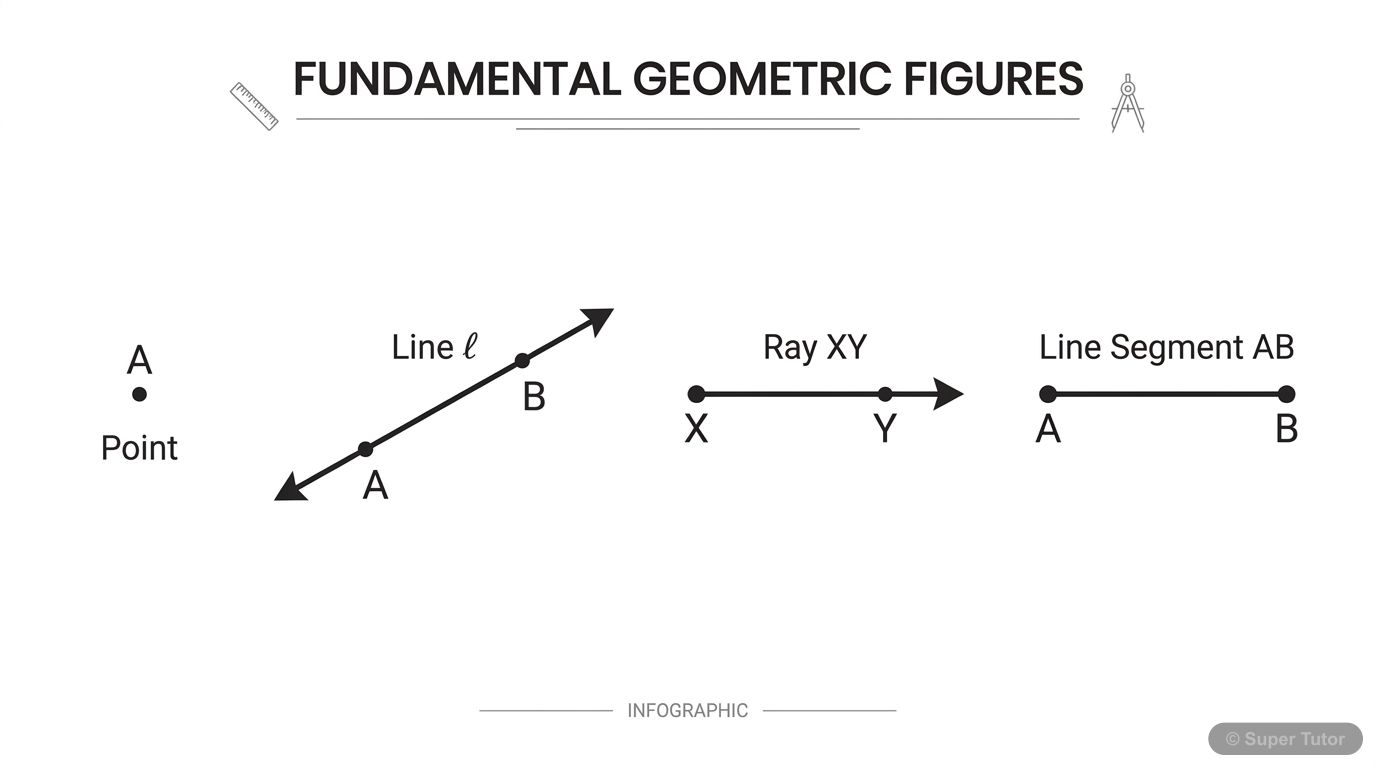
- Point: Shows location, represented by capital letters (A, B, C)
- Line: Extends infinitely in both directions, named as AB or with small letters (l, m)
- Line Segment: Part of line between two points, shortest path between them
- Acute Angle: Less than 90°
- Right Angle: Exactly 90°
- Obtuse Angle: Greater than 90° but less than 180°
- Adjacent Angles: Share common vertex and side, no overlap
- Complementary Angles: Sum equals 90°
- Supplementary Angles: Sum equals 180°
Common Mistakes to Avoid
Vertically opposite angles are any two angles that look opposite to each other in a diagram
The sum of angles in a triangle is always exactly 180°, so if two angles are given, the third angle can be found by simple subtraction without considering the triangle's validity
When a transversal cuts two lines, all corresponding angles are equal and all alternate angles are equal, regardless of whether the lines are parallel
Memory Tips
Complementary Angles sum to 90°
Supplementary Angles sum to 180°
Sum of angles in triangle equals 180°
Vertically Opposite Angles are equal
Want a personalised study plan?
Super Tutor creates a day-by-day plan for NIOS Class 10 Maths that adapts to your exam date and pace.
Create My Study Plan — FreeFrequently Asked Questions
What are the important topics in Lines And Angles for NIOS Class 10 Maths?
How to score full marks in Lines And Angles — NIOS Class 10 Maths?
Sources & Official References
Content is aligned to the official syllabus. Refer to the board website for the latest curriculum.
More resources for Lines And Angles
Important Questions
Practice with board exam-style questions
Syllabus
What topics to cover
Revision Notes
Key points for last-minute revision
Flashcards
Quick-fire cards for active recall
Formula Sheet
All formulas in one place
Chapter Summary
Understand the chapter at a glance
Practice Quiz
Test yourself with a quick quiz
Concept Maps
See how topics connect visually
For serious students
Get the full Lines And Angles chapter — for free.
Quizzes, flashcards, AI doubt-solver and a step-by-step study plan for NIOS Class 10 Maths.