Electrical Energy
NIOS · Class 10 · Science & Tech
Flashcards for Electrical Energy — NIOS Class 10 Science & Tech. Quick Q&A cards covering key concepts, definitions, and formulas.
Interactive on Super Tutor
Studying Electrical Energy? Get the full interactive chapter.
Quizzes, flashcards, AI doubt-solver and a step-by-step study plan — built for flashcards and more.
1,000+ Class 10 students started this chapter today
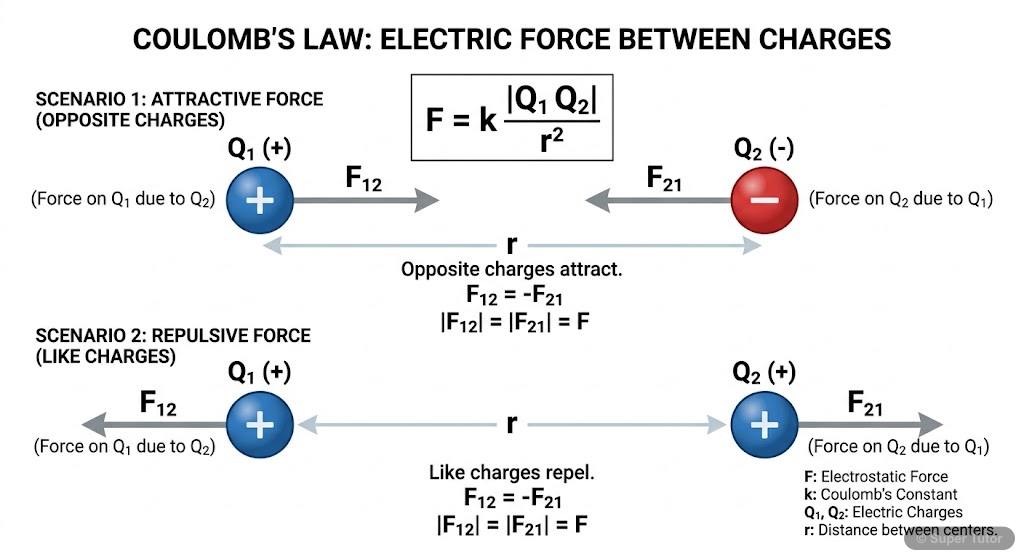
Super Tutor has 18+ illustrations like this for Electrical Energy alone — flashcards, concept maps, and step-by-step visuals.
See them allA plastic comb attracts small pieces of paper after rubbing through dry hair but not before. Why does this happen?
Answer
Rubbing the comb with dry hair creates static electricity through friction. Electrons transfer from hair to comb, making the comb negatively charged. This charge creates an electric field that attract…
Calculate the force between two point charges of +2μC and -3μC separated by 10cm in air.
Answer
Given: q₁ = +2×10⁻⁶ C, q₂ = -3×10⁻⁶ C, r = 0.1 m, k = 9×10⁹ Nm²C⁻² Using Coulomb's law: F = kq₁q₂/r² F = (9×10⁹ × 2×10⁻⁶ × 3×10⁻⁶)/(0.1)² F = 54×10⁻³/0.01 = 5.4 N Since charges are opposite, force is …
What is electric potential? How is it different from potential difference?
Answer
Electric potential at a point is the work done in bringing a unit positive charge from infinity to that point. It's measured in volts (V). Potential difference is the difference in potential between t…
How much work is done in moving 5C of charge across a potential difference of 12V?
Answer
Given: Charge (Q) = 5C, Potential difference (V) = 12V Work done (W) = V × Q W = 12V × 5C = 60J This energy is either supplied to move positive charge to higher potential or released when moving to lo…
Why do we get an electric shock when touching a metal door knob after walking on a carpet?
Answer
Walking on carpet creates static electricity due to friction between shoe soles and carpet fibers. Charges accumulate on our body (several thousand volts). When touching the grounded metal knob, rapid…
Define electric current and state its SI unit. How many electrons make 1 coulomb?
Answer
Electric current is the amount of charge flowing through any cross-section of a conductor per unit time. I = Q/t SI unit: Ampere (A) = 1 Coulomb/second Electrons in 1C: n = 1C ÷ (1.6×10⁻¹⁹C) = 6.25×10…
A bulb carries 0.5A current for 20 minutes. Calculate the charge that flows through the bulb.
Answer
Given: Current (I) = 0.5A, Time (t) = 20 min = 1200s Using Q = I × t Q = 0.5A × 1200s = 600C This means 600 coulombs of charge flowed through the bulb filament in 20 minutes, causing it to glow and pr…
State Ohm's law and explain why it cannot be applied when temperature changes.
Answer
Ohm's Law: Current through a conductor is directly proportional to potential difference across its ends, provided physical conditions remain constant. V = IR When temperature increases, atoms vibrate …
+12 more flashcards available
Practice AllFrequently Asked Questions
What are the important topics in Electrical Energy for NIOS Class 10 Science & Tech?
How to score full marks in Electrical Energy — NIOS Class 10 Science & Tech?
How many flashcards are available for Electrical Energy?
Sources & Official References
Content is aligned to the official syllabus. Refer to the board website for the latest curriculum.
More resources for Electrical Energy
Important Questions
Practice with board exam-style questions
Syllabus
What topics to cover
Revision Notes
Key points for last-minute revision
Study Plan
Step-by-step plan to ace this chapter
Formula Sheet
All formulas in one place
Chapter Summary
Understand the chapter at a glance
Practice Quiz
Test yourself with a quick quiz
Concept Maps
See how topics connect visually
For serious students
Get the full Electrical Energy chapter — for free.
Quizzes, flashcards, AI doubt-solver and a step-by-step study plan for NIOS Class 10 Science & Tech.