Force and Motion
NIOS · Class 10 · Science & Tech
Flashcards for Force and Motion — NIOS Class 10 Science & Tech. Quick Q&A cards covering key concepts, definitions, and formulas.
Interactive on Super Tutor
Studying Force and Motion? Get the full interactive chapter.
Quizzes, flashcards, AI doubt-solver and a step-by-step study plan — built for flashcards and more.
1,000+ Class 10 students started this chapter today
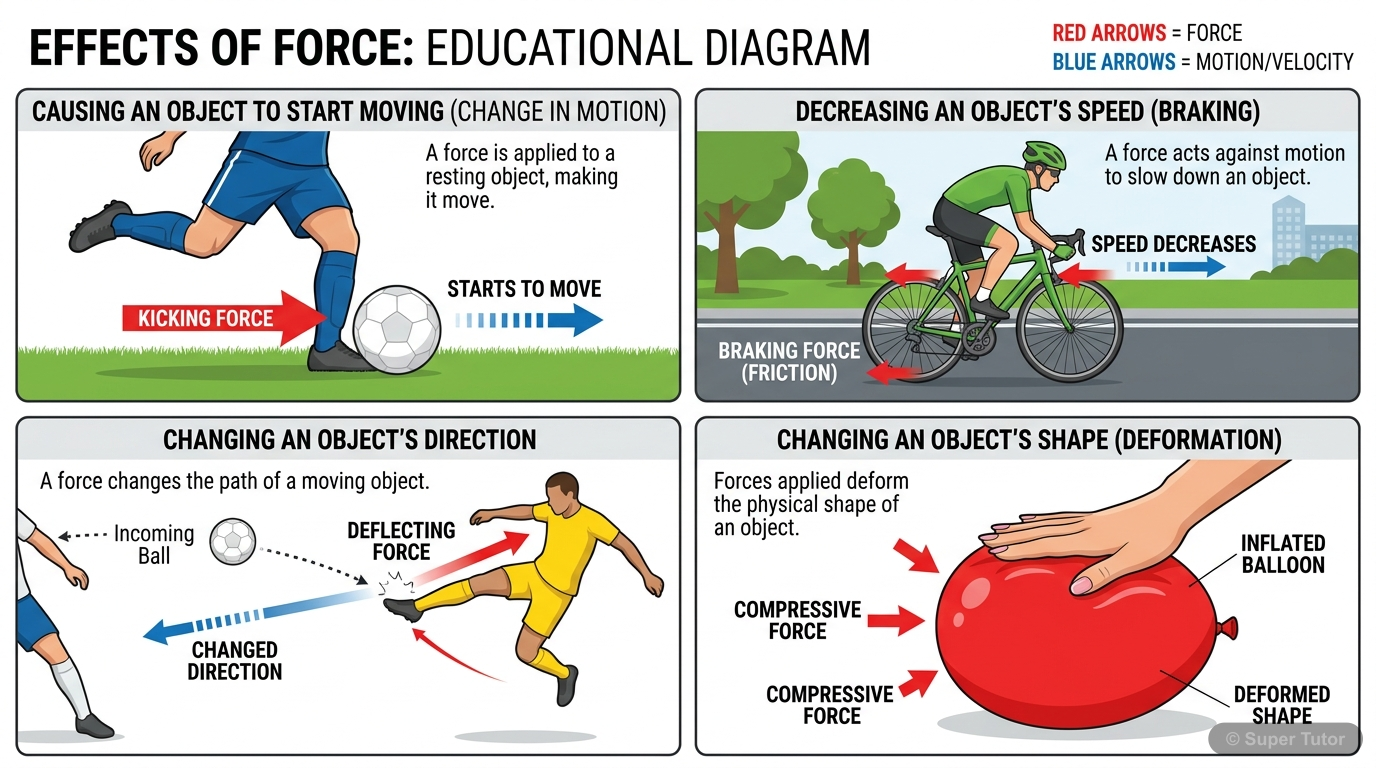
Super Tutor has 23+ illustrations like this for Force and Motion alone — flashcards, concept maps, and step-by-step visuals.
See them allWhat is force and what are its four main effects on objects?
Answer
Force is a push or pull acting on an object. Its four main effects are: 1) Make an object move from rest, 2) Change the speed of a moving object, 3) Change the direction of motion, 4) Change the shape…
A cricket player catches a fast ball by moving his hands backward. Calculate the advantage if the ball's momentum changes from 2 kg⋅m/s to 0 in 0.5 seconds instead of 0.1 seconds.
Answer
Using F = Δp/Δt: Case 1 (0.1s): F = 2/0.1 = 20 N. Case 2 (0.5s): F = 2/0.5 = 4 N. By increasing time by 5 times, the force reduces by 5 times (from 20 N to 4 N), preventing injury to hands.
Why do passengers fall backward when a bus starts suddenly?
Answer
Due to Newton's First Law (inertia). When the bus starts, passengers' feet move with the bus, but their upper body tends to remain at rest due to inertia of rest. This creates a backward falling motio…
What is momentum and how is it calculated? Give a practical example.
Answer
Momentum (p) = mass × velocity = m × v. SI unit: kg⋅m/s. Example: A truck (2000 kg) at 20 m/s has momentum = 2000 × 20 = 40,000 kg⋅m/s. This is why moving trucks are more dangerous than stationary one…
A rifle of mass 4 kg fires a bullet of mass 0.05 kg at velocity 300 m/s. Calculate the recoil velocity of the rifle.
Answer
Using conservation of momentum: Initial momentum = 0. Final momentum: 4 × v₁ + 0.05 × 300 = 0. Therefore: 4v₁ = -15, v₁ = -3.75 m/s. The rifle recoils at 3.75 m/s in the opposite direction to the bull…
What is the difference between balanced and unbalanced forces? Give examples.
Answer
Balanced forces: Equal and opposite forces that don't change motion but can change shape. Example: Pressing a balloon. Unbalanced forces: Unequal forces that change the state of rest or motion. Exampl…
How does a rocket work in space where there is no air to push against?
Answer
Rockets work on Newton's Third Law (action-reaction). Hot gases are expelled downward (action), creating an upward thrust on the rocket (reaction). No external medium is needed - the reaction comes fr…
A force of 25 N acts on an object of mass 5 kg. Calculate the acceleration produced.
Answer
Using Newton's Second Law: F = ma. Given: F = 25 N, m = 5 kg. Therefore: a = F/m = 25/5 = 5 m/s². The object accelerates at 5 meters per second squared in the direction of the applied force.
+12 more flashcards available
Practice AllFrequently Asked Questions
What are the important topics in Force and Motion for NIOS Class 10 Science & Tech?
How to score full marks in Force and Motion — NIOS Class 10 Science & Tech?
How many flashcards are available for Force and Motion?
Sources & Official References
Content is aligned to the official syllabus. Refer to the board website for the latest curriculum.
More resources for Force and Motion
Important Questions
Practice with board exam-style questions
Syllabus
What topics to cover
Revision Notes
Key points for last-minute revision
Study Plan
Step-by-step plan to ace this chapter
Formula Sheet
All formulas in one place
Chapter Summary
Understand the chapter at a glance
Practice Quiz
Test yourself with a quick quiz
Concept Maps
See how topics connect visually
For serious students
Get the full Force and Motion chapter — for free.
Quizzes, flashcards, AI doubt-solver and a step-by-step study plan for NIOS Class 10 Science & Tech.