Atomic Structure
NIOS · Class 10 · Science & Tech
Flashcards for Atomic Structure — NIOS Class 10 Science & Tech. Quick Q&A cards covering key concepts, definitions, and formulas.
Interactive on Super Tutor
Studying Atomic Structure? Get the full interactive chapter.
Quizzes, flashcards, AI doubt-solver and a step-by-step study plan — built for flashcards and more.
1,000+ Class 10 students started this chapter today
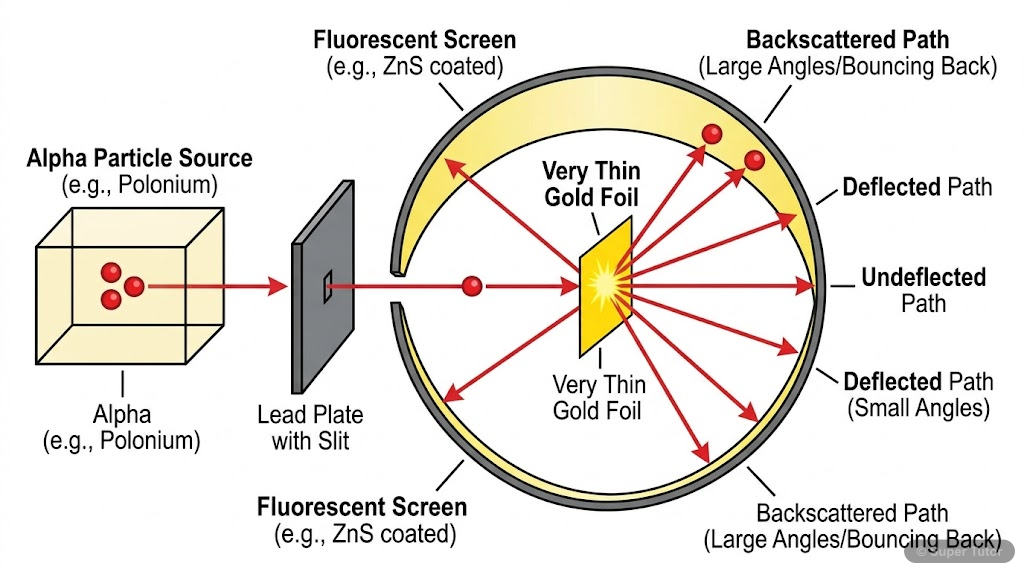
Learn better with visuals Super Tutor has hundreds of illustrations like this across every chapter — all free to try.
Get startedA helium atom has 2 protons and 2 neutrons. What is its mass number and atomic number?
Answer
Atomic number (Z) = 2 (number of protons) Mass number (A) = 4 (protons + neutrons = 2 + 2) Helium is represented as ⁴₂He. The atomic number determines the element's identity, while mass number gives t…
Why don't electrons fall into the nucleus despite being attracted to protons?
Answer
According to Bohr's model, electrons move in fixed energy levels called stationary orbits. In these orbits, electrons don't lose energy and remain stable. They can only jump between energy levels by a…
What happens when you pass electricity through a gas at very low pressure in a cathode ray tube?
Answer
Cathode rays are produced - a stream of negatively charged particles (electrons) traveling from cathode to anode. These rays: • Travel in straight lines • Are deflected by electric and magnetic fields…
Calculate the number of neutrons in ³⁵₁₇Cl (Chlorine-35).
Answer
Given: Mass number (A) = 35, Atomic number (Z) = 17 Number of neutrons = A - Z = 35 - 17 = 18 Chlorine-35 has: • 17 protons (atomic number) • 17 electrons (neutral atom) • 18 neutrons (calculated)…
Why did Thomson's 'plum pudding' model fail to explain Rutherford's gold foil experiment results?
Answer
Thomson's model predicted uniform distribution of positive charge, so alpha particles should pass through easily with minimal deflection. However, the experiment showed: • Most particles passed straig…
Write the electronic configuration of Sodium (Na, atomic number 11) and determine its valency.
Answer
Electronic configuration: 2, 8, 1 • K shell: 2 electrons (filled) • L shell: 8 electrons (filled) • M shell: 1 electron (valence electron) Valency = 1 (since Na has 1 valence electron, it tends to lo…
How do canal rays (anode rays) form in a discharge tube with perforated cathode?
Answer
Process: 1. Cathode emits electrons (cathode rays) 2. These electrons collide with gas atoms in the tube 3. Collision removes electrons from gas atoms, creating positive ions 4. Positive ions are attr…
What is a neutron and why was its discovery important?
Answer
Neutron: Electrically neutral particle in the atomic nucleus, discovered by James Chadwick in 1932. Importance: • Explained the mass-charge discrepancy (why helium is 4 times heavier than hydrogen, n…
+12 more flashcards available
Practice AllFrequently Asked Questions
What are the important topics in Atomic Structure for NIOS Class 10 Science & Tech?
How to score full marks in Atomic Structure — NIOS Class 10 Science & Tech?
How many flashcards are available for Atomic Structure?
Sources & Official References
Content is aligned to the official syllabus. Refer to the board website for the latest curriculum.
More resources for Atomic Structure
Important Questions
Practice with board exam-style questions
Syllabus
What topics to cover
Revision Notes
Key points for last-minute revision
Study Plan
Step-by-step plan to ace this chapter
Formula Sheet
All formulas in one place
Chapter Summary
Understand the chapter at a glance
Practice Quiz
Test yourself with a quick quiz
Concept Maps
See how topics connect visually
For serious students
Get the full Atomic Structure chapter — for free.
Quizzes, flashcards, AI doubt-solver and a step-by-step study plan for NIOS Class 10 Science & Tech.