Electrical Energy
NIOS · Class 10 · Science & Tech
Quick revision notes for Electrical Energy — NIOS Class 10 Science & Tech. Key concepts, formulas, and definitions for last-minute revision.
Interactive on Super Tutor
Studying Electrical Energy? Get the full interactive chapter.
Quizzes, flashcards, AI doubt-solver and a step-by-step study plan — built for revision notes and more.
1,000+ Class 10 students started this chapter today
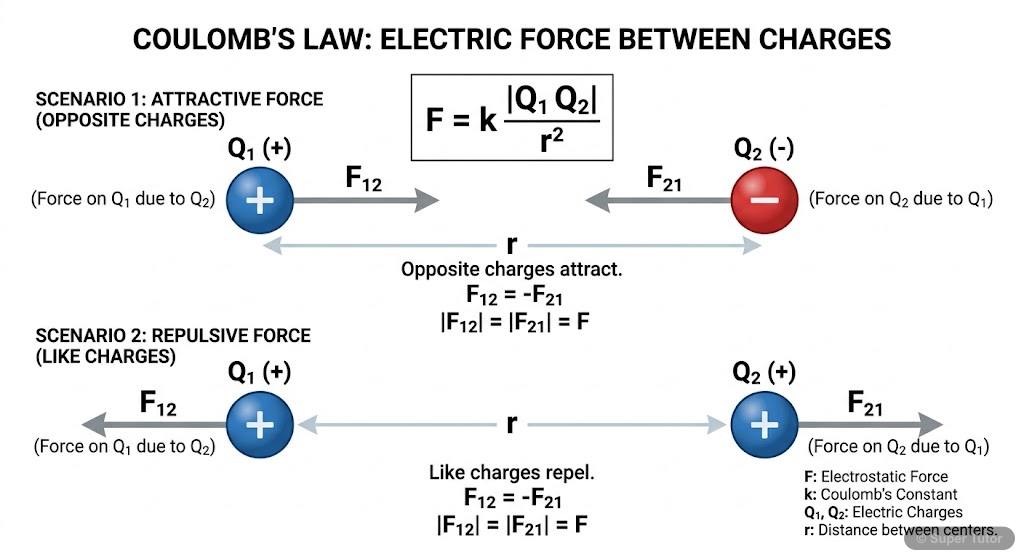
Super Tutor has 18+ illustrations like this for Electrical Energy alone — flashcards, concept maps, and step-by-step visuals.
See them allKey Topics to Revise
Electrostatics and Electric Charge
- Static electricity is produced when objects are rubbed together, causing transfer of electrons
- There are two types of charges: positive (like glass rubbed with silk) and negative (like plastic comb rubbed with hair)
- Like charges repel each other, unlike charges attract each other
Electric Potential and Potential Difference
- Electric potential is work done per unit charge to bring it from infinity to that point
- Potential difference is work done per unit charge to move it between two points
- Potential is a scalar quantity measured in volts (V)
Electric Current and Ohm's Law
- Electric current is rate of flow of charge through a cross-section
- Current flows from positive to negative terminal (conventional current)
- Electrons actually flow from negative to positive (electron flow)
Combination of Resistors
- Resistors can be combined in series or parallel arrangements
- In series: same current flows through all resistors
- In series: total voltage = sum of individual voltages
Get complete notes with diagrams and examples
Full NotesKey Concepts
Frequently Asked Questions
What are the important topics in Electrical Energy for NIOS Class 10 Science & Tech?
How to score full marks in Electrical Energy — NIOS Class 10 Science & Tech?
Sources & Official References
Content is aligned to the official syllabus. Refer to the board website for the latest curriculum.
More resources for Electrical Energy
Important Questions
Practice with board exam-style questions
Syllabus
What topics to cover
Study Plan
Step-by-step plan to ace this chapter
Flashcards
Quick-fire cards for active recall
Formula Sheet
All formulas in one place
Chapter Summary
Understand the chapter at a glance
Practice Quiz
Test yourself with a quick quiz
Concept Maps
See how topics connect visually
For serious students
Get the full Electrical Energy chapter — for free.
Quizzes, flashcards, AI doubt-solver and a step-by-step study plan for NIOS Class 10 Science & Tech.