Light Energy
NIOS · Class 10 · Science & Tech
Flashcards for Light Energy — NIOS Class 10 Science & Tech. Quick Q&A cards covering key concepts, definitions, and formulas.
Interactive on Super Tutor
Studying Light Energy? Get the full interactive chapter.
Quizzes, flashcards, AI doubt-solver and a step-by-step study plan — built for flashcards and more.
1,000+ Class 10 students started this chapter today
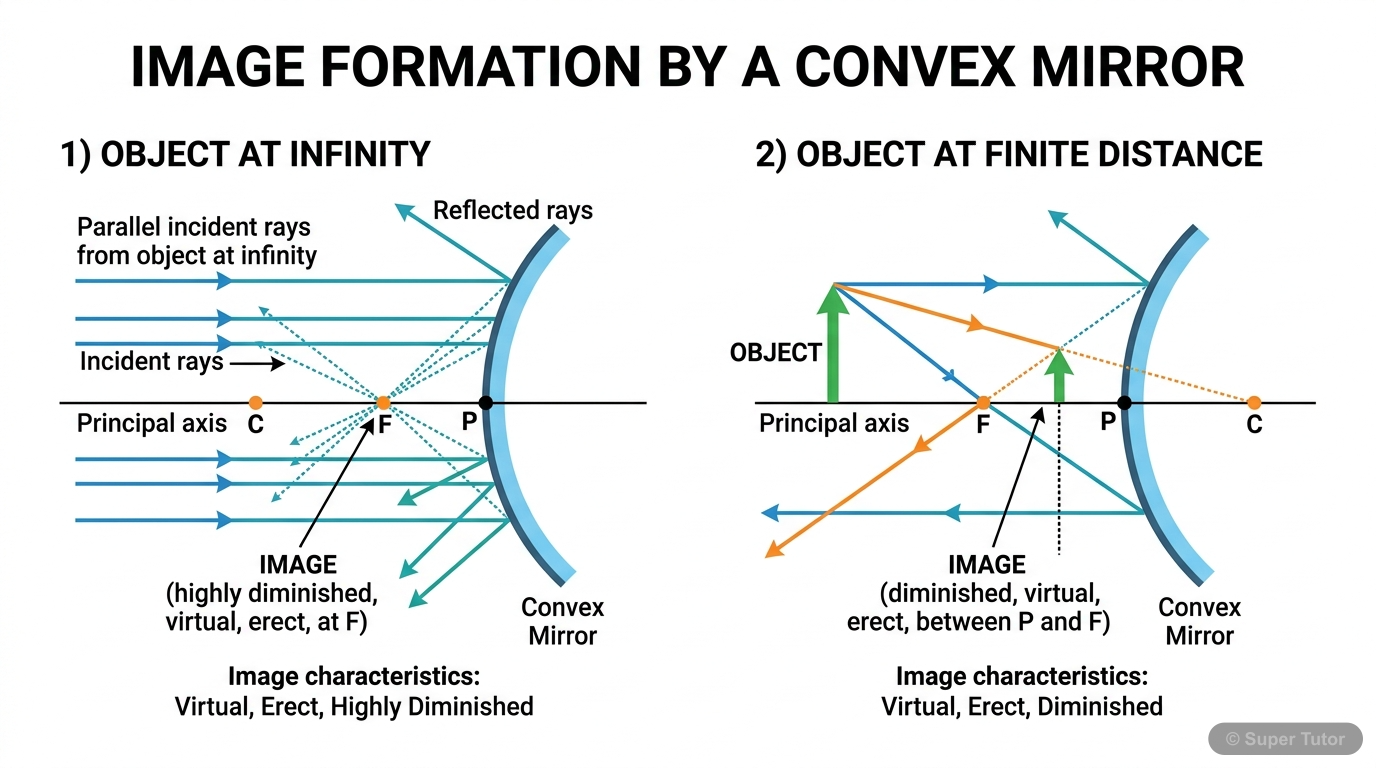
This is just one of 18+ visuals inside Super Tutor's Light Energy chapter
Explore the full setWhat is the relationship between focal length and radius of curvature in spherical mirrors?
Answer
The focal length (f) is half of the radius of curvature (R). Formula: f = R/2. This relationship exists because parallel rays reflecting from a spherical mirror converge at a point that is exactly hal…
A coin at the bottom of a water-filled glass appears closer to the surface. Why does this happen?
Answer
This occurs due to refraction of light. When light rays from the coin travel from water (denser medium) to air (rarer medium), they bend away from the normal. Our brain traces these bent rays backward…
What are the laws of reflection of light?
Answer
1. First Law: The incident ray, reflected ray, and normal at the point of incidence all lie in the same plane. 2. Second Law: The angle of incidence equals the angle of reflection (∠i = ∠r). These law…
How do you find the image position when an object is placed 30 cm in front of a concave mirror with focal length 20 cm?
Answer
Using mirror formula: 1/f = 1/v + 1/u. Given: u = -30 cm, f = -20 cm. Substituting: 1/(-20) = 1/v + 1/(-30). Solving: 1/v = -1/20 + 1/30 = -1/60. Therefore, v = -60 cm. Image is real, inverted, and fo…
Why does white light split into seven colors when passed through a prism?
Answer
This phenomenon is called dispersion. Different colors have different wavelengths and travel at different speeds in the glass prism. Each color has a different refractive index, causing them to bend b…
What happens to the image when you move an object from infinity towards a concave mirror?
Answer
As object moves closer: At infinity → image at focus (highly diminished, real). Beyond 2F → image between F and 2F (diminished, real). At 2F → image at 2F (same size, real). Between 2F and F → image b…
What is lateral inversion and why does it occur in plane mirrors?
Answer
Lateral inversion is the phenomenon where left appears as right and vice versa in a mirror image. It occurs because mirrors reverse the front-back direction (z-direction) in 3D space. Your left hand a…
Calculate the refractive index of glass if light speed reduces to 2×10⁸ m/s when entering from air.
Answer
Refractive index (n) = speed of light in vacuum / speed of light in medium. Given: speed in air ≈ 3×10⁸ m/s, speed in glass = 2×10⁸ m/s. Therefore: n = (3×10⁸) / (2×10⁸) = 1.5. The refractive index of…
+12 more flashcards available
Practice AllFrequently Asked Questions
What are the important topics in Light Energy for NIOS Class 10 Science & Tech?
How to score full marks in Light Energy — NIOS Class 10 Science & Tech?
How many flashcards are available for Light Energy?
Sources & Official References
Content is aligned to the official syllabus. Refer to the board website for the latest curriculum.
More resources for Light Energy
Important Questions
Practice with board exam-style questions
Syllabus
What topics to cover
Revision Notes
Key points for last-minute revision
Study Plan
Step-by-step plan to ace this chapter
Formula Sheet
All formulas in one place
Chapter Summary
Understand the chapter at a glance
Practice Quiz
Test yourself with a quick quiz
Concept Maps
See how topics connect visually
For serious students
Get the full Light Energy chapter — for free.
Quizzes, flashcards, AI doubt-solver and a step-by-step study plan for NIOS Class 10 Science & Tech.