Natural Environment
NIOS · Class 10 · Science & Tech
Flashcards for Natural Environment — NIOS Class 10 Science & Tech. Quick Q&A cards covering key concepts, definitions, and formulas.
Interactive on Super Tutor
Studying Natural Environment? Get the full interactive chapter.
Quizzes, flashcards, AI doubt-solver and a step-by-step study plan — built for flashcards and more.
1,000+ Class 10 students started this chapter today
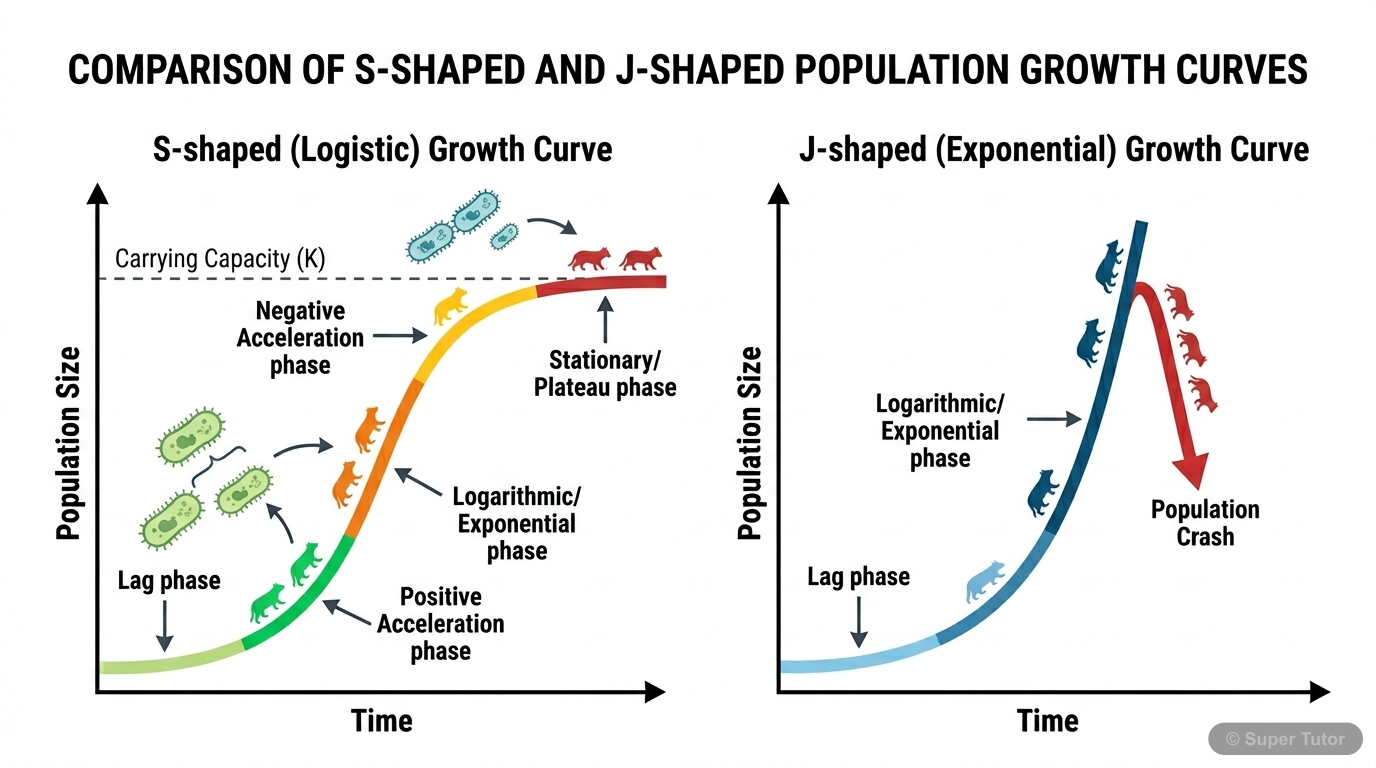
Learn better with visuals Super Tutor has hundreds of illustrations like this across every chapter — all free to try.
Get startedWhat is an ecosystem? Give two examples of natural ecosystems.
Answer
An ecosystem is a biological environment consisting of all organisms living in a particular area, along with the non-living physical components with which they interact. Examples: Terrestrial - grassl…
Why are plants called producers in an ecosystem? What trophic level do they occupy?
Answer
Plants are called producers because they manufacture their own food through photosynthesis and provide food to all other organisms directly or indirectly. They occupy the first trophic level (primary …
A pond has algae, small fish, big fish, and water birds. Construct a food chain from these organisms.
Answer
Algae → Small fish → Big fish → Water birds. Here algae are producers (1st trophic level), small fish are primary consumers (2nd level), big fish are secondary consumers (3rd level), and water birds a…
Why does energy decrease as we move from producers to top carnivores in a food chain?
Answer
Energy decreases because only 10% of energy is transferred to the next trophic level. The rest (90%) is lost as heat during metabolic processes like respiration, movement, and digestion. This is why f…
What happens to carbon dioxide released by animals during respiration?
Answer
Carbon dioxide released by animals is taken up by plants during photosynthesis to make food. It can also dissolve in water bodies or remain in the atmosphere. This continuous exchange forms the carbon…
How do bacteria help in the nitrogen cycle? Name two types of bacteria involved.
Answer
Bacteria convert atmospheric nitrogen into forms plants can use (nitrogen fixation) and break down dead matter to release nitrogen back. Two types: Rhizobium (fixes nitrogen in legume roots), Nitrosom…
Why do desert plants have fewer stomata and thick waxy leaves?
Answer
Desert plants have fewer stomata to reduce water loss through transpiration. Thick waxy leaves store water (succulent) and the waxy coating prevents water evaporation. These adaptations help survive i…
A camel can survive in desert heat while a polar bear lives in extreme cold. How are both adapted to their environments?
Answer
Camel: Hump stores fat, can drink large amounts of water, concentrated urine, scaly heat-resistant skin. Polar bear: Thick fur traps air for insulation, fat layer under skin, round bulky body with sho…
+12 more flashcards available
Practice AllFrequently Asked Questions
What are the important topics in Natural Environment for NIOS Class 10 Science & Tech?
How to score full marks in Natural Environment — NIOS Class 10 Science & Tech?
How many flashcards are available for Natural Environment?
Sources & Official References
Content is aligned to the official syllabus. Refer to the board website for the latest curriculum.
More resources for Natural Environment
Important Questions
Practice with board exam-style questions
Syllabus
What topics to cover
Revision Notes
Key points for last-minute revision
Study Plan
Step-by-step plan to ace this chapter
Formula Sheet
All formulas in one place
Chapter Summary
Understand the chapter at a glance
Practice Quiz
Test yourself with a quick quiz
Concept Maps
See how topics connect visually
For serious students
Get the full Natural Environment chapter — for free.
Quizzes, flashcards, AI doubt-solver and a step-by-step study plan for NIOS Class 10 Science & Tech.