Atoms and Molecules
NIOS · Class 10 · Science & Tech
Summary of Atoms and Molecules for NIOS Class 10 Science & Tech. Key concepts, important points, and chapter overview.
Interactive on Super Tutor
Studying Atoms and Molecules? Get the full interactive chapter.
Quizzes, flashcards, AI doubt-solver and a step-by-step study plan — built for chapter summary and more.
1,000+ Class 10 students started this chapter today
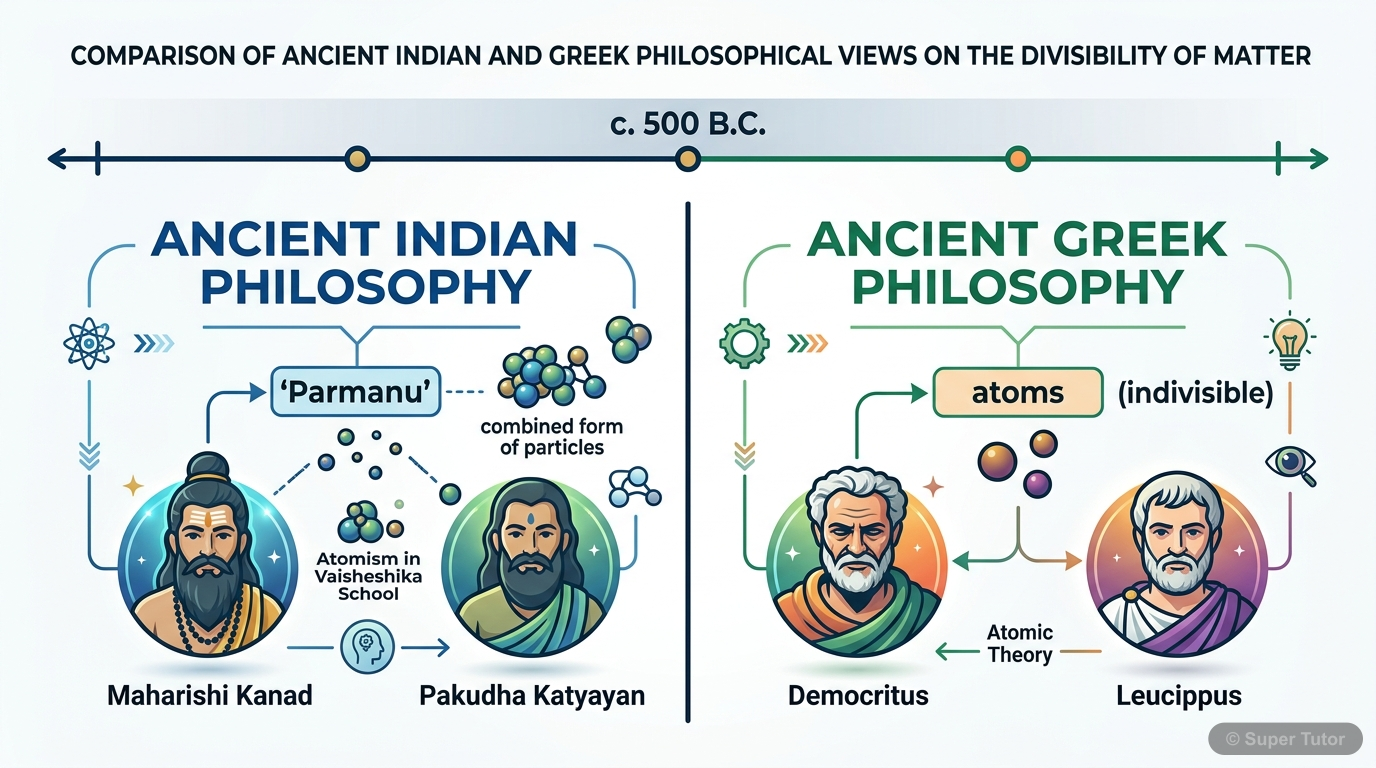
Learn better with visuals Super Tutor has hundreds of illustrations like this across every chapter — all free to try.
Get startedOverview
This chapter introduces the fundamental building blocks of matter - atoms and molecules. We explore how ancient Indian and Greek philosophers first conceptualized the divisibility of matter, leading to modern atomic theory. The chapter covers the laws of chemical combination, Dalton's atomic theory,
Key Concepts
Two fundamental laws govern chemical reactions
Two fundamental laws govern chemical reactions: (1) Law of Conservation of Mass - total mass of reactants equals total mass of products in any chemica
John Dalton proposed five key postulates
John Dalton proposed five key postulates in 1803: (1) Matter consists of indivisible atoms, (2) All atoms of the same element are identical in mass an
An atom is the smallest particle
An atom is the smallest particle of an element that retains chemical properties. Modern understanding shows atoms contain protons (positive charge), n
Isotopes are atoms of the same
Isotopes are atoms of the same element with identical atomic numbers but different mass numbers due to varying neutron counts. For example, oxygen has
A molecule is an aggregate
A molecule is an aggregate of two or more atoms held together by chemical bonds. Examples include diatomic molecules (H2, O2, N2), polyatomic molecule
Learning Objectives
- Understand the laws of conservation of mass and constant proportions with examples
- Learn Dalton's atomic theory and its key postulates
- Distinguish between atoms and molecules with their properties
- Calculate atomic mass, molecular mass, and formula mass
- Apply the mole concept to solve chemical problems
Frequently Asked Questions
What are the important topics in Atoms and Molecules for NIOS Class 10 Science & Tech?
How to score full marks in Atoms and Molecules — NIOS Class 10 Science & Tech?
Sources & Official References
Content is aligned to the official syllabus. Refer to the board website for the latest curriculum.
More resources for Atoms and Molecules
Important Questions
Practice with board exam-style questions
Syllabus
What topics to cover
Revision Notes
Key points for last-minute revision
Study Plan
Step-by-step plan to ace this chapter
Flashcards
Quick-fire cards for active recall
Formula Sheet
All formulas in one place
Practice Quiz
Test yourself with a quick quiz
Concept Maps
See how topics connect visually
For serious students
Get the full Atoms and Molecules chapter — for free.
Quizzes, flashcards, AI doubt-solver and a step-by-step study plan for NIOS Class 10 Science & Tech.