Work and Energy
NIOS · Class 10 · Science & Tech
Summary of Work and Energy for NIOS Class 10 Science & Tech. Key concepts, important points, and chapter overview.
Interactive on Super Tutor
Studying Work and Energy? Get the full interactive chapter.
Quizzes, flashcards, AI doubt-solver and a step-by-step study plan — built for chapter summary and more.
1,000+ Class 10 students started this chapter today
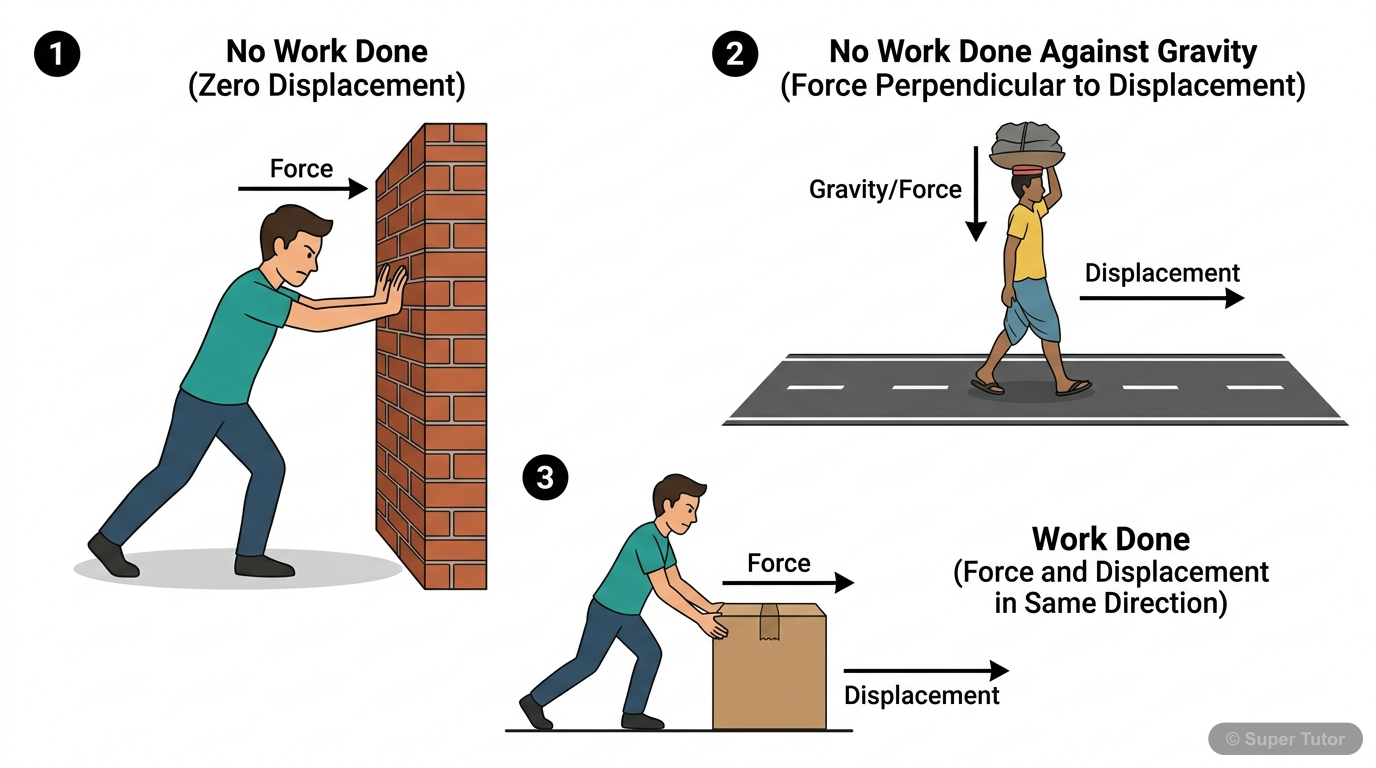
Super Tutor has 7+ illustrations like this for Work and Energy alone — flashcards, concept maps, and step-by-step visuals.
See them allOverview
Work and Energy is a fundamental chapter in physics that explains how forces cause motion and how energy enables objects to do work. In our daily life, we use terms like 'work' and 'energy' casually, but in physics, these have specific scientific meanings. This chapter explores the relationship betw
Key Concepts
Work is done when a force
Work is done when a force is applied on a body and the body moves through some distance in the direction of the force. Work = Force × Displacement in
Energy is the capacity of
Energy is the capacity of a body to do work. It exists in various forms: mechanical (potential and kinetic), thermal, light, electrical, magnetic, sou
Energy possessed by a body due
Energy possessed by a body due to its position or configuration. For gravitational potential energy: PE = mgh, where m is mass, g is acceleration due
Energy possessed by a body due
Energy possessed by a body due to its motion. KE = ½mv², where m is mass and v is velocity. Kinetic energy depends on both mass and velocity, with vel
The process of converting one form
The process of converting one form of energy into another. Examples include: electrical to light in bulbs, chemical to mechanical in muscles, potentia
Learning Objectives
- Define work, energy, and power with their SI units
- Calculate work done by a constant force using the formula W = F × d
- Identify and explain different forms of energy with examples
- Understand potential energy (PE = mgh) and kinetic energy (KE = ½mv²)
- Analyze energy transformations in various devices and natural processes
Frequently Asked Questions
What are the important topics in Work and Energy for NIOS Class 10 Science & Tech?
How to score full marks in Work and Energy — NIOS Class 10 Science & Tech?
Sources & Official References
Content is aligned to the official syllabus. Refer to the board website for the latest curriculum.
More resources for Work and Energy
Important Questions
Practice with board exam-style questions
Syllabus
What topics to cover
Revision Notes
Key points for last-minute revision
Study Plan
Step-by-step plan to ace this chapter
Flashcards
Quick-fire cards for active recall
Formula Sheet
All formulas in one place
Practice Quiz
Test yourself with a quick quiz
Concept Maps
See how topics connect visually
For serious students
Get the full Work and Energy chapter — for free.
Quizzes, flashcards, AI doubt-solver and a step-by-step study plan for NIOS Class 10 Science & Tech.