Gravitation
NIOS · Class 10 · Science & Tech
Summary of Gravitation for NIOS Class 10 Science & Tech. Key concepts, important points, and chapter overview.
Interactive on Super Tutor
Studying Gravitation? Get the full interactive chapter.
Quizzes, flashcards, AI doubt-solver and a step-by-step study plan — built for chapter summary and more.
1,000+ Class 10 students started this chapter today
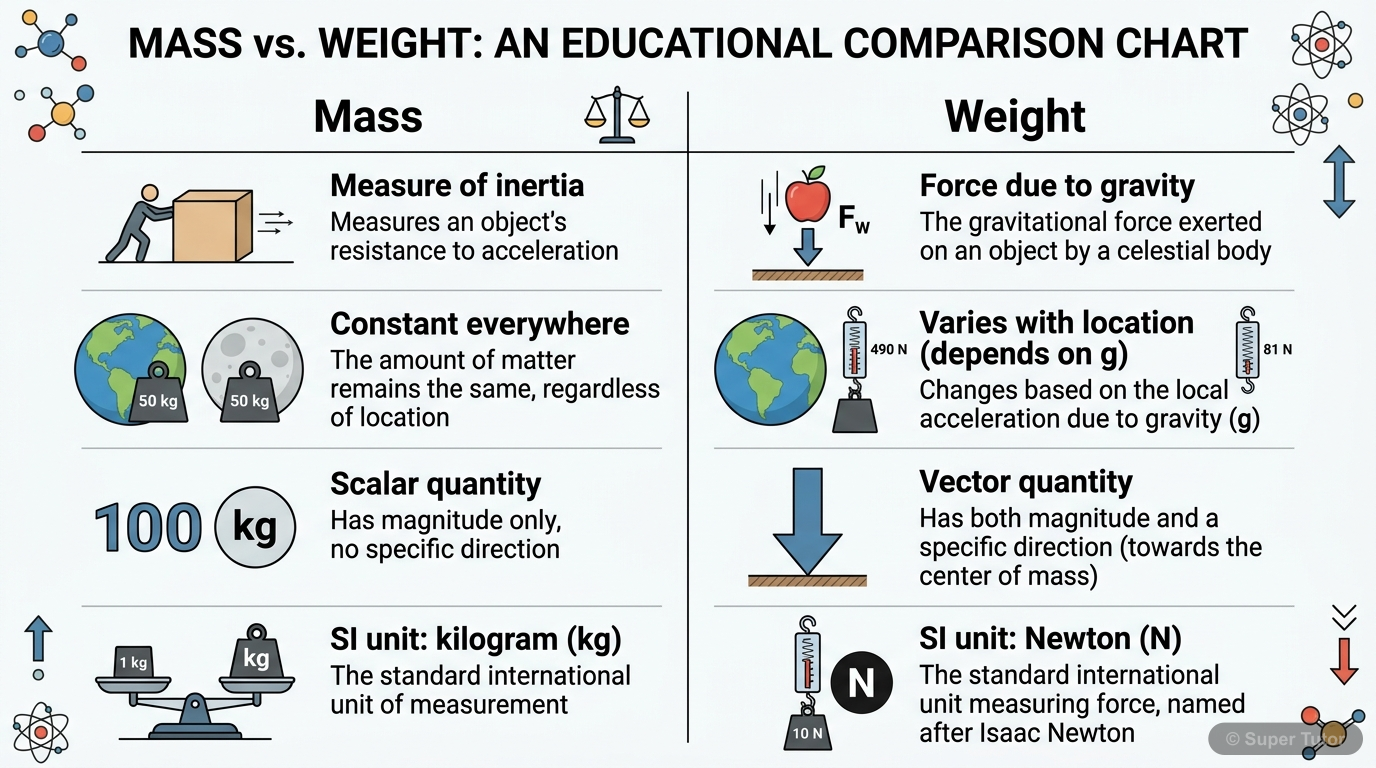
Super Tutor has 10+ illustrations like this for Gravitation alone — flashcards, concept maps, and step-by-step visuals.
See them allOverview
Gravitation is one of the fundamental forces of nature that governs the motion of objects in the universe. From an apple falling from a tree to planets orbiting the sun, everything is influenced by gravitational force. This chapter explores Newton's law of universal gravitation, acceleration due to
Key Concepts
Every particle in the universe attracts
Every particle in the universe attracts every other particle with a force proportional to the product of their masses and inversely proportional to th
The acceleration experienced by all objects
The acceleration experienced by all objects near Earth's surface due to gravitational attraction. Its value is approximately 9.8 ms⁻², independent of
Objects moving under Earth's gravity follow
Objects moving under Earth's gravity follow equations of uniformly accelerated motion: v = u + gt, s = ut + ½gt², and v² = u² + 2gs. For upward motion
Mass is the quantity of matter
Mass is the quantity of matter in an object and remains constant everywhere. Weight is the gravitational force acting on an object (W = mg) and varies
A condition where an object experiences
A condition where an object experiences no apparent weight, occurring when both the object and its support are in free fall with the same acceleration
Learning Objectives
- Understand the existence and nature of gravitational force
- State and apply Newton's law of universal gravitation
- Explain acceleration due to gravity and its independence from mass
- Derive and use equations of motion for objects under gravity
- Distinguish between mass and weight and understand weightlessness
Frequently Asked Questions
What are the important topics in Gravitation for NIOS Class 10 Science & Tech?
How to score full marks in Gravitation — NIOS Class 10 Science & Tech?
Sources & Official References
Content is aligned to the official syllabus. Refer to the board website for the latest curriculum.
More resources for Gravitation
Important Questions
Practice with board exam-style questions
Syllabus
What topics to cover
Revision Notes
Key points for last-minute revision
Study Plan
Step-by-step plan to ace this chapter
Flashcards
Quick-fire cards for active recall
Formula Sheet
All formulas in one place
Practice Quiz
Test yourself with a quick quiz
Concept Maps
See how topics connect visually
For serious students
Get the full Gravitation chapter — for free.
Quizzes, flashcards, AI doubt-solver and a step-by-step study plan for NIOS Class 10 Science & Tech.