Motion and Its Description
NIOS · Class 10 · Science & Tech
Summary of Motion and Its Description for NIOS Class 10 Science & Tech. Key concepts, important points, and chapter overview.
Interactive on Super Tutor
Studying Motion and Its Description? Get the full interactive chapter.
Quizzes, flashcards, AI doubt-solver and a step-by-step study plan — built for chapter summary and more.
1,000+ Class 10 students started this chapter today
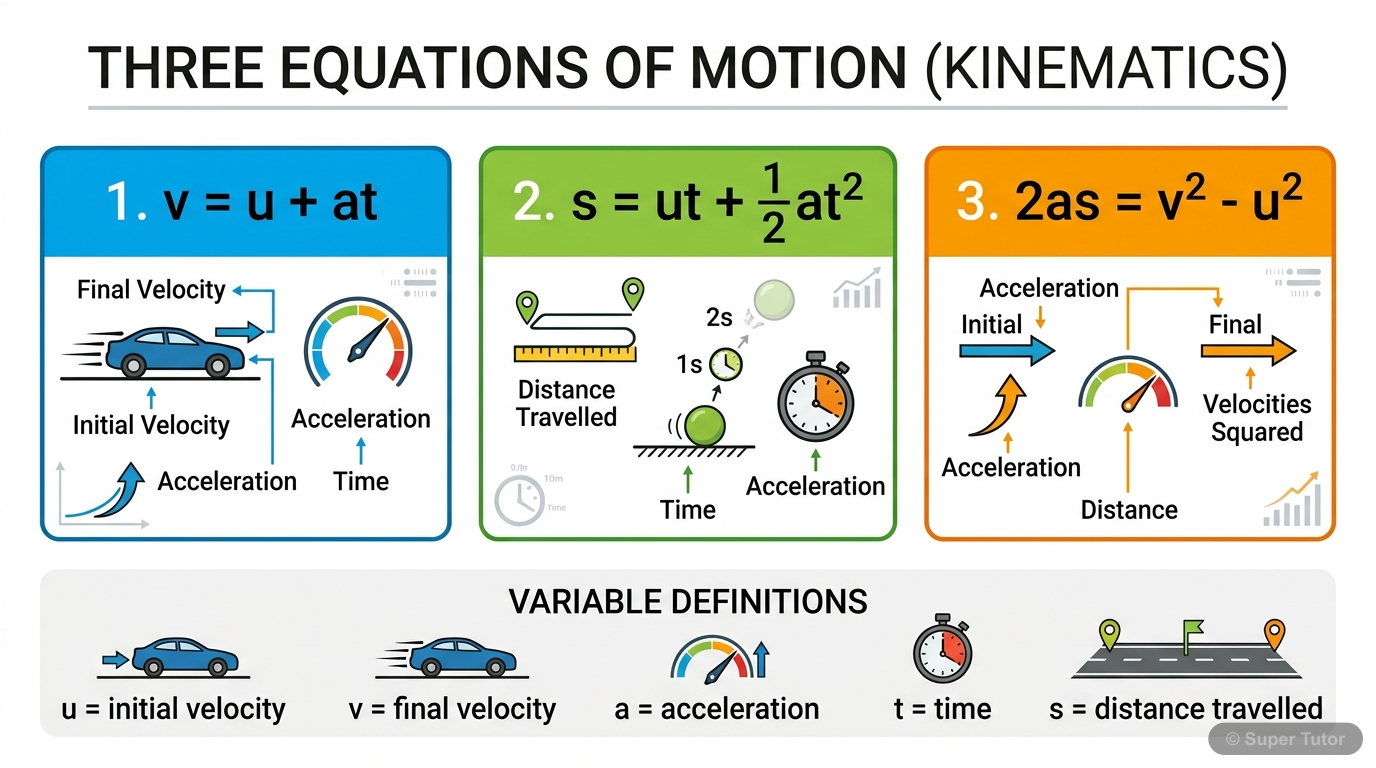
Super Tutor has 13+ illustrations like this for Motion and Its Description alone — flashcards, concept maps, and step-by-step visuals.
See them allOverview
Motion is one of the most fundamental concepts in physics that we observe everywhere in our daily lives. From a car moving on a road to the Earth revolving around the Sun, motion is all around us. This chapter introduces the scientific way to describe and analyze motion using concepts like distance,
Key Concepts
Motion is the continuous change
Motion is the continuous change in position of an object with respect to an observer. Rest occurs when there is no change in position. Motion is relat
Rectilinear motion occurs along a straight
Rectilinear motion occurs along a straight line (like a ball rolling on a table). Circular motion follows a circular path (like hands of a clock). Osc
Distance is the total path length
Distance is the total path length covered by an object during motion. Displacement is the shortest distance between initial and final positions. Dista
Speed is distance traveled per unit
Speed is distance traveled per unit time (scalar quantity with no direction). Velocity is displacement per unit time (vector quantity with direction).
Acceleration is the rate of change
Acceleration is the rate of change of velocity with time. It occurs when an object speeds up, slows down, or changes direction. Units: m/s². Positive
Learning Objectives
- Understand the concept of motion and distinguish between rest and motion
- Describe various types of motion - rectilinear, circular, rotational and oscillatory
- Define and calculate distance, displacement, speed, velocity and acceleration
- Understand uniform and non-uniform motion with real-life examples
- Draw and interpret position-time and velocity-time graphs
Frequently Asked Questions
What are the important topics in Motion and Its Description for NIOS Class 10 Science & Tech?
How to score full marks in Motion and Its Description — NIOS Class 10 Science & Tech?
Sources & Official References
Content is aligned to the official syllabus. Refer to the board website for the latest curriculum.
More resources for Motion and Its Description
Important Questions
Practice with board exam-style questions
Syllabus
What topics to cover
Revision Notes
Key points for last-minute revision
Study Plan
Step-by-step plan to ace this chapter
Flashcards
Quick-fire cards for active recall
Formula Sheet
All formulas in one place
Practice Quiz
Test yourself with a quick quiz
Concept Maps
See how topics connect visually
For serious students
Get the full Motion and Its Description chapter — for free.
Quizzes, flashcards, AI doubt-solver and a step-by-step study plan for NIOS Class 10 Science & Tech.