Control and Coordination
NIOS · Class 10 · Science & Tech
Summary of Control and Coordination for NIOS Class 10 Science & Tech. Key concepts, important points, and chapter overview.
Interactive on Super Tutor
Studying Control and Coordination? Get the full interactive chapter.
Quizzes, flashcards, AI doubt-solver and a step-by-step study plan — built for chapter summary and more.
1,000+ Class 10 students started this chapter today
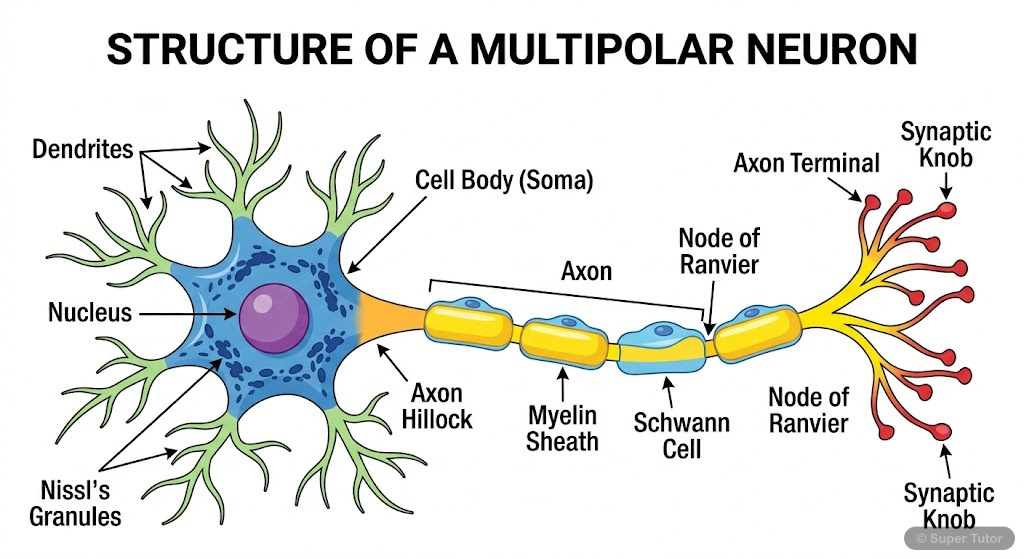
Super Tutor has 13+ illustrations like this for Control and Coordination alone — flashcards, concept maps, and step-by-step visuals.
See them allOverview
Control and coordination are essential functions that allow our body to work as a unified system. Just like a well-organized team, our body parts must communicate and work together efficiently. Two main systems handle this coordination: the nervous system (which works through electrical signals) and
Key Concepts
Neurons are the basic units
Neurons are the basic units of the nervous system, consisting of dendrites (receivers), cell body (processor), and axon (transmitter). They communicat
The CNS includes the brain
The CNS includes the brain and spinal cord. The brain has three main parts: cerebrum (thinking, memory, voluntary actions), cerebellum (balance, muscl
Reflexes are rapid
Reflexes are rapid, automatic responses to stimuli that don't require brain processing. They follow a reflex arc: stimulus → receptor → sensory neuron
This system uses hormones (chemical messengers)
This system uses hormones (chemical messengers) to coordinate body functions. Key glands include pituitary (growth, reproduction), thyroid (metabolism
This controls involuntary functions through two
This controls involuntary functions through two divisions: sympathetic (prepares body for stress/emergency - 'fight or flight') and parasympathetic (h
Learning Objectives
- Understand the roles of nervous and endocrine systems in body coordination
- Learn the structure and function of neurons as communication units
- Identify parts of the brain and spinal cord and their specific functions
- Distinguish between voluntary actions, involuntary actions, and reflex actions
- Explain how reflex arcs work to protect us from danger
Frequently Asked Questions
What are the important topics in Control and Coordination for NIOS Class 10 Science & Tech?
How to score full marks in Control and Coordination — NIOS Class 10 Science & Tech?
Sources & Official References
Content is aligned to the official syllabus. Refer to the board website for the latest curriculum.
More resources for Control and Coordination
Important Questions
Practice with board exam-style questions
Syllabus
What topics to cover
Revision Notes
Key points for last-minute revision
Study Plan
Step-by-step plan to ace this chapter
Flashcards
Quick-fire cards for active recall
Formula Sheet
All formulas in one place
Practice Quiz
Test yourself with a quick quiz
Concept Maps
See how topics connect visually
For serious students
Get the full Control and Coordination chapter — for free.
Quizzes, flashcards, AI doubt-solver and a step-by-step study plan for NIOS Class 10 Science & Tech.