Sound and Communication
NIOS · Class 10 · Science & Tech
Summary of Sound and Communication for NIOS Class 10 Science & Tech. Key concepts, important points, and chapter overview.
Interactive on Super Tutor
Studying Sound and Communication? Get the full interactive chapter.
Quizzes, flashcards, AI doubt-solver and a step-by-step study plan — built for chapter summary and more.
1,000+ Class 10 students started this chapter today
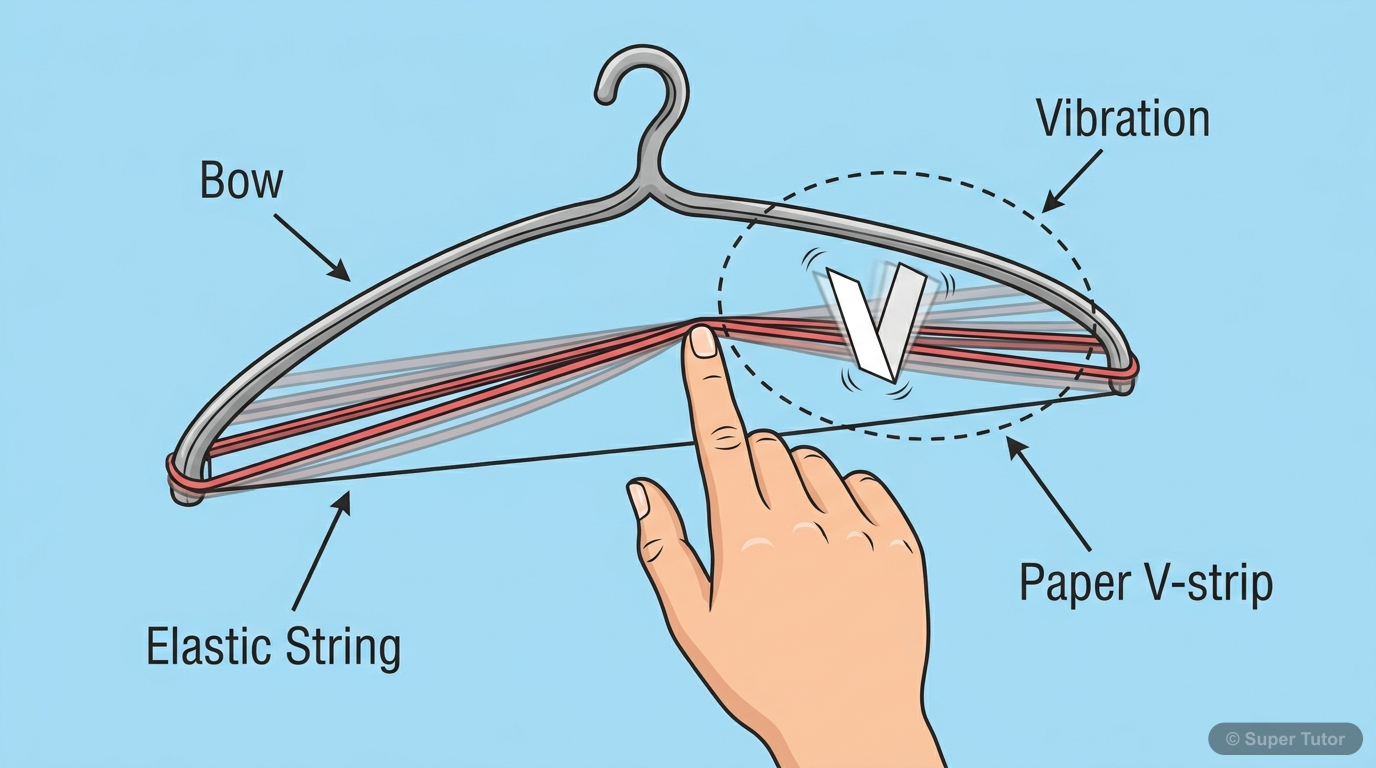
Learn better with visuals Super Tutor has hundreds of illustrations like this across every chapter — all free to try.
Get startedOverview
Sound is an integral part of our daily communication and plays a crucial role in how we interact with the world around us. From simple conversations to complex technological devices like SONAR and RADAR, sound waves enable us to communicate, navigate, and understand our environment. This chapter exp
Key Concepts
Sound is produced by vibrations
Sound is produced by vibrations and requires a medium (solid, liquid, or gas) to travel. When an object vibrates, it creates compressions and rarefact
Waves are characterized by four main
Waves are characterized by four main parameters: amplitude (maximum height), wavelength (distance between adjacent crests or troughs), frequency (numb
There are two main categories
There are two main categories: Mechanical waves (like sound) require a medium and include both transverse and longitudinal waves. Electromagnetic wave
Humans can hear frequencies between 16
Humans can hear frequencies between 16 Hz to 20,000 Hz. Sounds below 16 Hz are infrasonic, above 20 kHz are ultrasonic. Sound quality depends on loudn
SONAR (Sound Navigation and Ranging) uses
SONAR (Sound Navigation and Ranging) uses sound waves to detect objects underwater, while RADAR (Radio Detection and Ranging) uses electromagnetic wav
Learning Objectives
- Understand the characteristics and nature of waves, particularly sound waves
- Distinguish between mechanical waves (sound) and electromagnetic waves
- Explain the applications of different types of waves in communication devices like SONAR and RADAR
- Describe the importance and need for effective communication systems
- Identify various communication systems and their technological applications
Frequently Asked Questions
What are the important topics in Sound and Communication for NIOS Class 10 Science & Tech?
How to score full marks in Sound and Communication — NIOS Class 10 Science & Tech?
Sources & Official References
Content is aligned to the official syllabus. Refer to the board website for the latest curriculum.
More resources for Sound and Communication
Important Questions
Practice with board exam-style questions
Syllabus
What topics to cover
Revision Notes
Key points for last-minute revision
Study Plan
Step-by-step plan to ace this chapter
Flashcards
Quick-fire cards for active recall
Formula Sheet
All formulas in one place
Practice Quiz
Test yourself with a quick quiz
Concept Maps
See how topics connect visually
For serious students
Get the full Sound and Communication chapter — for free.
Quizzes, flashcards, AI doubt-solver and a step-by-step study plan for NIOS Class 10 Science & Tech.