Reproduction
NIOS · Class 10 · Science & Tech
Summary of Reproduction for NIOS Class 10 Science & Tech. Key concepts, important points, and chapter overview.
Interactive on Super Tutor
Studying Reproduction? Get the full interactive chapter.
Quizzes, flashcards, AI doubt-solver and a step-by-step study plan — built for chapter summary and more.
1,000+ Class 10 students started this chapter today
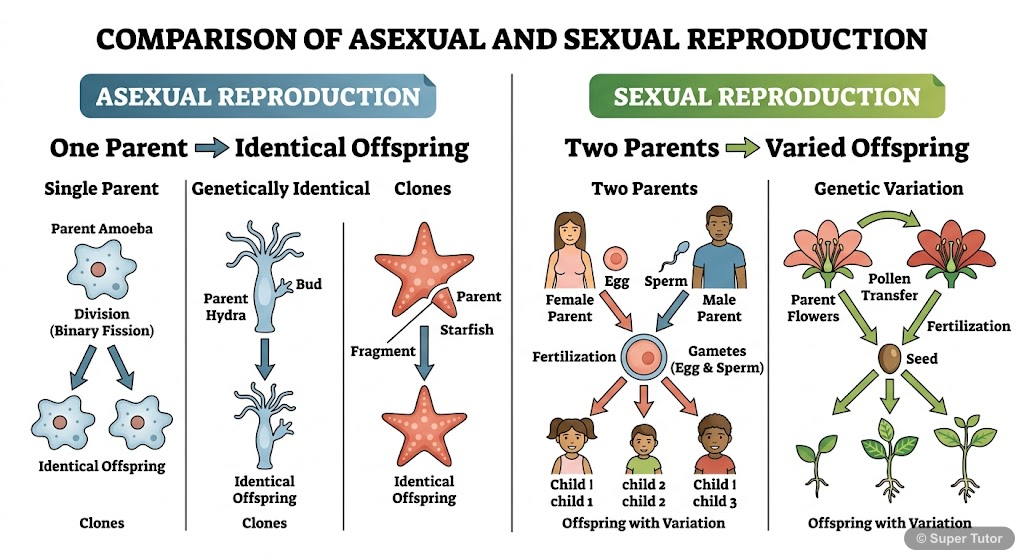
Learn better with visuals Super Tutor has hundreds of illustrations like this across every chapter — all free to try.
Get startedOverview
Reproduction is the fundamental biological process that ensures the continuity of life on Earth. It is a characteristic feature of all living organisms, from microscopic bacteria to complex multicellular plants and animals. This process allows organisms to produce offspring similar to themselves, en
Key Concepts
A mode of reproduction where offspring
A mode of reproduction where offspring are produced by a single individual without fusion of gametes. Methods include binary fission (amoeba, bacteria
A mode of reproduction involving fusion
A mode of reproduction involving fusion of male and female gametes from two different individuals. In plants, it occurs through flowers where pollen (
Humans reproduce sexually with distinct male
Humans reproduce sexually with distinct male and female reproductive systems. Males produce sperm in testes, while females produce eggs in ovaries. Fe
Adolescence (10
Adolescence (10-19 years) is the transitional period from childhood to adulthood, marked by puberty - the onset of reproductive maturity. It involves
Maintaining cleanliness of reproductive organs
Maintaining cleanliness of reproductive organs, understanding menstrual hygiene, preventing sexually transmitted diseases (STDs), and making informed
Learning Objectives
- Understand reproduction as a characteristic feature of organisms for species continuance
- Distinguish between asexual and sexual reproduction modes
- Identify different types of asexual reproduction in various organisms
- Describe reproductive processes in flowering plants including pollination and fertilization
- Understand animal reproduction with emphasis on human reproduction
Frequently Asked Questions
What are the important topics in Reproduction for NIOS Class 10 Science & Tech?
How to score full marks in Reproduction — NIOS Class 10 Science & Tech?
Sources & Official References
Content is aligned to the official syllabus. Refer to the board website for the latest curriculum.
More resources for Reproduction
Important Questions
Practice with board exam-style questions
Syllabus
What topics to cover
Revision Notes
Key points for last-minute revision
Study Plan
Step-by-step plan to ace this chapter
Flashcards
Quick-fire cards for active recall
Formula Sheet
All formulas in one place
Practice Quiz
Test yourself with a quick quiz
Concept Maps
See how topics connect visually
For serious students
Get the full Reproduction chapter — for free.
Quizzes, flashcards, AI doubt-solver and a step-by-step study plan for NIOS Class 10 Science & Tech.