Chemical Bonding
NIOS · Class 10 · Science & Tech
Summary of Chemical Bonding for NIOS Class 10 Science & Tech. Key concepts, important points, and chapter overview.
Interactive on Super Tutor
Studying Chemical Bonding? Get the full interactive chapter.
Quizzes, flashcards, AI doubt-solver and a step-by-step study plan — built for chapter summary and more.
1,000+ Class 10 students started this chapter today
Learn better with visuals Super Tutor has hundreds of illustrations like this across every chapter — all free to try.
Get startedOverview
Chemical bonding is a fundamental concept that explains why atoms combine to form molecules and compounds. This chapter explores the driving force behind chemical bond formation - the tendency of atoms to achieve stable electronic configurations like noble gases. We learn about two primary types of
Key Concepts
Noble gases (He
Noble gases (He, Ne, Ar, Kr, Xe, Rn) are chemically unreactive because they have stable electronic configurations with 8 electrons in their outermost
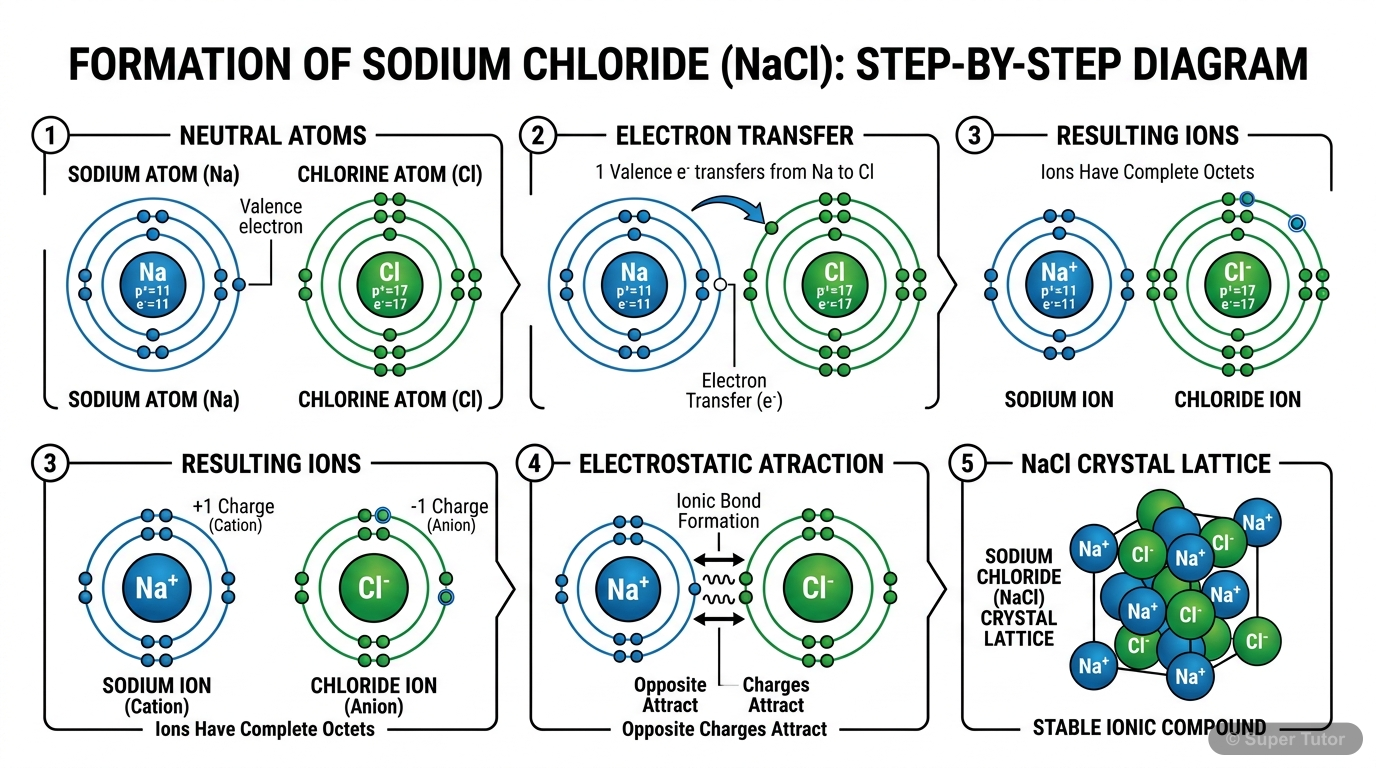
Ionic bonds form through complete transfer
Ionic bonds form through complete transfer of electrons from metal atoms (which become cations) to non-metal atoms (which become anions). The resultin
Covalent bonds form when atoms share
Covalent bonds form when atoms share electron pairs to achieve stable electronic configurations. Atoms can share one pair (single bond), two pairs (do
A method of representing chemical bonds
A method of representing chemical bonds using dots for electrons and lines for shared electron pairs. Helps visualize how atoms achieve stable configu
Learning Objectives
- Understand why atoms combine and the role of noble gas configuration in stability
- Explain the octet rule and its significance in chemical bonding
- Describe ionic bond formation through electron transfer between metals and non-metals
- Analyze the properties of ionic compounds and their applications
- Understand covalent bond formation through electron sharing
Frequently Asked Questions
What are the important topics in Chemical Bonding for NIOS Class 10 Science & Tech?
How to score full marks in Chemical Bonding — NIOS Class 10 Science & Tech?
Sources & Official References
Content is aligned to the official syllabus. Refer to the board website for the latest curriculum.
More resources for Chemical Bonding
Important Questions
Practice with board exam-style questions
Syllabus
What topics to cover
Revision Notes
Key points for last-minute revision
Study Plan
Step-by-step plan to ace this chapter
Flashcards
Quick-fire cards for active recall
Formula Sheet
All formulas in one place
Practice Quiz
Test yourself with a quick quiz
Concept Maps
See how topics connect visually
For serious students
Get the full Chemical Bonding chapter — for free.
Quizzes, flashcards, AI doubt-solver and a step-by-step study plan for NIOS Class 10 Science & Tech.